
Double Jacketed Spiral Cooling Roller Manufacturer in India
Industrial Spiral Cooling Rollers for Controlled Heating and Cooling Applications
In high-speed plastic extrusion, film casting, and web converting lines, standard open-cavity rollers often face operational limitations. They can create boundary layer thermal resistance, thermal lag, and cross-web temperature variations, which may lead to web distortion, gauge variation, and increased material waste.
At Siva Rollers (Siva Engineering Works), an Industrial Roller Manufacturer based in Ahmedabad, Gujarat, India, we engineer high-precision Double Jacketed Spiral Cooling Rollers. Designed to assist in fluid distribution and reduce hot spots, our Spiral Double Jacketed Cooling technology directs forced flow across the active face width to support uniform temperature control.
Whether you require a dedicated Industrial Cooling Roller for film extrusion or a versatile Heating & Cooling Roller for thermal stabilization, our custom-built solutions are designed to optimize heat transfer performance and support reliable line operation.
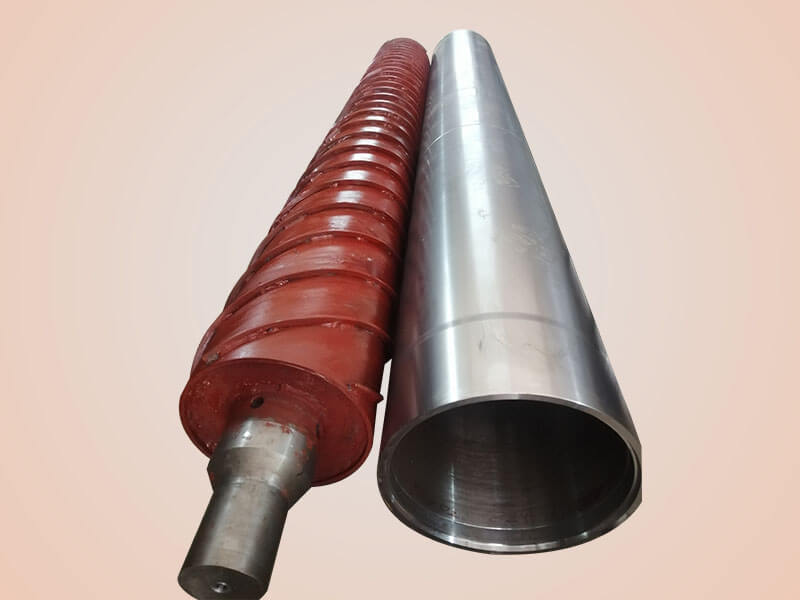
What Is a Double Jacketed Spiral Cooling Roller?
A Double Jacketed Spiral Cooling Roller is an industrial roller featuring a dual-shell construction and an internal spiral flow arrangement. This design provides a defined continuous channel for circulating a suitable heat-transfer medium (such as water, glycol, or thermal oil) within the roller assembly.
The primary objective of this architecture is to enhance heat transfer across the active working surface. Actual surface temperature uniformity and heat-transfer performance depend on operational parameters, including fluid velocity, flow rate, roller dimensions, shell thickness, and operating conditions.
In typical processing lines, the roller maintains contact with a moving material while the thermal medium circulates internally. The roller absorbs heat from a warmer web during cooling or transfers heat to the material when configured for heating processes.
Internal Double-Jacketed Spiral Geometry & Construction
Unlike conventional single-cavity hollow rolls where cooling fluid moves at low velocity and may form insulating fluid layers, a double-jacketed spiral roller utilizes a dual-shell structural layout:
+-----------------------------------------------------------------------------+
|                            OUTER PRECISION SHELL                            |
| +-------------------------------------------------------------------------+ |
| |        INTERNAL HELICAL / SPIRAL BAFFLE CHANNEL (Guided Flow)           | |
| | +---------------------------------------------------------------------+ | |
| | |                         INNER RIGID CORE SHAFT                        | | |
| | +---------------------------------------------------------------------+ | |
| |         FLUID FLOW DIRECTION: CONSTRAINED SPIRAL PASSAGEAGE           | |
| +-------------------------------------------------------------------------+ |
|                            OUTER PRECISION SHELL                            |
+-----------------------------------------------------------------------------+- Inner Rigid Core Shaft: Provides foundational structural support to handle mechanical load, torque, and web tension across wide spans.
- Precision Spiral Baffle Channel: Machined or fitted around the inner core to form a defined spiral pathway. This channel guides liquid media directly against the inner face of the outer shell.
- Outer Shell Assembly: Concentrically fitted over the internal spiral core. The narrow annular passage ensures fluid follows the helical path, maximizing fluid contact area with the shell face.
Thermal Dynamics & Flow Comparison
Understanding internal construction helps explain the mechanical and thermal differences between spiral double-jacketed designs and conventional open-cavity rolls:
Operational Metric | Standard Open-Cavity / Single-Shell Roller | Siva Rollers Double Jacketed Spiral Cooling Roller |
Flow Pattern | Low-velocity, unguided fluid path | Guided continuous spiral channel flow |
Boundary Layer Effect | Higher tendency for fluid stagnation layers | Increased fluid velocity helps disrupt boundary layer thermal resistance |
Temperature Profile | Susceptible to middle-to-edge thermal variance | Promotes more uniform surface temperature distribution |
Heat Transfer Capability | Lower heat transfer coefficient | Enhanced heat exchange efficiency per unit area |
Thermal Response Time | Slower response to line speed or temp adjustments | Faster thermal adjustment and stabilization |
Custom Roller Manufacturing
Need a Custom Double Jacketed Spiral Cooling Roller?
Share your required roller dimensions and application with SIVA ROLLERS (SIVA ENGINEERING WORKS).
Technical Specifications & Manufacturing Range
Every Heavy Duty Cooling Roller manufactured by Siva Rollers (Siva Engineering Works) is built to match specific machinery configurations, bearing mountings, and rotary union connections.
Engineering Parameter | Technical Specification & Capability Range |
Roller Length Capacity | 500 mm to 6,000 mm (Custom active face width) |
Roller Outer Diameter | 150 mm to 600 mm |
Operating Temperature Range | 80°C to 200°C\ (Configurable for heating or cooling media) |
Surface Finish Options | Matt Finish, Glossy Finish, and Mirror Finish |
Heat Transfer Media | Chilled Water, Water-Glycol Mixtures, or Thermal Oil |
Customization | Built according to user-provided drawings or OEM machine specs |
Precision Surface Finishes for Web & Extrusion Lines
The outer surface finish directly influences web release, optical clarity, friction properties, and overall film quality. We offer surface finishing options tailored to your substrate requirements:
1. Mirror Finish
- Process: Precision cylindrical grinding followed by fine micro-lapping and polishing.
- Suitable Applications: High-clarity PET, PP, and PVC cast films, optical sheets, and high-gloss lamination lines where maximum clarity and surface smoothness are required.
2. Glossy Finish
- Process: Precision grinding and controlled polishing to provide a clean, smooth standard surface.
- Suitable Applications: General plastic extrusion cooling, blown film take-up units, co-extruded sheets, and standard converting lines.
3. Matt Finish / Textured Finish
- Process: Controlled blasting or micro-texturing treatments to achieve a uniform matte topography.
- Suitable Applications: Non-tack web handling, breathable films, embossed sheet lines, and applications requiring reduced friction or air entrapment prevention.
Multi-Industry Process Applications
Our double-jacketed spiral cooling rollers are applied across a range of continuous manufacturing processes:
Industry Sector | Primary Process Application | Thermal Engineering Purpose |
Cast Film & Extrusion | Chill roll units for CPP, PET, PE, and barrier films | Rapid thermal quenching from polymer melt |
Plastic Sheet Extrusion | Calender roll banks for ABS, HIPS, PP, PC sheets | Controlling thermal consistency across wide sheet profiles |
Flexible Packaging | Lamination cooling rolls | Heat extraction following adhesive thermal activation |
Paper & Foil Converting | Extrusion coating & web conditioning | Web temperature stabilization and tension control |
Textile & Non-Woven | Thermal bonding & finishing rolls | Surface temperature control under nip pressure up to 200°C |
Addressing Production Defects in Extrusion & Converting
In continuous web processing, thermal inconsistencies on roller surfaces can manifest as structural or surface defects. Upgrading to a spiral double-jacketed design helps address several common processing issues:
- Cross-Web Thickness Variance: Uneven shell temperatures can lead to differential thermal expansion across the roll face. Spiral channel fluid distribution helps maintain a consistent shell profile.
- Web Curling & Internal Stress: Asymmetric cooling rates across the material web can induce internal stress. Controlled temperature distribution across the roll face supports balanced cooling.
- Surface Haze in Film: Slow heat removal during quenching can affect polymer crystallization. Guided high-velocity fluid flow supports efficient heat removal to help preserve film clarity.
- Air Entrapment: Choosing the appropriate surface finish (Mirror, Glossy, or Matt) assists in proper air evacuation and contact between the web and the roller surface.
Operating Best Practices for Roller Maintenance
To maintain fluid flow and extend the working life of double-jacketed rollers, consider the following general operational guidelines based on your system setup:
- Fluid Quality & Filtration: Using treated cooling media and appropriate inline filtration helps reduce mineral scaling, rust, and particle accumulation within narrow spiral passages.
- Rotary Union Maintenance: Periodic inspection of rotary seals, flexible connections, and support arms helps prevent fluid leaks and flow restrictions.
- System Flushing: Periodic flushing of internal flow channels—especially in open-loop water systems—helps clear bio-films and sediment build-up.
- Thermal Ramping: When operating at elevated temperatures (up to 200°C ) gradual heating and cooling transitions help reduce thermal shock on welded joints and mechanical seals.
Direct Engineering RFQ Checklist for Purchasing & Technical Teams
To help us evaluate your requirement and provide an accurate technical proposal, please gather the following parameters before submitting your inquiry:
- [ ] Roller Dimensions: Active Face Width, Overall Length, and Outer Diameter ( 150 mm to 600 mm OD, 500 mm to 6,000 mm Length).
- [ ] Operating Temperature: Target surface temperature (80°C to 200°C) and heating/cooling medium details.
- [ ] Media & Flow Requirements: Chilled water, water-glycol, or thermal oil, along with system operating pressure.
- [ ] Surface Finish: Matt Finish, Glossy Finish, or Mirror Finish.
- [ ] Mounting Details: Bearing journal sizes, keyway specs, and rotary union thread details.
- [ ] Process Material: Film/sheet type, line speed (m/min) and process application.
Why Choose SIVA ROLLERS (SIVA ENGINEERING WORKS)?
SIVA ROLLERS (SIVA ENGINEERING WORKS) is based in Ahmedabad, Gujarat, India, providing industrial roller manufacturing and refurbishment services.
With over 10 years of experience in industrial roller engineering, we focus on matching roller design to customer machinery and operational parameters. Our approach emphasizes factual technical communication and tailored manufacturing.
- Application-focused Selection: We discuss your material, line speed, and thermal parameters prior to confirming specifications.
- Custom Dimensioning: Custom length (500 mm to 6000 mm) and diameter (150–600 mm) capabilities to fit existing or new machine layouts.
- Surface Engineering: Precision Matt, Glossy, or Mirror surface options based on web handling requirements.
- Technical Support: Review of existing roller drawings, photos, or machine specs to assist in replacement or new equipment builds.
Request a Quote for a Double Jacketed Spiral Cooling Roller
- Required roller diameter and active length
- Operating temperature range (80°C to 200°C) and process duty (heating, cooling, or both)
- Heat-transfer medium and system pressure details
- Preferred surface finish: Matt, Glossy, or Mirror
- Processed material type and production application
- Existing roller drawings, photos, or machine details (if available)
Let’s Find the Right Roller for Your Application
Planning a new installation or improving an existing production line? Connect with SIVA ROLLERS (SIVA ENGINEERING WORKS) to discuss your industrial roller manufacturing, coating or refurbishment requirements.
Tell us what your production line needs
- ✓ Custom industrial rollers
- ✓ Roller coating solutions
- ✓ Roller repair and refurbishment
- ✓ Application-specific requirements
SIVA ROLLERS (SIVA ENGINEERING WORKS)
Your Trust, Our Quality.
FAQs
A Double Jacketed Spiral Cooling Roller is an industrial roller with a dual-shell construction and an internal spiral flow channel. It circulates a heat-transfer medium, such as water, a water-glycol mixture, or thermal oil, to support controlled heating or cooling across the roller surface.
A Double Jacketed Spiral Cooling Roller provides a guided fluid flow path that can improve heat transfer and support more uniform surface temperature distribution. Its performance depends on roller dimensions, fluid flow rate, operating pressure, and process conditions
SIVA ROLLERS (SIVA ENGINEERING WORKS) is an industrial roller manufacturer based in Ahmedabad, Gujarat, India. The company manufactures custom industrial rollers and provides roller refurbishment services, with designs tailored to customer drawings, machinery specifications, and application requirements.
A standard hollow cooling roller generally uses an internal cavity for fluid circulation, while a Double Jacketed Spiral Cooling Roller uses a guided spiral passage between its internal structure and outer shell. This arrangement can improve fluid distribution and heat transfer, depending on the roller design and operating conditions.
Double Jacketed Spiral Cooling Rollers are used in plastic film extrusion, cast film production, plastic sheet processing, flexible packaging, lamination, paper and foil converting, and selected textile processing applications. They help manage roller surface temperature during continuous production.
SIVA ROLLERS offers custom manufacturing with roller diameters from 150 mm to 600 mm and roller lengths from 500 mm to 6,000 mm. The final dimensions depend on the machine layout, active face width, mounting arrangement, and application requirements.
Yes. A Double Jacketed Spiral Cooling Roller can be designed for heating or cooling applications by circulating a suitable heat-transfer medium through its internal passages. The operating temperature, fluid type, pressure, rotary union, and sealing arrangement must be suitable for the intended duty.
SIVA ROLLERS lists a configurable operating temperature range of 80°C to 200°C for its application-specific roller designs. The suitable temperature depends on the heating or cooling medium, pressure, sealing components, construction, and operating conditions and should be confirmed during technical evaluation.
SIVA ROLLERS offers matt, glossy, and mirror surface finish options. The appropriate finish depends on the processed material, surface contact requirements, web release, and the required appearance or quality of the finished product.
Depending on the design and operating conditions, suitable heat-transfer media may include chilled water, water-glycol mixtures, or thermal oil. Fluid selection should consider the required temperature, viscosity, operating pressure, corrosion compatibility, and heat-transfer system specifications.
To request a quotation from SIVA ROLLERS (SIVA ENGINEERING WORKS), provide the required roller diameter, active face width, overall length, operating temperature, heating or cooling medium, system pressure, surface finish, mounting details, and application. Machine drawings, photographs, or existing roller specifications can help with technical evaluation.
You can contact SIVA ROLLERS (SIVA ENGINEERING WORKS), Ahmedabad, Gujarat, India, to discuss your custom roller requirements. Visit www.sivarollers.com, email info@sivarollers.com, or call +91 75070 10009. Share your roller dimensions, process details, and operating conditions to help the team assess your requirement.