
Plastic & Extrusion Line Cooling Rollers Manufacturer in India
In plastic extrusion and film manufacturing, consistent cooling plays an important role in product quality, dimensional stability and smooth material handling. When a production line requires controlled heat removal, the right roller design can help manage the cooling process and support consistent contact between the roller surface and the moving material.
SIVA ROLLERS (SIVA ENGINEERING WORKS) manufactures industrial rollers for manufacturing and material-processing requirements. Our Plastic & Extrusion Line Cooling Rollers are intended for industrial applications where roller dimensions, operating temperature, surface finish and production-line requirements must be considered together.
Also known by terms such as Spiral Double Jacketed Cooling, Double Jacketed Spiral Cooling Roller and Heating & Cooling Roller, these products can be evaluated according to the process requirements of the application. The suitable configuration depends on the material being processed, the required thermal conditions and the existing machine arrangement.
If you are looking for an Industrial Roller Manufacturer in India for a new extrusion line, replacement roller or application-specific requirement, contact SIVA ROLLERS to discuss your specifications and request a quotation.
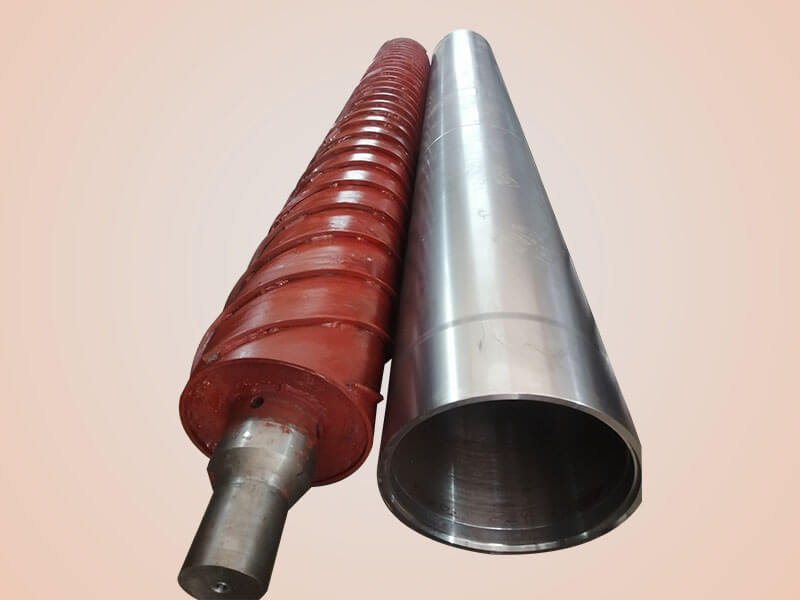
What Are Plastic & Extrusion Line Cooling Rollers?
Plastic and extrusion line cooling rollers are used in production systems where heat must be transferred away from a moving plastic material or processed web. Depending on the machine design, the roller may support cooling, temperature management and material handling at a particular stage of production.
In a typical extrusion process, the temperature of the material changes as it moves through the production line. Cooling requirements can vary according to the polymer, material thickness, line speed, contact conditions and the desired properties of the finished product.
- Maintaining consistent contact between the material and roller surface.
- Supporting the required cooling conditions during continuous processing.
- Reducing process variation associated with unsuitable roller conditions.
- Matching roller dimensions to the available machine layout.
- Selecting an appropriate surface finish for the material and application.
- Planning inspection and maintenance around actual operating conditions.
Cooling performance is not determined by the roller alone. The internal construction, heat-transfer medium, flow arrangement, machine settings and material characteristics all influence the final result.
Technical & Dimensional Specifications
Every industrial cooling roller built by Siva Rollers (Siva Engineering Works) is engineered to meet exacting mechanical and thermal thresholds required by modern high-speed plastic processing equipment.
| Technical Parameter | Engineering Range & Capability |
| Roller Length Capacity | 500 to 6000mm (Customizable to exact face width) |
| Roller Diameter Range | 150 mm to 600mm outer diameter options |
| Operating Temperature Range | Controlled working range from 80°C to 200°C |
| Surface Finish Options | Super-Mirror Finish Ra < 0.01 μmHigh-Gloss Finish, Satin / Matt Finish |
| Internal Flow Architecture | Precision double jacketed spiral cooling configuration with forced turbulent channels |
| Mechanical Balancing | ISO 1940 2-Plane Dynamic Balancing at maximum rated operational RPM |
Why Open-Cavity Rolls Fail
In standard open-cavity or simple shell chill rolls, temperature-control fluid enters a large open internal chamber. This design creates severe hydrodynamic and thermal inefficiencies during high-speed web transport:
- Fluid Stagnation & Boundary Layer Insulations: The large internal volume reduces fluid velocity dramatically. As fluid slows down, a stagnant boundary layer forms along the inner wall, insulating the roller shell from the primary coolant flow.
- Thermal Channeling & Hot Spots: Fluid naturally follows the path of least resistance, leaving dead zones across the face width. This creates localized surface temperature spikes (±4°C to ±6°C).
- Web Defect Generation: Uneven thermal quenching across the web causes localized shrinkage variations. In blown, cast, or sheet lines, this results in gauge variation, lay-flat issues, severe stress concentrations, and gauge bands during winding.
Industry Applications Across Polymer Processing
As a specialized industrial roller manufacturer, Siva Rollers (Siva Engineering Works) designs custom chilling and heating rolls across multiple extrusion and converting sectors:
- BOPP / BOPET / CPP Cast Film Lines: Rapid chilling locks in polymer crystallization to maintain optical transparency and eliminate gauge band variations across wide face widths up to 6000 mm.
- Blown Film Extrusion Lines: Used in secondary web cooling, collapsed bubble chilling, and inline annealing rolls. Prevents film blocking and stabilizes high-density polyethylene (HDPE) and linear low-density polyethylene (LLDPE) webs.
- Sheet Extrusion Lines (PP, PS, PET, PVC, ABS): Supports thick sheet calendering stacks where high radial stiffness and diameter options up to 600 mm prevent roll flexure under heavy nip pressures.
- Extrusion Lamination & Coating: Delivers instant thermal quenching at the nip point where molten polymer meets paper, foil, or woven fabric substrates to secure inter-layer bond adhesion.
Technical Performance Comparison
Performance & Engineering Parameter | Standard Open-Cavity Rollers | Siva Rollers Double Jacketed Systems |
Internal Flow Hydrodynamics | Low-velocity, open cavity fluid flow | High-Velocity Precision Spiral Passages |
Flow Regime | Laminar / Stagnant (Low Heat Transfer) | Forced Turbulent Flow (High Heat Transfer) |
Surface Temperature Gradient | Uneven Temperature Distribution (±4°C to ±6°C) | Highly Uniform (±1°C Across the Roller Face Width) |
Dimensional Flexibility | Limited standard sizes | Roller Diameter: 150–600 mm | Roller Length: 500–6000 mm |
Thermal Operating Envelope | Narrow operating range | Adjustable from 80°C to 200°C |
Deflection Resistance | Basic shaft integration | Heavy-Duty Core Architecture & Dynamic Balance |
Custom Manufacturing & Quality Assurance Workflow
Every project executed by Siva Rollers (Siva Engineering Works) follows a structured manufacturing process:
[1. Process Audit] ---> [2. Hydrodynamic Design] ---> [3. CNC Machining] ---> [4. Dynamic Balancing] ---> [5. Hydro-Testing]- Parameter Audit: Analysis of line speeds, resin thermal properties, operating temperatures 80°C to 200°C, roller length: 500 mm to 6000 mm, and roller diameter: 150 mm to 600 mm.
- Hydrodynamic Internal Design: Spiral passage pitch, depth, and channel widths are calculated to maintain turbulent flow with minimal fluid pressure drop across rotary unions.
- Precision Machining & Fabrication: Machine-cut spiral baffles and outer shell assemblies are precision fitted to eliminate internal fluid bypass.
- Pressure & Leak Testing: Every roll undergoes hydrostatic pressure testing to verify seal integrity before final surface finishing.
- Dynamic Balancing & Inspection: Final inspection verifies surface roughness (Ra), runout tolerance, and 2-plane dynamic balance at actual operating RPMs.
Why Contact SIVA ROLLERS (SIVA ENGINEERING WORKS)?
SIVA ROLLERS (SIVA ENGINEERING WORKS) is an Ahmedabad, Gujarat-based industrial roller manufacturer serving industrial requirements.
With 10+ years of experience in industrial roller manufacturing and repair, the company works with buyers who need rollers for production equipment, maintenance requirements and application-specific industrial use.
When discussing a Plastic & Extrusion Line Cooling Roller requirement, customers can share the working dimensions, temperature conditions, finish preference and machine details to help establish the correct scope of supply.
Our approach focuses on understanding the application before finalizing the product requirement. This helps buyers communicate their technical needs more clearly and evaluate the suitability of the proposed roller for their equipment.
Whether you are planning a new installation or sourcing a replacement roller, contact our team to discuss your requirement.
Upgrade Your Extrusion Line Efficiency
Optimize cooling performance, reduce operational scrap rates, and maintain continuous line speeds. Contact our technical engineering team today to review your drawings, operational parameters, or custom roller specifications.
FAQs
Plastic & Extrusion Line Cooling Rollers are used to remove heat from plastic films, sheets and other processed materials during manufacturing. They help manage material temperature, support dimensional stability and maintain consistent contact between the material and roller surface in extrusion and film-processing lines.
SIVA ROLLERS (SIVA ENGINEERING WORKS) is an industrial roller manufacturer based in Ahmedabad, Gujarat, India, with 10+ years of experience in industrial roller manufacturing and repair. The company supplies industrial rollers for manufacturing applications and helps buyers discuss cooling roller requirements according to their machine dimensions and process conditions.
A Double Jacketed Spiral Cooling Roller is an industrial roller designed with an internal jacket and spiral flow passages to circulate a temperature-control medium. Its internal construction can help distribute heat-transfer fluid along the roller shell. Actual cooling performance depends on the roller design, fluid flow, operating conditions and production-line requirements.
Yes. Depending on the application and operating function, these products may be referred to as Heating & Cooling Rollers, Industrial Cooling Rollers, Spiral Double Jacketed Cooling Rollers or Double Jacketed Spiral Cooling Rollers. The exact design and function should be confirmed according to whether the process requires cooling, heating or temperature regulation.
Industrial Cooling Rollers are used in plastic film extrusion, cast film production, plastic sheet manufacturing, extrusion lamination, coating and converting applications. They may also be used in processes involving materials such as BOPP, BOPET, CPP, PE, PP, PET and PVC, depending on the production equipment and roller specifications.
The product specifications provided for this application list customizable roller lengths from 500 mm to 6000 mm and outer diameters from 150 mm to 600 mm. The suitable dimensions depend on the machine layout, working width, operating conditions and installation requirements. Buyers should confirm availability and technical feasibility with SIVA ROLLERS.
A standard cooling roller may use an open internal cavity for fluid circulation, whereas a Double Jacketed Spiral Cooling Roller uses a more defined internal flow path. Depending on the design, spiral passages can support more controlled fluid circulation and heat transfer. The actual difference in temperature uniformity and cooling efficiency must be established from the design and operating data.
The appropriate surface finish depends on the material being processed, the required contact conditions, the risk of material sticking and the finished product quality. Depending on the application, a roller may require a polished, high-gloss, satin or matt finish. SIVA ROLLERS can discuss the suitable finish based on the application and confirmed manufacturing capabilities.
Cooling performance depends on several factors, including the roller construction, coolant temperature, fluid flow rate, internal passage design, roller surface temperature, material thickness, production speed and contact between the material and roller. Correctly matching these factors to the extrusion process helps buyers evaluate the roller's suitability for their production requirements.
Yes, custom manufacturing may be possible depending on the machine arrangement and technical requirements. Buyers should provide the existing roller dimensions, face width, outer diameter, shaft details, operating temperature, material type and connection requirements. These details help SIVA ROLLERS evaluate the application and discuss a suitable replacement or custom roller.
Unsuitable cooling conditions may contribute to inconsistent material temperature, dimensional variation, uneven shrinkage, surface defects or difficulties during winding. These problems can also be influenced by extrusion settings, material properties and other machine components. Checking the roller condition and reviewing the overall cooling process can help identify possible causes.
To request a quotation from SIVA ROLLERS (SIVA ENGINEERING WORKS), share your required roller diameter, face length, overall dimensions, operating temperature, application details and machine drawing, if available. Also mention whether you need a new roller or a replacement. This information helps the team review your requirements and discuss the next steps for a suitable quotation.