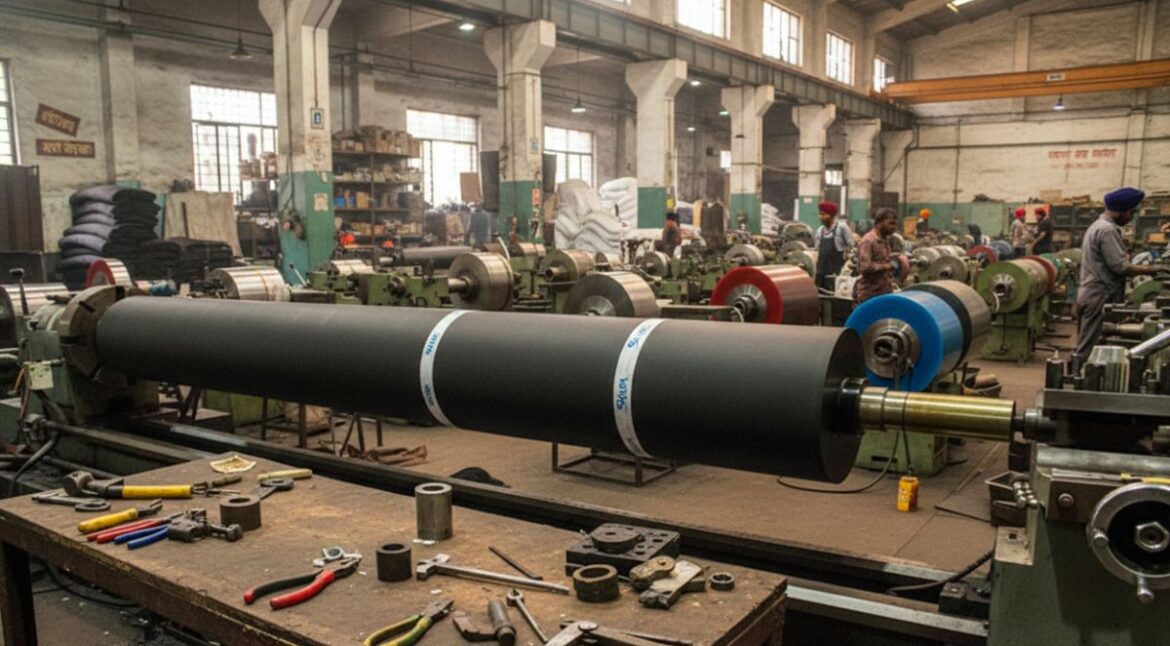
Custom Rubber Rollers vs Standard Rollers: Which Is Right for Your Industrial Application?
In high-speed manufacturing, the smallest component often carries the heaviest burden. For factory owners, maintenance engineers, and OEMs, the rubber roller is that component. Whether it is driving a web press, laminating sensitive films, or conveying heavy industrial loads, the choice between custom rubber rollers vs standard rollers can be the difference between a high-efficiency operation and a maintenance nightmare.
Standardized solutions offer convenience, but custom engineering offers precision. As a leading rubber roller manufacturer, we often see companies struggling to balance initial procurement costs with long-term machine performance.
This guide breaks down the technical and economic factors of both options to help you determine the optimal path for your specific industrial application.
Understanding the Fundamentals: Standard vs. Custom
What are Standard Rubber Rollers?
Standard rollers are “off-the-shelf” components manufactured to common industry dimensions and material specifications. They are typically produced in large batches with fixed parameters for length, diameter, core material, and rubber compound (often a general-purpose NBR or Neoprene).
Best for: General-purpose conveying, low-speed applications, and non-critical environments where precision tolerances are not a primary concern.
What are Custom Rubber Rollers?
Custom rollers are engineered from the ground up to meet specific environmental and mechanical stressors. A custom rubber roller manufacturer evaluates factors like chemical exposure, extreme temperatures, torque requirements, and the delicate nature of the substrate being handled.
Best for: High-speed printing, flexible packaging, textile processing, and specialized OEM machinery where “standard” simply won’t survive the operating conditions.
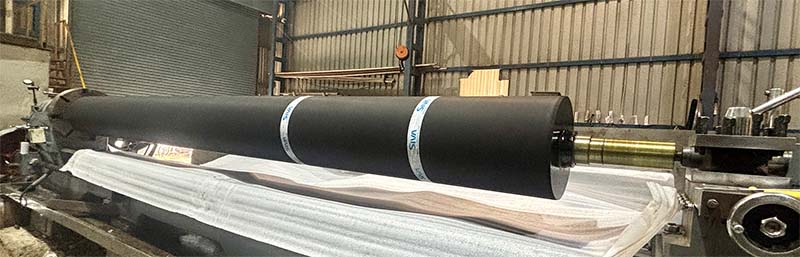
Technical Comparison: Performance and Engineering
1. Material Chemistry and Compound Selection
Standard rollers usually offer a limited range of durometers and general-grade compounds. However, industrial environments are rarely “standard.”
- NBR (Nitrile) Rollers: Excellent oil resistance, but standard grades may swell when exposed to certain solvents used in modern printing.
- EPDM Rubber Rollers: Ideal for heat and weather resistance. Custom EPDM formulations can be adjusted for specific ozone resistance in high-voltage environments.
- Silicone Rollers: Essential for high-temperature release applications. Custom silicone allows for specific heat-transfer properties that standard rollers cannot match.
- Polyurethane Rubber Rollers: Known for extreme abrasion resistance. Custom PU allows for fine-tuning the rubber roller hardness (Shore A / D) to ensure the roller doesn’t mar sensitive surfaces while maintaining high load-bearing capacity.
2. Dimensional Precision and Run-out Tolerances
Standard rollers are manufactured to “commercial” tolerances. For a conveyor belt moving cardboard boxes, this is fine. But for printing rubber rollers or packaging rubber rollers, even a few microns of “run-out” (vibration during rotation) can cause ink misting, uneven coating, or material waste.
Custom manufacturing ensures that the core—whether steel, aluminum, or stainless steel—is dynamically balanced and the rubber surface is precision-ground to exact specifications.
3. Surface Finish and Profile
Does your application require a mirror finish, a specific Ra value for friction, or perhaps a crowned profile to prevent web steering issues? Standard rollers come with a flat, uniform finish. A custom rubber roller manufacturer in India can provide specialized finishes like:
- Spiral grooves for water shedding.
- Diamond patterns for increased grip.
- Rough textures for non-stick properties.
The Economic Reality: Initial Cost vs. Total Cost of Ownership (TCO)
The most common reason for choosing standard rubber rollers is the lower upfront cost. However, for industrial buyers, the “Total Cost of Ownership” is the more relevant metric.
The Hidden Costs of Standard Rollers
- Increased Downtime: If a standard roller wears out in 4 months while a custom roller lasts 12, you aren’t just paying for three rollers; you are paying for three instances of machine downtime and labor.
- Substrate Waste: In the packaging industry, a roller with incorrect hardness can cause “tracking” issues, leading to thousands of dollars in wasted film or paper.
- Energy Consumption: Rollers that aren’t perfectly balanced or have the wrong coefficient of friction force the machine’s motors to work harder, increasing energy costs.
The ROI of Custom Industrial Rollers
Custom rollers are an investment in machine uptime. By selecting the exact polymer and hardness for your specific chemistry and speed, you extend the maintenance cycle. In high-output factories, the reduction in “Changeover Time” alone often pays for the price difference between custom and standard rollers within the first six months.
Real-World Industrial Use Cases
To better understand where to apply each type, let’s look at common rubber roller applications:
Case A: The Corrugated Box Industry (Standard May Suffice)
In simple material handling and corrugated transport, the speeds are moderate and the environment is relatively dry. Standard industrial rubber rollers with a mid-range Shore A hardness often provide adequate service life at a lower price point.
Case B: High-Speed Rotogravure Printing (Custom is Critical)
Here, the rollers are exposed to high-solvent inks, constant friction, and extreme speeds. A standard roller would likely swell or degrade within weeks. Custom-engineered NBR or specialized synthetic compounds are required to maintain consistent ink transfer and prevent “dot gain” issues.
Case C: Food Processing & Medical Packaging (Custom Required)
Standard rollers rarely meet the stringent FDA or hygiene requirements for direct food contact. Custom silicone or white NBR rollers, manufactured in controlled environments, ensure compliance and prevent contamination.
How to Choose Best Rubber Roller for Your Industry
Feature | Standard Rubber Rollers | Custom Rubber Rollers |
Availability | Immediate / In-stock | 2–4 weeks (lead time required) |
Initial Price | Lower | Higher |
Durability | Moderate | Optimized for Environment |
Precision | Commercial Grade | Aerospace / High-Precision |
Chemical Resistance | Limited to general NBR | Custom-matched to your solvents |
Best For | General Conveying | High-Speed, High-Precision, Harsh Chemicals |
Why Partner Siva Rollers with a Specialized Rubber Roller Manufacturer in India?
India has become a global hub for high-quality mechanical components. Working with a domestic expert like Siva Rollers offers several advantages:
- Technical Consultation: We don’t just take orders; we evaluate your machine’s blueprints and operating conditions to recommend the perfect compound.
- Material Innovation: From high-rebound polyurethane rubber rollers to heat-resistant silicone rollers, we stay at the forefront of polymer science.
- Cost-Efficiency: You get European-grade precision with the logistical and cost benefits of manufacturing in India.
Whether you are an OEM designing a new machine or a factory manager looking to optimize an existing line, the rubber roller performance is a critical variable in your success.
Making the Final Call
If your application involves standard dimensions, low speeds, and no chemical exposure, standard rubber rollers are a sensible, budget-friendly choice. However, if your business relies on precision, high-speed output, and minimizing downtime, custom rubber rollers are the only way to ensure long-term profitability.
Don’t let a “standard” component hold back your “extraordinary” machinery. Understanding the nuances of rubber roller hardness (Shore A / D) and polymer selection is the first step toward industrial excellence.
Need help deciding between custom and standard rubber rollers? Contact Siva Rollers for expert technical consultation and custom manufacturing support.
Contact Us
Emial : info@sivarollers.com
Phone Number :
FAQs
Standard rubber rollers are off-the-shelf components manufactured to general industry dimensions and common compounds like basic NBR. They are best for low-speed conveying. Custom rubber rollers are engineered for specific industrial environments, featuring precision-matched polymer chemistry (EPDM, Silicone, PU), exact Shore hardness, and micron-level dimensional tolerances to handle high speeds or corrosive chemicals.
You should opt for custom rubber rollers if your application involves:
- High-Speed Operations: Where vibration or "run-out" causes substrate waste.
- Chemical Exposure: Use of specific solvents, inks, or cleaning agents that degrade general-purpose rubber.
- Extreme Temperatures: Applications requiring heat-resistant silicone or EPDM.
- Precision Requirements: High-end printing, laminating, or medical packaging where uniform pressure is critical.
Rubber roller hardness determines the "footprint" or nip area when the roller is under load.
- Lower Shore A (30–50): Provides high friction and a larger contact area, ideal for delicate web handling or "wringing" applications.
- Higher Shore A/D (70+): Offers high load-bearing capacity and abrasion resistance, ideal for heavy-duty conveying and crushing. Custom manufacturing allows for precision to within ±2 Shore points, ensuring consistent machine tension.
For printing rubber rollers, NBR (Nitrile) is the industry standard due to its excellent resistance to oil-based inks. However, for UV-curing inks or high-speed flexographic printing, custom-formulated EPDM or specialized synthetic blends are preferred to prevent swelling and ensure consistent ink transfer.
You should inspect for "glazing" (a shiny, hard surface), swelling, pitting, or visible cracks. If the roller no longer maintains its Shore hardness or exhibits "run-out" (uneven rotation), it needs recovering. A custom rubber roller manufacturer can often strip the old rubber and bond a new high-performance layer to the existing core to save costs.
Swelling is primarily caused by chemical incompatibility between the roller compound and industrial solvents, inks, or oils. For example, standard NBR swells when exposed to aromatic hydrocarbons. Switching to a custom industrial roller made of EPDM or specialized Fluorocarbon (Viton) can eliminate swelling issues.
Typical lead times for custom rollers range from 2 to 4 weeks, depending on the complexity of the core and the curing time of the polymer. However, a specialized rubber roller manufacturer in India like Siva Rollers can often provide expedited prototyping for urgent maintenance breakdowns.
It depends on the application. Polyurethane rollers are superior for abrasion resistance and load-bearing (e.g., steel mills), while Nitrile (NBR) is superior for oil and solvent resistance (e.g., offset printing). Customizing the polymer ensures you don't overpay for properties you don't need.
Polyurethane (PU) rollers offer significantly higher load-bearing capacity and superior abrasion resistance compared to standard rubber. They are the preferred choice for industrial rollers in the steel, paper, and mining industries because they resist flat-spotting and have a life cycle up to 4x longer than standard NBR.
Yes. Leading rubber roller manufacturers in India, such as Siva Rollers, utilize advanced CNC grinding and dynamic balancing equipment to achieve micron-level tolerances (± 0.01mm). By combining global polymer standards with domestic manufacturing efficiencies, they provide high-performance custom industrial rollers that meet ISO and international OEM specifications.
The ROI is calculated by measuring the Total Cost of Ownership (TCO). While custom rollers have a higher initial price, they reduce costs by:
- Extending Maintenance Intervals: Reducing the frequency of roller replacements.
- Reducing Waste: Eliminating "dot gain" in printing or tracking issues in packaging.
- Lowering Energy Costs: Perfectly balanced rollers reduce the load on drive motors.
To receive an accurate technical proposal, provide the following:
- Dimensions: Core diameter, finished diameter, and face length.
- Environment: Operating temperature and chemical/solvent exposure.
- Mechanical Specs: Operating speed (RPM) and required Shore hardness.
- Core Material: Steel, Aluminum, or Stainless Steel.
Need technical assistance? For precise engineering support, contact Siva Rollers, a premier custom rubber roller manufacturer dedicated to reducing industrial downtime through polymer innovation.