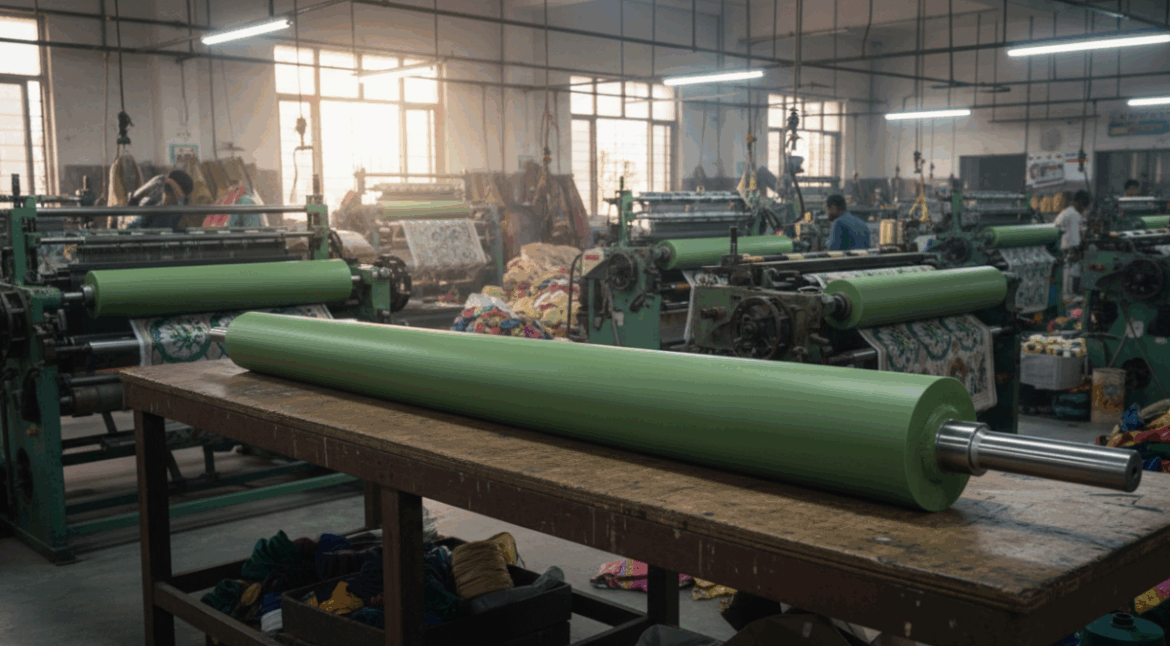
How a Teflon Roller Solves Sticking, Heat & Wear Problems in Industrial Machines
In the fiercely competitive landscape of Indian manufacturing—from the high-speed packaging hubs in Pune to the heavy machinery units in Chennai and the processing plants across Gujarat—your machinery is your lifeline. Speed, precision, and relentless reliability are not optional; they are the bedrock of profitability. Yet, a silent enemy lurks within many production lines, consistently chipping away at your bottom line: roller failure.
You know the headache well. The material is moving, the pressure is on, and then the inevitable happens. Adhesives gum up. Inks transfer unevenly. Plastic film begins to tear. Your team is forced to hit the emergency stop button, initiating hours of frustrating, non-productive cleaning and maintenance. This vicious cycle—sticking, component degradation from heat, and premature wear—is the hidden cost of downtime. Traditional rollers made from standard rubber, chrome, or even mild steel simply cannot handle the high stress, high-temperature, and chemically aggressive demands of modern industrial processing.
But what if a single, engineered component could stop these three critical issues—sticking, excessive heat, and rapid wear—dead in their tracks?
This is where the truly revolutionary Teflon Coated Roller transforms the industrial efficiency conversation. It’s more than a mere spare part; it’s an integrated performance upgrade. If you are a purchase manager or an engineer searching for a permanent, cost-effective fix to challenging production issues, you are looking for a trusted Teflon Roller Manufacturer. Let’s explore the technical superiority of this solution and why it is the definitive choice for modern Indian industry.
Conquering the Sticking Crisis: The Zero-Adhesion Advantage
The number one culprit behind machine downtime is adhesion—when the material being processed bonds or sticks inappropriately to the roller surface. This isn’t just a minor inconvenience; it’s a major operational disaster that affects quality and output in many sectors:
- In Packaging: Hot-melt glue gums up sealing rollers, leading to inconsistent seals and rejects.
- In Textiles: Sizing agents, dyes, and wet finishing resins build up on guide rollers, causing fabric dragging and tearing.
- In Printing: Ink and toner residues adhere to fuser and pressure rollers, resulting in poor image transfer and continuous cleaning breaks.
- In Food Processing: Dough, syrups, or confectionery products stick, slowing lines and raising sanitation concerns.
The Science of Slippery: Polytetrafluoroethylene (PTFE)
The secret behind the Teflon Roller lies in its core material: Polytetrafluoroethylene (PTFE). This incredible polymer has the lowest coefficient of friction of almost any known solid. What does that mean for your factory floor?
It means zero adhesion. The surface energy is so low that sticky substances—whether they are hot, wet, or dry—simply cannot bond to the surface. They slide right off.
By integrating a high-quality Teflon Roller into your production line, you can expect:
- Massive Reduction in Cleaning Time: Cut down on the tedious, labor-intensive scraping and scrubbing. Downtime dedicated to cleaning can be reduced by 80% or more.
- Consistent Product Quality: With no build-up to alter the roller’s diameter or surface texture, you guarantee uniform pressure, perfect lamination, and flawless printing, leading to minimal material wastage.
- Increased Line Speed: Your machines can run at their optimal speeds because the fear of material jamming or tearing due to adhesion is removed.
If you are currently struggling with persistent sticking, it’s time to consult a reliable Teflon Roller Manufacturer who understands the exact coating chemistry required for your adhesive or resin.
Exceptional Heat Resistance for Critical Processes
Many high-speed processes rely on intense, continuous heat. Consider the thermal applications central to several key Indian industries:
- Lamination & Bonding: Fusing multiple layers of film or paper together requires high, consistent temperatures.
- Textile Finishing: Drying, curing, and heat-setting textiles demand rollers that maintain integrity in extreme heat.
- Printing Fusing Units: Rollers must often operate above $200^\circ\text{C}$ to melt and fuse toner onto paper.
Traditional materials, especially rubber and many common polymers, quickly soften, deform, and degrade under this relentless thermal stress, leading to roller warping, short lifespan, and ultimately, catastrophic failure.
Thermal Stability: Operating Safely in the Red Zone
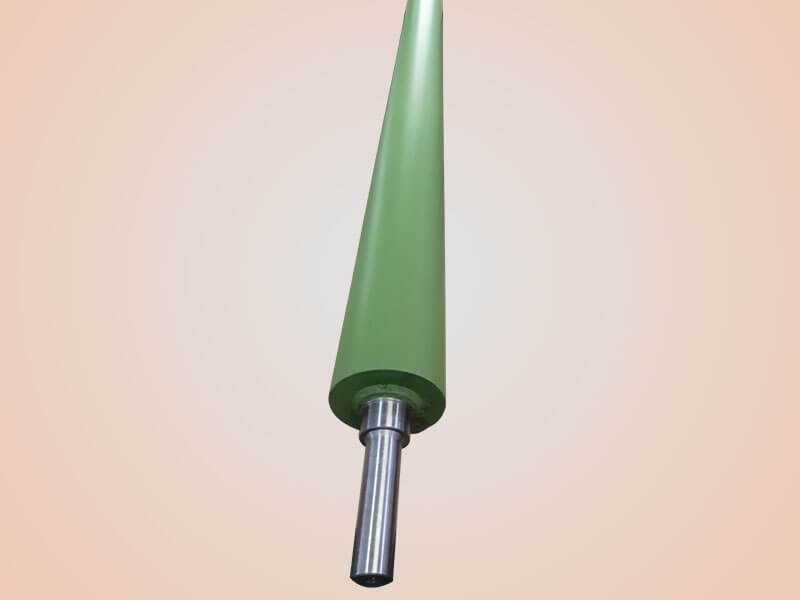
PTFE is renowned globally for its superior thermal stability. A high-grade Teflon Roller can function perfectly in continuous operating temperatures ranging from $200^\circ\text{C}$ up to $260^\circ\text{C}$ (and specialized variants like PFA can handle even higher peaks, near $350^\circ\text{C}$), without suffering:
- Degradation: The coating won’t crack, melt, or become brittle.
- Loss of Non-Stick Properties: The anti-adhesion characteristic remains effective even at maximum operating temperatures.
- Dimensional Instability: The roller maintains its precision-engineered shape, ensuring the material transfer remains perfect and wrinkle-free.
When you purchase Factory direct PTFE rollers, you are investing in components designed to handle extreme thermal loads effortlessly, leading to extended service life, reduced need for frequent temperature adjustments, and significant energy savings because the process temperature remains stable and optimized.
Solving Wear, Abrasion, and Chemical Corrosion
The industrial floor is a brutal environment. Rollers are constantly bombarded by abrasive dust, mechanical friction, and the caustic nature of cleaning agents, dyes, solvents, and acids. A roller that only solves sticking but fails due to chemical attack in a few months is not a solution; it’s a deferred cost.
Chemical Inertness and Extended Service Life
This is where the true long-term value of the Teflon Roller emerges. PTFE is chemically inert—it simply does not react with nearly all industrial acids, bases, solvents, or processing chemicals. This non-reactive nature is crucial for:
- Corrosion Prevention: Protecting the metallic core (steel or aluminum) from rust and chemical damage, maximizing its useful life.
- Pharmaceutical and Chemical Purity: Ensuring that the roller itself will not leach contaminants or react with sensitive materials, a non-negotiable requirement for high-purity applications.
- Easier, Safer Cleaning: Harsh cleaning chemicals can be used effectively without fear of damaging the roller’s functional surface.
Furthermore, Teflon’s exceptionally low friction coefficient acts as a double shield. It minimizes abrasive wear on the roller’s surface and significantly reduces mechanical stress on the entire drive system—including machine bearings and motors.
The result? A Teflon Roller consistently outlasts conventional rollers, often by several years. This extended service life dramatically slashes your replacement frequency and the associated labor costs, proving that the durable choice is always the most economical choice in the long run.
Why Customization Matters for ROI
While the generic benefits of a Teflon Roller are universally appealing, the precise needs of a textile mill handling fine yarn versus a food plant handling viscous slurry are worlds apart. A standard, off-the-shelf roller often leads to suboptimal performance because it fails to account for three crucial process variables:
- Core Dynamics: The core material (mild steel, stainless steel, or aluminum) and its wall thickness must be precisely matched to the load-bearing capacity and the line’s rotational speed.
- Coating Specification: The specific type of PTFE variant (like FEP or PFA for extreme heat) and the coating thickness (measured in microns) must be tailored to the material being processed. A rougher finish is sometimes needed for better grip, while a polished finish is essential for absolute non-stick release.
- End-Use Environment: Factors like humidity, cleaning protocols, and even atmospheric corrosives need to be considered when engineering the perfect coating system.
This is precisely why you need to partner with a Custom Teflon roller manufacturer. They do not offer a generic product; they offer a precision-engineered solution. By working directly with a specialist, you ensure that the roller is perfectly integrated into your machine from day one, guaranteeing maximum performance and the superior Return on Investment (ROI) you expect. Choosing Factory direct PTFE rollers also eliminates middleman costs, giving you the highest quality product at the most competitive price.
Choose the Best Teflon Roller Manufacturer in India
In the pursuit of operational excellence, you need a partner who combines world-class coating technology with a deep understanding of the unique challenges faced by the Indian manufacturing sector.
If your goal is to eliminate costly downtime, boost material consistency, and reduce maintenance costs permanently, look no further than Siva Roller.
Proudly recognized as a leading Teflon Roller Manufacturer in India, Siva Roller combines decades of focused expertise with state-of-the-art coating and finishing technology. Our advanced manufacturing facility, strategically located in the industrial heartland of Ahmedabad, Gujarat, is equipped to serve the entire nation with precision-engineered solutions. We are dedicated to providing industrial buyers across India with high-quality, durable, and fully customized rollers that are not just replacements, but genuine performance upgrades.
When you partner with Siva Roller, you gain:
- Assured Indian Quality: Robust manufacturing standards right here in India.
- Custom Design Expertise: Personalized consultation to design the exact roller solution for your specific machine, material, and temperature requirements.
- Nationwide Service: From Ahmedabad to Kolkata, we deliver reliable, high-performance rollers that ensure your facility runs smoothly.
The Final Verdict: Efficiency Starts with the Right Roller
The choice is now clearer than ever. Sticking with conventional rollers means accepting inefficiency, lost production, and the never-ending cycle of heat-related failures. By switching to a high-grade Teflon Roller, you are choosing a future of uninterrupted production, minimal cleaning, and consistently high-quality output.
Stop managing roller problems and start focusing on scaling your business across India. If you are ready to find the precise, custom-built roller solution that will push your factory to the first rank of efficiency and reliability, it is time to connect with the experts. Reach out to Siva Roller today and let the Best Teflon Roller Manufacturer in India engineer a permanent solution to your sticking, heat, and wear challenges. Your next great leap in productivity is just a consultation away.
Contact US : +91 75070 10009 , info@sivarollers.com
FAQs
A Teflon Roller primarily solves three major production issues: material sticking, heat-related roller failure, and rapid surface wear. Its PTFE coating prevents adhesion, withstands high temperatures, and resists chemical and abrasive damage, making it ideal for continuous industrial operations.
PTFE (Polytetrafluoroethylene) has an extremely low coefficient of friction and very low surface energy. This means adhesives, inks, films, resins, and food products cannot bond to the surface, unlike rubber or metal rollers that allow buildup and contamination.
Teflon Rollers are widely used in packaging, printing, textiles, food processing, pharmaceuticals, lamination, plastic film extrusion, and chemical processing industries—anywhere sticking, heat, or chemical exposure causes downtime.
A standard industrial-grade Teflon Roller can operate continuously between 200°C and 260°C. Specialized PTFE variants such as PFA-coated rollers can handle intermittent temperatures up to 350°C, making them suitable for high-heat lamination and fusing processes.
Yes. PTFE is chemically inert and resists almost all industrial acids, alkalis, solvents, dyes, and cleaning chemicals. This makes Teflon Rollers ideal for corrosive environments and ensures long service life without surface degradation.
By preventing material buildup, Teflon Rollers drastically reduce cleaning frequency, unplanned stoppages, and roller replacements. Many facilities report up to 80% reduction in cleaning-related downtime after switching to PTFE-coated rollers.
A standard roller may not match your machine’s load, speed, temperature, or material requirements. A Custom Teflon roller manufacturer designs rollers with the correct core material, coating thickness, surface finish, and PTFE variant—ensuring optimal performance and maximum ROI.
Yes. Factory direct PTFE rollers eliminate distributor margins, ensure better quality control, faster customization, and technical support directly from the manufacturer. Over time, their longer lifespan and lower maintenance costs make them significantly more economical.
Depending on operating conditions, a high-quality Teflon Roller can last 2–4 times longer than rubber or chrome rollers. Reduced wear, chemical resistance, and thermal stability all contribute to extended service life.
Look for a Teflon Roller Manufacturer with in-house coating capability, customization expertise, industry experience, and nationwide service support. A manufacturer who understands Indian industrial conditions will deliver better performance and long-term reliability.