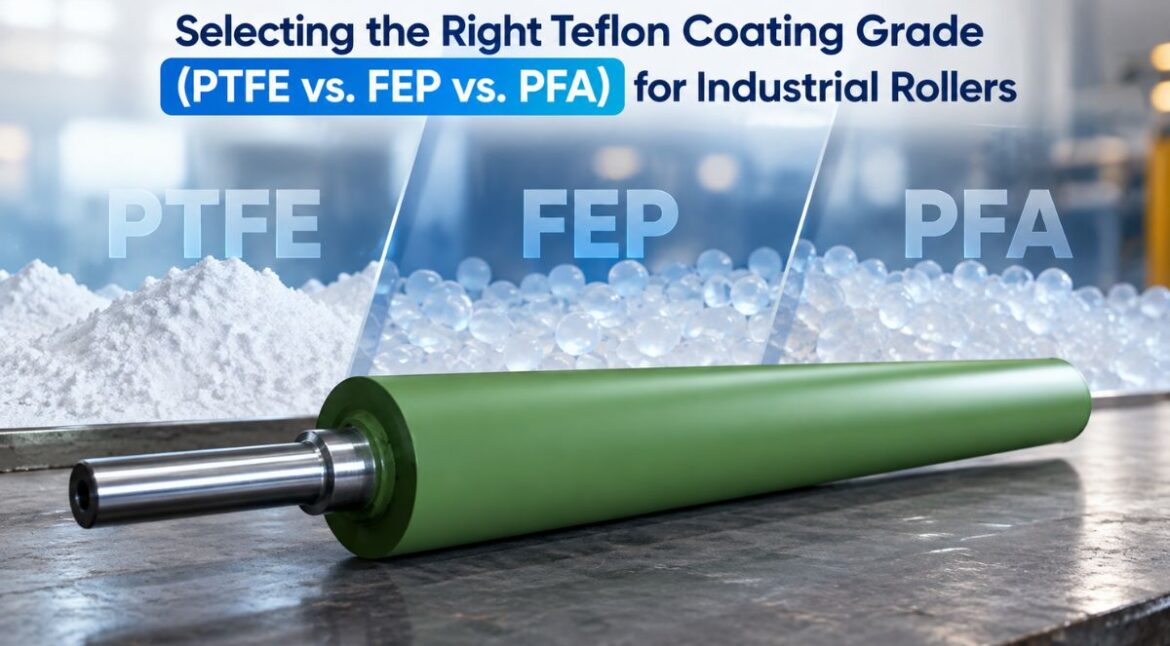
Selecting the Right Teflon Coating Grade (PTFE vs. FEP vs. PFA) for Industrial Rollers
In modern manufacturing, unexpected line stoppage is every plant manager’s worst nightmare. Imagine a busy packaging or textile production line running at full capacity. Suddenly, delicate film tears, sticky liquid adhesive builds up, or heat causes material to weld onto a roller surface. Within minutes, clean production turns into a costly cleanup operation.
At the center of these daily industrial challenges sits a deceptively simple component: the industrial roller.
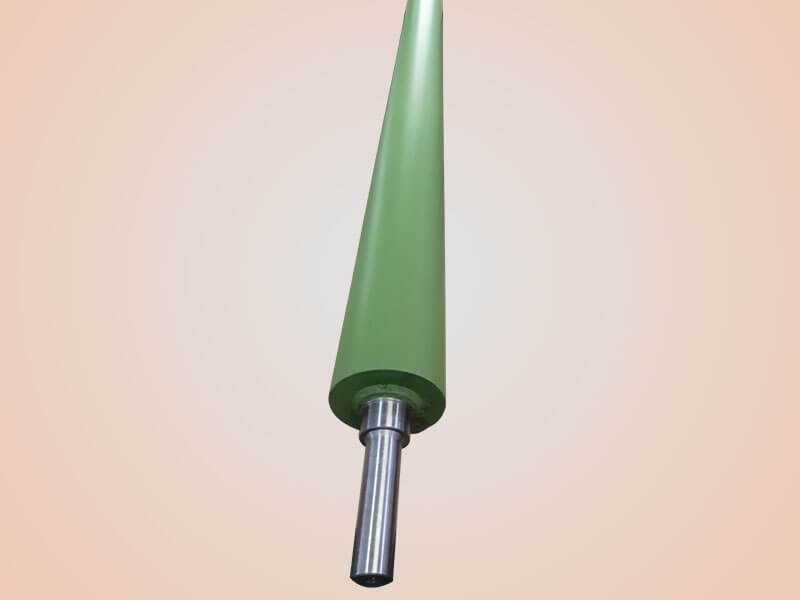
When configured correctly with a specialized non-stick surface, a Teflon coated roller ensures smooth material transport, eliminates unwanted adhesive buildup, withstands continuous processing heat, and keeps production moving cleanly. However, one common misconception plagues many plant floors: assuming that all non-stick coatings are identical.
In reality, fluoropolymer coatings come in distinct family grades, most notably PTFE, FEP, and PFA. Selecting the wrong grade can lead to premature coating wear, frequent maintenance shutdowns, or unnecessary operational expenditure.
In this comprehensive guide, we strip away confusing technical jargon to explain how each coating grade performs in real-world factory environments and how to choose the ideal solution for your machinery.
The True Cost of Choosing the Wrong Roller Coating
When a roller surface fails to perform, the visible warning signs show up immediately on your final product:
- Material Snagging and Drag: Wet inks, laminating adhesives, or hot plastic films stick to uncoated or improperly coated rolls, causing wrinkles and uneven tension.
- Surface Scratching & Scuffing: Soft or ill-suited coatings degrade quickly under constant friction, leaving abrasive debris that damages sensitive webs.
- Chemical Blistering: Exposure to harsh washdown chemicals or corrosive processing liquids can cause inferior coatings to peel off the metallic roller core.
- Frequent Maintenance Stoppages: Line operators spend hours scraping, scrubbing, and cleaning residue off rollers, taking away valuable production hours.
Understanding that a Teflon roller is an engineered operational asset—rather than just a generic mechanical spare part—is the first step toward achieving uninterrupted production flow.
Demystifying the Big Three: PTFE, FEP, and PFA in Plain English
While all three belong to the fluoropolymer family, each material exhibits unique physical behaviors under factory conditions. You do not need a degree in chemical engineering to understand how they differ. Here is how they compare in daily industrial use.
1. PTFE (Polytetrafluoroethylene): The High-Heat Non-Stick Pioneer
PTFE is the original and most widely recognized non-stick fluoropolymer. In industrial applications, it is renowned for offering exceptionally low surface friction and high thermal resistance.
Key Floor Characteristics:
- Ultra-Slippery Surface: Materials glide across a PTFE surface with virtually zero stickiness or resistance.
- High Heat Endurance: Operates reliably under elevated thermal conditions where standard rubber or polyurethane rollers would degrade or melt.
- Powdered/Sintered Structure: Because PTFE does not melt and flow like typical plastics when baked, its applied layer forms a dense, smooth micro-structure.
Best Industrial Uses:
- Drying cylinders and heat-sealing equipment.
- Non-stick guide rollers handling dry powders, webs, and light films.
- High-temperature web guiding where material friction must be kept to an absolute minimum.
2. FEP (Fluorinated Ethylene Propylene): The Smooth, Pore-Free Shield
Unlike PTFE, FEP melts completely during the high-temperature baking process. This allows it to form a continuous, non-porous liquid-like barrier across the metal roller surface.
Key Floor Characteristics:
- Non-Porous Barrier: Creates a completely sealed layer that prevents corrosive chemicals, moisture, or sticky liquids from penetrating down to the underlying metal core.
- Exceptional Release Property: Known for offering superior release performance against sticky substances like hot-melt adhesives, pressure-sensitive tapes, and wet resins.
- Flexible & Impact Resistant: Displays good elasticity, making it resilient under mild mechanical impacts or slight flexing during continuous rotation.
Best Industrial Uses:
- Adhesive tape converting lines and glue applicator rollers.
- Flexible packaging machinery handling liquid laminates.
- Rollers exposed to mild chemical washdowns and wet processing environments.
3. PFA (Perfluoroalkoxy): The Heavy-Duty Tough Performer
PFA combines the best attributes of both PTFE and FEP. It melts and flows during baking to form a continuous, pore-free barrier like FEP, yet retains the exceptional high-temperature stamina of PTFE alongside improved mechanical toughness.
Key Floor Characteristics:
- Maximum Thermal & Chemical Resistance: Handles harsh chemical exposure and high operational temperatures without softening or cracking.
- High Crack & Stress Resistance: Stands up remarkably well to continuous mechanical stress, high web tension, and repeated thermal cycling.
- Longer Service Life in Tough Operations: Holds up significantly longer under continuous heavy-duty industrial processing.
Best Industrial Uses:
- Heavy-duty chemical processing and textile dyeing rollers.
- High-speed film extrusion and hot-melt laminating units.
- Critical manufacturing lines where unscheduled maintenance downtime is unacceptably costly.
Practical Application Matchmaker: Choosing by Factory Conditions
Rather than analyzing complex laboratory data, plant engineers and production heads should evaluate their operational environment. Match your specific factory conditions with the recommended solution below:
Scenario A: Working with Sticky Adhesives, Gums, or Tapes
- The Challenge: Hot-melt glue, liquid adhesives, or tacky coatings stick to guide rolls, causing web wrap-arounds and severe edge tearing.
- The Ideal Choice: FEP or PFA Coating
- Why It Works: FEP and PFA bake into a smooth, seamless film. Sticky substances cannot find microscopic anchor points to cling to, enabling effortless release and quick cleanups.
Scenario B: Continuous High-Heat Processing (Drying & Heat Sealing)
- The Challenge: Rollers operate near hot heating elements or directly contact hot webs, causing conventional coatings to blister, discolour, or harden.
- The Ideal Choice: PTFE or PFA Coating
- Why It Works: Both grades maintain structural stability under continuous heat, preventing material transfer and ensuring uniform thermal transfer to the web.
Scenario C: Corrosive Chemicals, Dyes, or Frequent Washdowns
- The Challenge: Aggressive chemicals, solvents, or damp processing environments penetrate porous coatings, rusting the underlying metal core and causing the coating to peel off.
- The Ideal Choice: PFA Coating
- Why It Works: PFA acts as a non-porous chemical shield. It prevents aggressive liquids from reaching the steel or aluminum roller substrate, preserving the core’s structural integrity.
Essential Shop-Floor Factors Before Customizing Your Roller
Selecting the right fluoropolymer grade is only one part of the equation. To ensure your industrial roller performs consistently over millions of rotations, several physical parameters must be addressed during design and fabrication.
Substrate Metal Selection & Surface Preparation
A non-stick coating is only as durable as the metal core beneath it. Whether your core is crafted from mild steel, stainless steel, or lightweight aluminum, the metal must undergo specialized grit-blasting and surface profiling. Proper core preparation ensures the coating anchors securely without risk of flaking or delamination.
Operating Web Tension and Mechanical Load
Heavy web tension creates localized pressure on roller surfaces. While non-stick coatings provide smooth release, they are not designed to withstand sharp blade impacts or extreme nip pressures. Understanding your line tension helps determine whether a thin release coating or a reinforced composite coating system is required.
Surface Finish Requirements
Different production lines require different surface textures:
- Mirror Finish: Ideal for clear films and delicate materials where surface impression must be completely avoided.
- Traction Finish (Textured): Provides non-stick properties while maintaining subtle friction to drive lightweight webs without slip.
Why Partnering with a Trusted Manufacturer Matters: The Siva Rollers Advantage
Applying fluoropolymer coatings to industrial rolls is a precise engineering discipline. It requires meticulous temperature control during curing, precise uniform thickness application, and thorough quality inspection.
As a dedicated Teflon Roller Manufacturer in India, Siva Rollers brings extensive hands-on experience to every project. Rather than offering off-the-shelf, one-size-fits-all products, the engineering team evaluates your specific process parameters—material type, line speed, temperature, chemical exposure, and web tension—to recommend the ideal non-stick roller setup.
What Sets Siva Rollers Apart:
- Precision Substrate Engineering: Manufacturing high-precision roller cores balanced dynamically for vibration-free high-speed operation.
- Customized Coating Formulations: Tailoring PTFE, FEP, and PFA grades to suit specific industry requirements across packaging, textiles, printing, and converting.
- Core Refurbishing & Re-coating Services: Extending the lifespan of existing equipment by stripping worn layers, inspecting core integrity, and applying fresh, high-grade non-stick surfaces.
- Commitment to Quality & Trust: Built on honest technical guidance, consistent product quality, and reliable post-installation support.
Learn more about industrial roller solutions and custom options by visiting Siva Rollers.
Best Practices for Extending the Life of Your Teflon Coated Roller
Even the highest quality Teflon roller requires correct care on the factory floor to deliver a long operational lifespan. Simple daily maintenance habits can prevent costly damage.
1. Use Soft Cleaning Tools
Even the highest quality Teflon roller requires correct care on the factory floor to deliver a long operational lifespan. Simple daily maintenance habits can prevent costly damage.
2. Select Compatible Cleaning Solvents
Use mild, approved solvents for cleaning. While fluoropolymers resist most chemicals, improper cleaning agents can damage underlying primer coats if deep surface scratches are already present.
3. Practice Safe Installation and Handling
During installation or maintenance shutdowns, shield rollers with protective foam sleeves or heavy canvas wraps. Dropping hand tools on an exposed roller surface can dent the metal core and chip the protective non-stick shell.
4. Schedule Timely Re-coating
Do not wait until a coating is completely worn down to the bare metal. Scheduling a re-coating service at the first sign of surface wear prevents core rust and keeps reconditioning costs low.
Making the Smart Investment for Your Plant
Choosing between PTFE, FEP, and PFA is not about finding the most expensive coating—it is about choosing the right mechanical match for your specific production line.
- Choose PTFE for ultra-low friction and high dry heat applications.
- Choose FEP for smooth release against sticky gums, wet resins, and moderate temperatures.
- Choose PFA for heavy-duty environments demanding tough chemical resistance, high heat, and long-term mechanical endurance.
Investing time into selecting the proper Teflon coated roller pays off in smoother operation, higher product consistency, reduced scrap, and fewer maintenance shutdowns.
Ready to Optimize Your Industrial Production Line?
Consult with the technical experts at Siva Rollers to analyze your roller requirements, choose the perfect non-stick coating grade, and request a tailored quote for your facility.
Visit Siva Rollers today to connect with an experienced industrial roller team.
FAQs
PTFE offers very low friction and high-temperature performance, FEP provides smooth release and a continuous non-porous surface, while PFA combines high-temperature and chemical resistance with greater mechanical toughness. The right grade depends on the roller’s temperature, material, chemicals, load, and operating conditions.
PTFE or PFA can be suitable for high-temperature industrial roller applications. PTFE is commonly considered where low friction and heat resistance are important, while PFA may be preferred when high heat is combined with demanding chemical or mechanical conditions.
Yes. FEP can be suitable for rollers handling adhesives, tapes, wet resins, and other sticky materials because of its smooth release characteristics and continuous coating structure. The final coating selection should be based on the specific process conditions.
PFA can be considered when an industrial roller is exposed to a combination of high temperature, chemical exposure, mechanical stress, or repeated thermal cycling. It is particularly useful for demanding processes where coating durability and chemical resistance are important.
Start by evaluating operating temperature, material being processed, chemical exposure, web tension, roller speed, mechanical load, cleaning methods, and required surface finish. These factors help determine whether PTFE, FEP, PFA, or another coating system is appropriate.
FEP or PFA may be suitable for adhesive-handling rollers where easy material release and resistance to sticky buildup are important. The choice depends on adhesive type, operating temperature, chemical exposure, and mechanical conditions.
Yes, existing industrial rollers can often be refurbished and re-coated after the old coating is removed and the roller core is inspected and properly prepared. Suitability depends on the condition and material of the roller substrate and the required coating system.
Proper surface preparation helps the fluoropolymer coating bond securely to the roller substrate. Cleaning, surface profiling, and suitable preparation of the metal core can help reduce the risk of premature peeling, flaking, or delamination.
Use compatible cleaning agents and soft cleaning tools, avoid metal scrapers and sharp objects, protect the coated surface during installation, and inspect the coating regularly for wear or damage. Timely re-coating can also help prevent further deterioration of the roller surface.
Siva Rollers (Siva Engineering Works) provides Teflon coated roller solutions for industrial applications and can evaluate requirements such as operating temperature, material type, line conditions, chemical exposure, and web tension to determine a suitable coating approach.