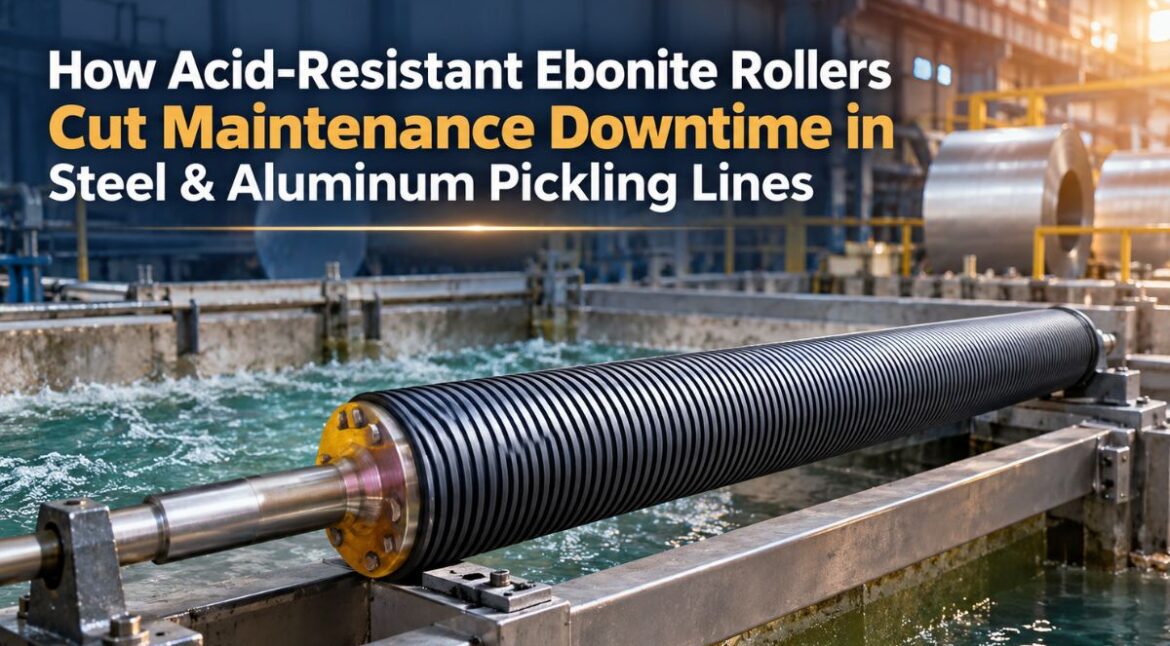
How Acid-Resistant Ebonite Rollers Cut Maintenance Downtime in Steel & Aluminum Pickling Lines
Every plant manager in the steel and aluminum industry knows the sinking feeling that comes with an unscheduled line stoppage.
When a continuous pickling line comes to a sudden halt, the financial clock starts ticking immediately. Lost tonnage, idle operators, wasted heating energy, and damaged metal coils all add up within minutes.
While heavy machinery, drive motors, and acid heating systems usually get the most attention during plant planning, the real source of repeated micro-downtime is often much smaller and easier to overlook: the roller.
In severe chemical environments like acid pickling tanks, squeeze positions, hold-down zones, and rinse sections, standard rubber rollers constantly fight a losing battle. Hydrochloric acid, sulfuric acid, and mixed nitric-hydrofluoric acid baths break down standard flexible coatings faster than most maintenance schedules can keep up with.
This is where the Ebonite Roller comes into play.
By replacing soft, vulnerable rubber coverings with tough, chemically inert ebonite coatings, modern metal processing plants are dramatic lowering their scheduled maintenance hours, protecting their core equipment, and keeping their pickling lines running smoothly shift after shift.
In this guide, we will break down why traditional roller coatings fail in acid baths, how hard ebonite technology solves these operational pain points, and how upgrading your mill’s rollers can directly boost your production efficiency.
The Hostile Environment of Steel and Aluminum Pickling Lines
To understand why roller failure is so common, it helps to look closely at what happens inside a pickling tank.
Before steel or aluminum sheet coils can move on to cold rolling, galvanizing, or surface coating, their surfaces must be thoroughly cleaned. During hot rolling, a tough layer of oxide scale forms on the metal strip. The pickling process removes this scale by passing the continuous metal strip through tanks filled with heated acid solutions.
- In Steel Pickling Lines: Continuous Pickling Lines (CPL) and Push-Pull Pickling Lines primarily use hot hydrochloric acid (HCl) or sulfuric acid ($H_2SO_4$) to dissolve rust and iron oxide scale.
- In Aluminum Etching & Pickling Lines: The process relies on specialized acid combinations (such as nitric and hydrofluoric acid blends) or alkaline pre-treatments to remove natural oxide layers and etch the surface for uniform finish quality.
For a roller operating inside or directly above these acid tanks, conditions are extremely tough. The roller core must endure:
- Direct Chemical Immersion: Constant contact with aggressive acid baths.
- Elevated Temperatures: Acid solutions are heated to maximize oxide removal efficiency, accelerating chemical reactions.
- Heavy Mechanical Pressure: High line tension, strip steering forces, and continuous compression.
- Abrasive Surface Friction: Contact with raw metal edges, scale particles, and high-speed metal movement.
When conventional soft rubber rollers operate under these conditions, they begin to degrade from the inside out.
Why Soft Rubber Rollers Frequently Fail in Acid Tanks
Soft rubber compounds (such as standard synthetic rubbers) are often selected because they offer good flexibility and initial grip. However, in heated acid environments, flexibility turns into a major weakness over time.
- Chemical Swelling and Softening
Acid molecules slowly penetrate the porous surface of standard soft rubber. As the rubber absorbs acid, it expands, softens, and loses its original structural shape. This leads to an uneven roller surface, known as “crowning” or surface distortion.
- Surface Pitting and Blistering
Trapped acid inside the rubber matrix creates internal chemical reactions. Over time, blisters form on the surface and rupture, leaving tiny pits and cracks. These rough areas scratch delicate aluminum or cold-rolled steel surfaces, leading to rejected product coils.
- Acid Seepage to the Steel Core
Perhaps the most destructive issue occurs when acid seepage reaches the inner steel core of the roller. Once acid corrodes the bond line between the rubber cover and the metal shaft, the entire coating can detach or peel away—a failure known as debonding.
- Frequent Line Shutdowns for Regrinding
To prevent product defects caused by pitted or swollen rollers, maintenance teams must frequently pull rollers out of the line for surface grinding and re-polishing. Every time a roller is changed, the line must be slowed down or completely shut down, consuming valuable production hours.
For detailed background on standard industrial corrosion challenges and material behavior, resources such as Corrosionpedia offer valuable insights into chemical degradation mechanisms in industrial manufacturing.
What Is an Ebonite Roller? A Simple Industrial Explanation
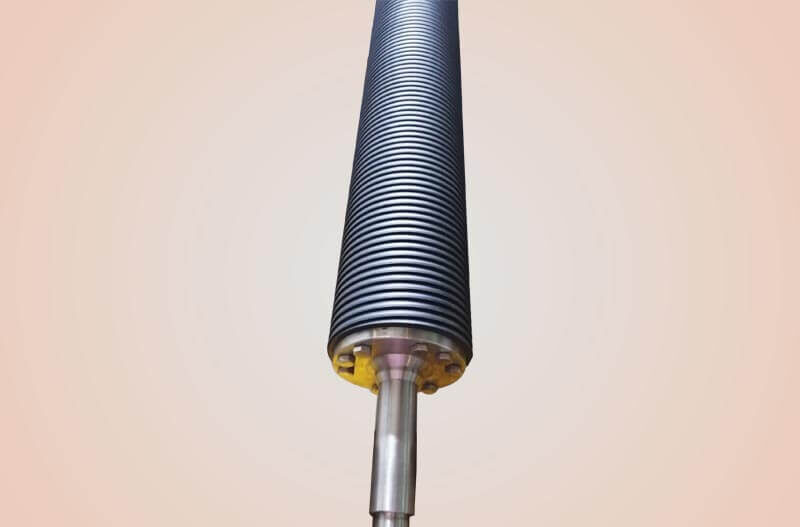
An Ebonite Roller (often referred to as an Ebonite Coated Roller) is built with a specialized, highly vulcanized hard rubber formulation.
Unlike soft rubber, which contains lower amounts of cross-linking agents, ebonite undergoes an extensive vulcanization process that transforms the rubber into a rigid, non-porous, hard material with a stone-like surface finish (typically measuring 95 to 100 on the Shore D hardness scale).
Think of soft rubber as a flexible sponge and ebonite as a solid protective shield. Because ebonite is non-porous and incredibly hard, acid molecules cannot penetrate its surface.
Key Practical Advantages of Ebonite Coatings:
- Zero Swelling: Acid solutions cannot absorb into the material, preserving the precise diameter and roundness of the roller.
- Glass-Smooth Surface Finish: Can be ground and polished to extremely fine tolerances, ensuring smooth strip passage without marking the metal.
- Exceptional Mechanical Toughness: Resists cut marks, abrasive wear from sharp strip edges, and high mechanical pressure.
- Core Protection: Acts as an impenetrable barrier that seals the inner steel core from corrosive acid contact.
How Acid-Resistant Ebonite Rollers Cut Maintenance Downtime
Upgrading to acid-resistant ebonite rollers is one of the most effective mechanical improvements a plant engineering team can make. Here is how ebonite directly reduces downtime and saves operational costs:
1. Eliminating Unscheduled Line Stops
When soft rollers fail unexpectedly due to debonding or severe pitting, the pickling line must be halted immediately to replace the roller. In contrast, ebonite coated rollers maintain their structural integrity across long operational campaigns. Plant managers can schedule maintenance during planned annual turnarounds rather than dealing with middle-of-the-night emergency shutdowns.
2. Extending Operating Lifespan Between Regrinds
Because ebonite resists chemical attack and physical wear, its surface stays flat and smooth for significantly longer periods. Where soft rubber rollers might require surface re-grinding every few weeks or months, a well-engineered ebonite roller can run for many months—and often years—without needing surface correction.
3. Preventing Acid Carry-Over and Solution Contamination
In continuous pickling, squeeze rollers play a crucial role in stripping acid off the metal sheet before it moves into rinse tanks or subsequent process stages. If a roller surface becomes grooved, pitted, or swollen, acid leaks through the gaps. This “acid carry-over” contaminates rinse water tanks, accelerates chemical consumption, and creates extra cleaning workload for water treatment facilities.
Ebonite rollers maintain an exact, uniform nip pressure across the full width of the metal strip, ensuring clean squeegee action and minimal chemical loss.
4. Eliminating Strip Tracking Issues and Chatter Marks
An uneven or degraded roller causes the moving steel or aluminum strip to slip, wander off-center, or vibrate. This leads to line stoppages, edge damage, and surface chatter marks. The rigidity of an ebonite roller provides solid, stable guidance, keeping continuous strip tracking accurate at high line speeds.
5. Protecting Long-Term Capital Investment in Roller Cores
A roller core is a costly precision-machined steel shaft. Replacing damaged rubber coatings is relatively straightforward, but replacing an acid-corroded, pitted steel shaft is far more expensive. Ebonite forms a permanent chemical bond with the metal core, acting as a lifetime rust-proofing shell that preserves the structural integrity of your valuable shafts.
For broader industry context on continuous strip processing standards and quality practices, plant engineers often refer to resources from organizations like the World Steel Association and the Association for Iron & Steel Technology.
Real-World Comparison: Ebonite Rollers vs. Soft Rubber Rollers
To see the operational contrast clearly, let us compare how these two coating choices perform across key operational areas in pickling lines:
- Resistance to Hot Acid: Soft rubber exhibits moderate to poor resistance, frequently swelling or blistering. Ebonite offers outstanding resistance with no chemical absorption.
- Surface Hardness Maintenance: Soft rubber quickly loses its original surface profile under load. Ebonite retains its exact geometric dimensions over extended continuous operation.
- Risk of Core Debonding: Soft rubber carries a high risk when acid penetrates to the bond line. Ebonite features a virtually seamless, impervious bond seal.
- Maintenance Effort: Soft rubber requires frequent removal, grinding, and recoating. Ebonite needs minimal intervention and long maintenance cycles.
- Overall Operational Cost: While soft rubber may have a slightly lower initial purchase hurdle, its total cost of ownership is high due to downtime. Ebonite yields a significantly lower total cost through uninterrupted production runs.
Tailoring Ebonite Solutions: Steel vs. Aluminum Pickling Lines
Not all pickling lines are identical, and an experienced manufacturer knows how to tailor ebonite formulations to specific operational requirements.
For Steel Pickling Lines
Steel pickling involves heavy-gauge sheet coils, high strip tension, and aggressive hydrochloric acid solutions.
In these lines, ebonite rollers are extensively used in:
- Tank Immersion Positions: Holding the heavy steel strip down inside the acid solution.
- Deflector and Steering Positions: Guiding the strip in and out of process tanks under high mechanical stress.
- Squeeze Roller Systems: Removing bulk acid before the strip enters the water rinse section.
Here, the key requirement is maximum mechanical impact resistance combined with total resistance to hot HCl vapor and liquid immersion.
For Aluminum Processing Lines
Aluminum pickling, cleaning, and conversion lines handle lighter gauges where surface perfection is essential. Even microscopic scratches on aluminum can lead to cosmetic defects during final anodizing or painting.
Ebonite rollers used in aluminum lines are ground and micro-polished to achieve exceptional surface smoothness. They provide firm, uniform support without trapping tiny metal particles or acid residues that could indent the soft aluminum coil.
Why Precision Manufacturing Matters: Partnering with Siva Rollers
Achieving true acid resistance and long operational life from an ebonite roller depends entirely on the manufacturing process. Ebonite is not simply a raw material you buy off the shelf—it is an engineered product that requires careful chemical compounding, controlled vulcanization, and precision machining.
If an ebonite coating is improperly cured or bonded, air pockets or internal stress lines can form beneath the surface. Under hot acid conditions, these hidden defects quickly lead to premature failure.
This is why working with a dedicated, experienced Ebonite Roller Manufacturer is critical.
The Siva Rollers Commitment to Quality
As a trusted Ebonite Roller Manufacturer in India, Siva Rollers brings deep material expertise and state-of-the-art manufacturing processes to the industrial roller sector.
Siva Rollers focuses on producing high-reliability Ebonite Coated Rollers designed specifically to meet the demanding requirements of steel mills, aluminum processing plants, and continuous metal processing lines.
What Sets Quality Ebonite Rollers Apart:
- Custom Chemical Formulations: Tailoring the rubber compound to match the exact acid concentration, operating temperature, and line speed of your facility.
- Advanced Vulcanization Control: Ensuring uniform cross-linking throughout the entire depth of the ebonite layer to eliminate soft spots or brittleness.
- High-Precision Dynamic Balancing: Eliminating roller vibration at high line speeds, which extends bearing life and prevents strip chatter.
- Flawless Surface Grinding: Delivering precise cylindrical or crowned profiles tailored to your specific strip steering dynamics.
By partnering with a knowledgeable specialist like Siva Rollers, maintenance engineers gain long-term peace of mind, knowing their pickling lines are backed by robust, quality-tested industrial components.
Best Practices for Extending Ebonite Roller Service Life
While ebonite rollers are built for maximum durability, simple operational care can help your plant extend their service life even further:
- Maintain Consistent Cooling During Stopped Lines
If a pickling line stops unexpectedly, avoid leaving static rollers partially submerged in hot acid for extended periods without circulation. While ebonite handles acid immersion easily, uneven thermal exposure across a stopped roller can cause localized stress.
- Inspect Side Seals and Bearings
Corroded or failing bearings can cause a roller to drag rather than rotate smoothly. Ensure bearing housings are well-sealed against acid vapors so the ebonite roller can turn freely without skid wear against the moving sheet metal.
- Store Standby Rollers Properly
Keep spare ebonite rollers stored in a cool, clean, dry environment away from direct sunlight, ozone sources, or direct heat radiation. Use supportive storage racks that support the shaft ends rather than resting the full weight of the roller on the ebonite coating.
- Conduct Planned Visual Inspections
During scheduled plant maintenance turnarounds, inspect roller surfaces for physical impact marks caused by mechanical debris or broken coil ends. Catching localized mechanical damage early allows for light re-polishing before deeper issues develop.
Final Thoughts: Transforming Downtime into Production Output
In high-speed steel and aluminum processing, downtime is the single greatest enemy of profitability. Every hour spent replacing a degraded soft rubber roller or cleaning up acid drag-out is an hour of lost plant capacity.
Switching to high-performance Ebonite Rollers is a proven, straightforward mechanical upgrade that protects core equipment, eliminates frequent maintenance stops, and ensures consistent surface quality on your finished coils.
By investing in precision-engineered Ebonite Coated Rollers from a reliable industry expert like Siva Rollers, plant managers can turn maintenance headaches into reliable, uninterrupted production runs.
Need Expert Guidance for Your Pickling Line Rollers?
If you are looking to optimize your line efficiency, reduce maintenance overhead, or custom-engineer long-lasting rollers for your plant, explore solutions directly at Siva Rollers. Get in touch with their engineering team to find the exact roller coating specification for your operating environment.
FAQs
An Ebonite Roller is an industrial roller covered with a highly vulcanized hard rubber material called ebonite. Its hard, non-porous surface provides strong resistance to chemical attack and is suitable for demanding industrial environments.
Ebonite Rollers are used in steel pickling lines because they can withstand aggressive acid environments, mechanical pressure, and continuous strip movement. They are suitable for applications such as tank immersion, strip guiding, and squeeze roller systems.
Ebonite Rollers help reduce maintenance downtime by resisting chemical degradation, surface pitting, swelling, and coating failure. This can reduce the need for frequent roller removal, grinding, and replacement.
Standard soft rubber rollers can absorb acid, causing swelling, softening, surface distortion, blistering, pitting, and eventual coating debonding. These problems can lead to product defects and unplanned line stoppages.
Yes. Ebonite Rollers can be used in aluminum pickling, cleaning, and conversion lines where surface quality is important. Their hard, smooth surface can provide firm and uniform strip support while helping minimize surface damage.
Ebonite Rollers can be used in tank immersion positions, deflector and steering positions, and squeeze roller systems in steel processing lines. They can also be used in aluminum processing applications where chemical resistance and surface smoothness are required.
Ebonite Rollers maintain a stable and uniform roller surface, supporting consistent nip pressure in squeeze applications. This helps remove acid from the metal strip before it reaches rinse sections and can reduce chemical carry-over and cleaning requirements.
Ebonite Rollers are harder and more resistant to chemical attack, while soft rubber rollers provide greater flexibility but can be more vulnerable to swelling, blistering, and degradation in aggressive acid environments. The appropriate coating depends on the operating conditions of the roller.
Important factors include the type and concentration of acid, operating temperature, line speed, mechanical load, roller position, and required surface finish. The ebonite formulation, vulcanization process, balancing, and surface grinding should also match the application requirements.
Siva Rollers manufactures Ebonite Coated Rollers for demanding industrial applications, including steel mills, aluminum processing plants, and continuous metal processing lines. The article highlights custom formulation, controlled vulcanization, dynamic balancing, and precision surface grinding as part of its manufacturing approach.