
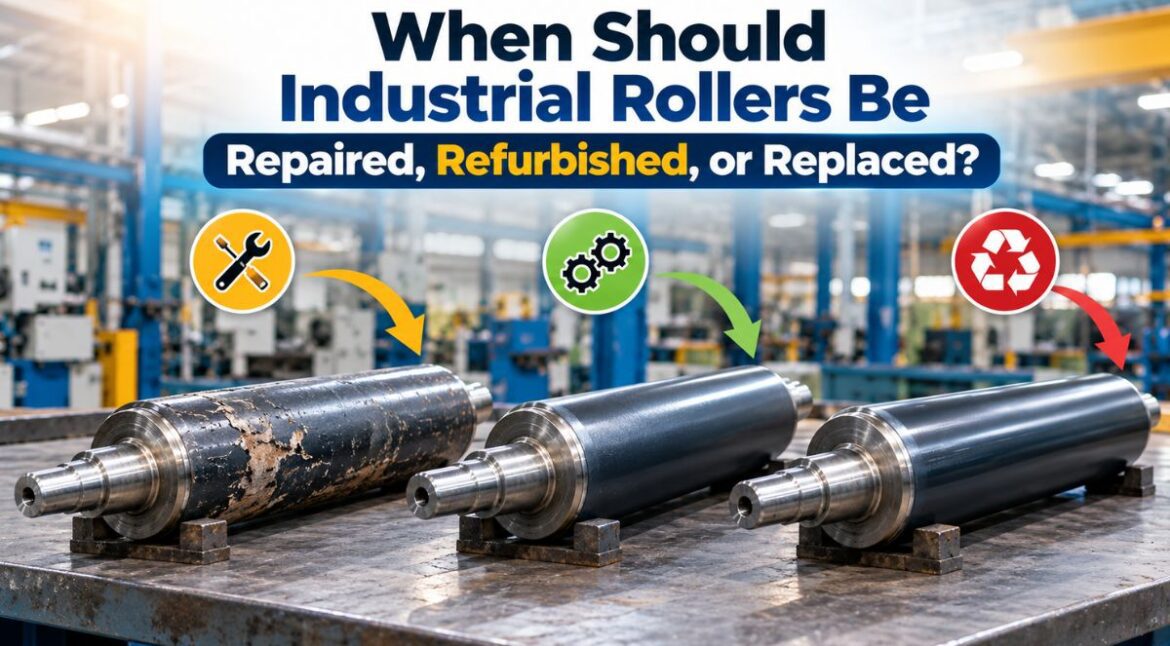
When Should Industrial Rollers Be Repaired, Refurbished, or Replaced?
In continuous manufacturing operations—whether processing flexible packaging, converting paper, extruding plastic films, printing, or handling textiles—industrial rollers are critical mechanical components. A single failing roller can compromise web tension, induce material wrinkling, disrupt coating uniformity, or cause sudden line stoppages.
When a roller shows signs of surface wear, core damage, or mechanical vibration, operations teams face a critical financial and technical choice: Should you repair the roller, undertake full refurbishing, or purchase a brand-new replacement?
Making the wrong decision can lead to unnecessary capital expenditure or, conversely, repeated line shutdowns caused by temporary fixes applied to fundamentally compromised equipment. This guide provides plant managers, maintenance engineers, and purchasing heads with a structured framework to evaluate worn industrial rollers accurately, assess total cost of ownership (TCO), and select the right restoration path.
Understanding the Terminology: Repair vs. Refurbishing vs. Replacement
In industrial maintenance, terms like “repair,” “refurbishing,” and “reconditioning” are often used interchangeably. However, from an engineering and cost perspective, they represent distinct scopes of work.
  [ INITIAL ROLLER DIAGNOSTIC ]
                    |
      +-------------+-------------+
      |                           |
[ Localized Harm? ]       [ Extensive Wear / Failure? ]
      |                           |
      v                           v
  REPAIR                  REFURBISHING / RECONDITIONING
(Localized Fix)          (Core Stripping, Resurfacing, Dynamic Balancing)
1. Industrial Roller Repair (Localized Corrective Maintenance)
Industrial roller repair addresses localized, non-structural defects while preserving the majority of the roller’s existing surface and internal mechanical structure.
- Typical Scope: Repairing minor journal damage, replacing worn bearings, repairing local surface nicks, or re-machining a keyway.
- Best Suited For: Minor operational issues where the core structural integrity and primary coating remain intact.
- Turnaround: Fast (often within 24 to 48 hours depending on scope).
2. Industrial Roller Refurbishing & Reconditioning
Industrial roller refurbishing (or reconditioning) is a total restoration process. It returns a severely worn or degraded roller to its original manufacturing tolerances and performance standards.
- Typical Scope: Complete stripping of worn rubber, polyurethane, or chrome coatings; non-destructive testing (NDT) of the steel or iron core; journal repair/sleeving; re-application of protective or functional coatings; precision cylindrical grinding; and dynamic balancing.
- Best Suited For: Heavy surface wear, coating delamination, corrosion, or operational age where the underlying core remains dimensionally sound.
- Turnaround: Moderate (typically 5 to 10 working days, depending on coating specifications).
3. Roller Replacement (New Fabrication)
Replacement involves fabricating a completely new roller assembly—including raw material sourcing, heavy machining, specialized core construction, coating, grinding, and testing.
- Typical Scope: End-to-end manufacturing based on OEM drawings or reverse engineering.
- Best Suited For: Structurally cracked cores, severe journal fracture, irrecoverable bow or sag, thermal fatigue in internal shells, or process engineering upgrades.
- Turnaround: Longer lead times (often weeks, depending on material availability and machining complexity).
Need Custom Industrial Rollers?
✓ Custom Diameter & Length
✓ Temperature Control Design
✓ Fast Manufacturing
✓ Technical Support
4-Step Technical Assessment Framework
Before deciding on a course of action, your engineering team should conduct a systematic evaluation using the following four steps.
+-----------------------------------------------------------------+
| STEP 1: Core & Journal Integrity Analysis                       |
| Check runout, crack inspection (NDT), journal wear, keyways     |
+-----------------------------------------------------------------+
                                |
                                v
+-----------------------------------------------------------------+
| STEP 2: Surface & Coating Condition Assessment                  |
| Hardness check (Shore A/D), bonding/delamination, pitting       |
+-----------------------------------------------------------------+
                                |
                                v
+-----------------------------------------------------------------+
| STEP 3: Operational Requirements & Line Speed Alignment          |
| Operating speed, temperature, web tension, chemistry            |
+-----------------------------------------------------------------+
                                |
                                v
+-----------------------------------------------------------------+
| STEP 4: Total Cost of Ownership (TCO) Calculation               |
| direct repair cost vs. new fabrication vs. downtime risk        |
+-----------------------------------------------------------------+
Step 1: Core and Journal Integrity Analysis
The underlying metallic structure determines whether restoration is technically viable.
- Dimensional Runout Check: Mount the roller on precision V-blocks or a lathe and measure Radial Runout (TIR) along the body and journal bearing seats using a dial indicator. Excessive runout indicates a bent shaft or distorted shell.
- Journal Inspection: Check bearing journals for grooving, fretting corrosion, or undersized dimensions caused by bearing inner-ring spinning.
- Structural NDT: For high-load application rollers (such as calendar rollers or nip rolls), perform magnetic particle testing (MPT) or dye penetrant testing (DPT) around journal-to-flange weld joints to rule out fatigue cracking.
Engineering Rule of Thumb: If the main structural shell exhibits severe permanent deformation, circumferential stress cracking, or internal wall thinning (in hollow rolls), repair or refurbishing is rarely viable. Replacement is recommended.
Step 2: Surface & Coating Condition Assessment
The condition of the outer functional layer dictates whether local repair or full recoating is necessary.
- Hardness Profile: Measure surface hardness across multiple axial points using a Shore durometer (for rubber/polyurethane) or a portable hardness tester (for chrome/metallic coatings). Hardness variations indicate chemical attack, thermal degradation, or uneven wear.
- Bonding and Delamination: Inspect rubber-to-metal or polyurethane-to-metal interfaces for localized debonding or blisters caused by fluid ingress or high nip pressures.
- Surface Defects: Identify deep scores, corrosion pitting, impact dents, or wear patterns (such as center wear or edge grooving).
Step 3: Operating Environment & Process Demands
Match the roller’s current condition against process conditions:
- Operating Speed: High-speed converting lines require strict dynamic balancing tolerances (ISO 1940 Grade G2.5 or G6.3).
- Chemical Exposure: Solvents, inks, acids, or plasticizers soften or embrittle coatings over time, requiring updated compound selection during refurbishing.
- Thermal Cycles: Heating or cooling rollers (such as double-shell cooling rolls) require clear internal passages free of corrosion build-up or hydraulic restriction.
Step 4: Total Cost of Ownership (TCO) Calculation
Compare options using total financial impact, not just upfront invoice cost:
Total Cost = Service or Fabrication Cost + Downtime Cost During Lead Time + Risk-Adjusted Cost of Potential Failure
In many cases, refurbishing an existing heavy-duty core yields performance equivalent to a new roller at 40% to 60% of the capital cost, with significantly reduced lead times.
When to Choose Repair vs. Refurbish vs. Replace
Condition Observed | Recommended Action | Engineering Justification |
Localized bearing journal wear; shell & coating intact | Local Repair | Journal can be built up via thermal spray, sleeving, or precision machining without disturbing the body coating. |
Minor surface nick or shallow scratch on rubber roll | Local Repair / Regrind | Localized filling or light precision cylindrical regrinding restores geometric profile if wall thickness allows. |
Worn rubber/polyurethane, uneven diameter, surface oxidation | Refurbishing | Core remains sound. Stripping old material, applying a new elastomer compound, grinding, and balancing restores original specifications. |
Pitted, scratched, or worn hard chrome coating | Refurbishing | Chemical stripping, grinding, core inspection, re-chroming, and superfinishing restores mirror surface finishes (Ra < 0.05 μm) |
Fractured journal weld, cracked body shell, severe core bow | Replacement | Structural failure compromises safety and mechanical integrity; repair carries a high risk of catastrophic line failure. |
Internal flow passage blockage or thin walls on cooling rolls | Replacement | Internal corrosion compromises heat transfer efficiency and pressure safety limits. |
Industry-Specific Decision Matrix
1. Flexible Packaging & Plastic Film Extrusion
- Common Applications: Corona treater rolls, nip rollers, slitter-rewinder rolls, silicone pressure rolls.
- Key Challenge: Chemical exposure, high temperatures, surface scarring from film edges or cutting blades.
- Recommendation: High-tension silicone or specialized rubber rolls with edge-grooving should be refurbished as soon as durometer drift exceeds ± 5 Shore A to prevent film tracking errors and uneven tension.
2. Printing & Paper Converting
- Common Applications: Anilox base rolls, impression cylinders, dampening rolls, guide rollers.
- Key Challenge: Precise surface geometry, concentricity, and corrosion control.
- Recommendation: Impression cylinders with light surface scratching can often undergo surface polish and local repair. However, if concentricity tolerances exceed 0.01 mm full refurbishing (re-machining, re-chroming, precision grinding) is mandatory to prevent print registration errors.
3. Textile Processing
- Common Applications: Squeezing rollers, dyeing mangles, padded rolls, guide rollers.
- Key Challenge: Chemical bath resistance, high nip pressures, uneven center-to-edge squeezing.
- Recommendation: Rubber-covered squeeze rollers suffering from “crown wear” (where the center wears faster than the ends) require full refurbishing, including crown profile grinding to ensure uniform liquor extraction.
4. Industrial Material Handling & Web Handling
- Common Applications: Drive rollers, idler rollers, tension rolls.
- Key Challenge: High wear, mechanical impact, bearing failure.
- Recommendation: Standard idler rollers with damaged bearing journals are ideal candidates for journal repair or shaft replacement, preserving the main tube assembly.
Quality Assurance & Testing Standards in Roller Restoration
When sending a roller for repair or refurbishing, ensuring technical compliance requires strict quality control measures. Professional roller service facilities follow standardized inspection protocols:
+-----------------------------------------------------------------------+
| TYPICAL REFURBISHING QUALITY CONTROL PROTOCOL                         |
+-----------------------------------------------------------------------+
| 1. Incoming Inspection: Runout measurement, NDT core check            |
| 2. Core Preparation: Chemical stripping, grit blasting, bonding coat |
| 3. Vulcanization / Coating: Controlled curing process                 |
| 4. Precision Grinding: Cylindrical grinding to specified Ra & profile |
| 5. Dynamic Balancing: Balancing to ISO 1940 standard                  |
| 6. Final QC Documentation: Hardness, dimension, & runout report       |
+-----------------------------------------------------------------------+- Dynamic Balancing (ISO 1940): High-speed rollers must be dynamically balanced to Grade G2.5 or G6.3 to prevent vibration, premature bearing failure, and machine frame fatigue.
- Surface Finish Measurement ($Ra$): Hard chrome or specialized metal rolls must undergo surface profile analysis to ensure compliance with surface finish parameters (from matte to mirror finishes).
- Ultrasonic & Non-Destructive Testing: Core integrity checks verify that reused steel shells have no subsurface fatigue cracks or bonding defects.
- Hardness & Dimensional Certificates: Final quality checks record dimensional accuracy, TIR runout, and Shore hardness across the entire face length.
Evaluate Your Roller Assets with Siva Rollers
Deciding between repair, refurbishing, and replacement requires engineering clarity, precise measurement, and practical manufacturing expertise. Unnecessary replacements increase capital costs, while improper repairs risk unexpected production downtime.
Siva Rollers provides engineering evaluations and industrial roller services for plant operations across India and internationally. Whether you require localized journal repair, complete rubber/polyurethane recoating, precision cylindrical grinding, dynamic balancing, or custom roller fabrication, our team evaluates your equipment against your operational requirements.
Request a Technical Roller Assessment
If you are currently experiencing surface wear, vibration, coating degradation, or quality defects on your production line, contact our engineering team:
- Engineering Assessment: Send us your roller dimensions, operating parameters, and photographs of the current wear pattern.
- On-Site / Diagnostic Support: Discuss your application with our technical specialists to determine the most cost-effective restoration route.
Contact Siva Rollers today to schedule a technical evaluation for your industrial rollers.
FAQs
Industrial roller repair fixes localised defects, such as minor journal damage, worn bearings, or surface nicks. Refurbishing involves restoring a worn roller through coating removal, core inspection, recoating, precision grinding, and balancing. Replacement means manufacturing a new roller when the existing core is structurally damaged or cannot reliably meet operational requirements.
Choose repair when the roller core is structurally sound and the damage is limited to a specific area. Complete refurbishing is generally more suitable when the roller has extensive surface wear, coating delamination, corrosion, uneven diameter, or degraded rubber or polyurethane coating. A technical inspection helps determine the appropriate restoration method.
An industrial roller should be considered for replacement when it has a severely cracked core, fractured journal welds, irrecoverable bending or deformation, excessive internal wall thinning, or compromised internal passages that cannot be safely restored. Replacement may also be necessary when the existing design cannot meet updated production requirements or safety standards.
Industrial roller refurbishing can be more cost-effective when the existing core is structurally sound and suitable for reuse. It may reduce manufacturing costs, material consumption, and lead time compared with new fabrication. However, the final decision should consider restoration costs, expected service life, downtime, and the risk of future failure rather than the initial price alone.
Industrial roller repair may take 24–48 hours for straightforward jobs, while complete refurbishing may require approximately 5–10 working days, depending on the damage, coating requirements, machining, and testing. Manufacturing a new roller can take several weeks or longer, depending on material availability and design complexity. These are indicative timelines, not guaranteed turnaround periods.
Common warning signs include uneven surface wear, coating peeling, corrosion, scratches, abnormal vibration, bearing noise, excessive runout, roller diameter variation, and inconsistent material tracking. Wrinkling, uneven coating, print registration errors, or inconsistent fabric squeezing may also indicate a roller-related problem. A proper inspection is needed to identify the root cause.
A technical assessment should examine core and journal integrity, radial runout, surface condition, coating hardness, bonding or delamination, and dimensional accuracy. Non-destructive testing may be necessary to identify structural cracks. Operating speed, temperature, chemical exposure, web tension, and dynamic balancing requirements should also be considered before selecting a restoration method.
Yes, rubber-coated and polyurethane-coated rollers can often be refurbished when their underlying cores remain structurally suitable. The process may involve removing the worn coating, inspecting and preparing the core, applying a suitable replacement coating, and carrying out precision grinding and final quality checks. The coating material should be selected according to the application's operating conditions and chemical exposure.
A worn, damaged, or improperly balanced roller can contribute to material wrinkling, uneven web tension, poor surface finish, coating inconsistencies, vibration, and premature bearing wear. In printing, packaging, plastic film processing, and textile production, these problems can affect product quality and increase unplanned downtime. Regular inspection and timely restoration help maintain reliable machine operation.
SIVA ROLLERS (SIVA ENGINEERING WORKS), based in Ahmedabad, Gujarat, India, provides industrial roller manufacturing, repair, and restoration services. Depending on the roller's condition and application, services may include journal repair, recoating, precision cylindrical grinding, dynamic balancing, and custom roller fabrication. Buyers can contact the engineering team with roller dimensions, application details, operating conditions, and photographs of the damage to discuss a suitable solution.