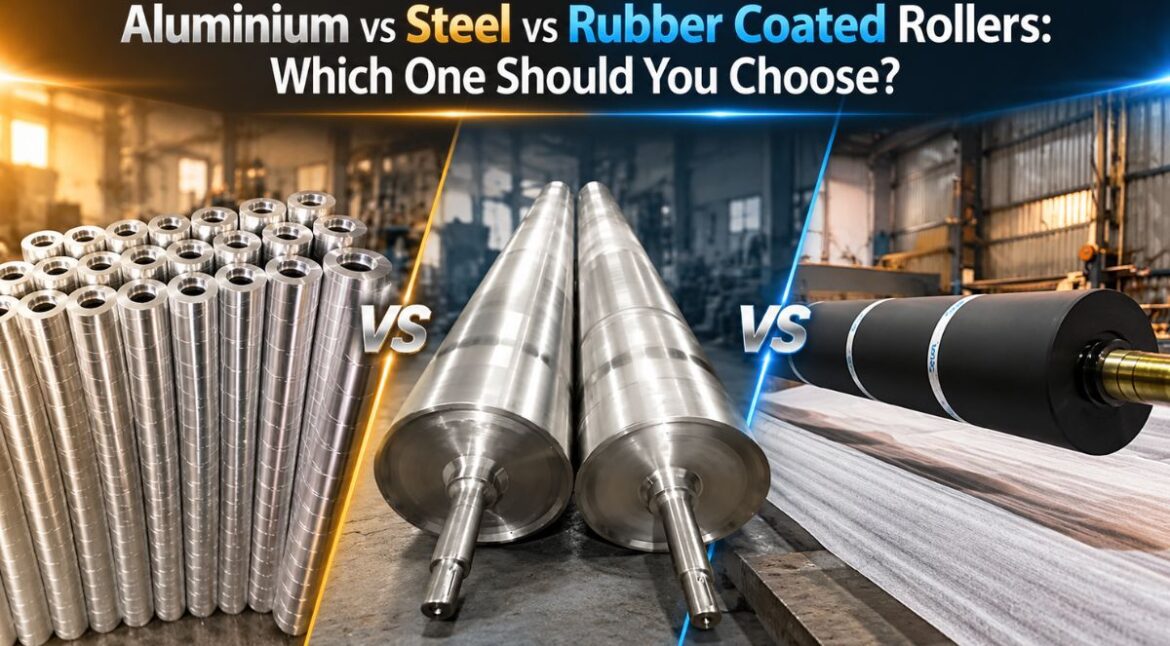
Aluminium vs Steel vs Rubber Coated Rollers: Which One Should You Choose?
Choosing the right industrial roller affects material handling, surface quality, machine performance and maintenance requirements. When comparing aluminium vs steel vs rubber coated rollers, the right choice depends on the material being processed, the operating environment, the required roller function and the demands of your production line.
For plant managers, maintenance heads, purchase managers and process engineers, the decision is not simply about choosing a metal or coating. A roller that works well in a textile processing line may not be suitable for a plastic film machine or a paper converting application.
Aluminium rollers are useful where low weight and web spreading are important. Steel rollers are suitable for applications requiring structural strength, while rubber coated rollers provide a compliant surface that can improve contact with the processed material.
This guide explains the differences between these three roller types, their common applications, their limitations and the practical factors to consider before placing an order.
What Is the Difference Between Aluminium, Steel and Rubber Coated Rollers?
Aluminium rollers are generally selected for their low weight, steel rollers for their structural strength, and rubber coated rollers for their surface grip and compliance. The correct option depends on the application rather than material choice alone.
Each roller type performs a different role in industrial machinery.
- Aluminium rollers: Suitable for applications where lower rotating mass, easier handling or web spreading is important.
- Steel rollers: Suitable for applications requiring a strong roller body, dimensional stability and compatibility with the machine’s operating conditions.
- Rubber coated rollers: Suitable for applications where surface contact, grip, cushioning or controlled interaction with the processed material is required.
It is also important to distinguish the roller core from its working surface. A rubber coated roller, for example, can have a metal core with a rubber covering. Its performance depends on both the core design and the properties of the coating.
Before choosing a roller, identify the job it must perform: guide material, spread a web, support a moving sheet, transfer heat or provide controlled surface contact.
Aluminium Rollers: When Should You Choose Them?
Choose an aluminium roller when lower roller weight, reduced rotating mass or web spreading is important to your process. Aluminium is particularly relevant in applications where the roller must guide or spread a moving web without adding unnecessary weight to the rotating assembly.
Key advantages of aluminium rollers
Aluminium is lighter than steel for an equivalent volume of material. Depending on the roller design, this can reduce rotating mass and make handling easier during installation or maintenance.
Other potential benefits include:
- Lower roller weight compared with a geometrically equivalent steel roller.
- Suitability for applications where reduced rotating mass is desirable.
- Potential use in web handling and material guiding systems.
- Application-specific designs for spreading wrinkles across moving films, fabrics or other flexible materials.
An aluminium roller must still be designed for the required load, operating speed, deflection limits and mounting arrangement. Low weight alone does not establish suitability.
Where are aluminium rollers commonly used?
Aluminium rollers can be considered for textile processing, plastic film handling, paper converting and other web-processing applications, depending on the machine design.
An aluminium spreader roller is a more specialised option. Its purpose is to help spread a moving web and reduce wrinkles as the material passes through a process.
For example, a production line handling flexible film may need a roller that helps control wrinkles before coating, printing or another downstream operation. The roller’s geometry and installation position must suit the material and process.
What should you check before selecting aluminium?
Aluminium is not automatically the right choice for every lightweight application. The roller must withstand the applied load and operating conditions without excessive bending or surface damage.
Check the required diameter, face length, mounting arrangement, operating speed, material contact and cleaning conditions. Also consider whether the application involves abrasion, heat or chemicals that could affect the roller’s suitability.
If your process requires web spreading, explore Siva Rollers’ aluminium spreader roller options.
Steel Rollers: When Is Steel the Better Choice?
Choose a steel roller when the application requires a strong roller body and the design must accommodate the machine’s operating loads and conditions. Steel rollers are used across industrial processing equipment, with the appropriate construction depending on the application.
Steel offers higher stiffness than aluminium for an equivalent geometry. This can be useful where roller deflection must be controlled, although actual performance depends on the material grade, wall thickness, diameter, unsupported span and loading.
Key advantages of steel rollers
Steel rollers can be designed for demanding industrial duties where the roller must support material, maintain alignment or form part of a processing system.
Potential advantages include:
- Structural strength for appropriately designed roller assemblies.
- Suitability for a range of industrial guiding and processing functions.
- Compatibility with application-specific surface treatments or coatings.
- Flexibility in roller design to meet different machine requirements.
Steel is not one uniform material category. Carbon steel, stainless steel and other steel grades have different properties and corrosion resistance. The material must be selected according to the operating environment.
Where are steel rollers commonly used?
Steel rollers are found in paper processing, printing, converting, textile machinery, plastic film lines and other industrial applications.
A stainless steel roller may be appropriate where the process requires corrosion resistance or frequent cleaning, depending on the stainless steel grade and the chemicals involved.
For material guiding applications, Siva Rollers offers stainless steel guide rollers. These can be considered when selecting a roller for a suitable guiding position in an industrial machine.
What are the limitations of steel rollers?
Steel is heavier than aluminium for the same volume. A steel roller may therefore increase rotating mass, which matters in applications involving frequent acceleration, deceleration or handling.
Steel can also corrode when the material grade and surface protection are unsuitable for the environment. Surface finish, alignment, balance and maintenance remain important regardless of the roller material.
Before choosing steel, evaluate the applied load, roller span, required surface condition, operating speed, exposure to moisture or chemicals and the effect of roller weight on the machine.
Rubber Coated Rollers: When Do You Need a Coated Surface?
Choose a rubber coated roller when the process requires a compliant contact surface, suitable grip or cushioning between the roller and the processed material. Its suitability depends on the coating properties, core design and operating conditions.
Unlike an uncoated metal roller, a rubber coated roller has an outer layer selected for the intended contact with the material. This layer changes how the roller interacts with the web, sheet or other workpiece.
Key advantages of rubber coated rollers
A suitable rubber coating can help provide friction, improve contact and accommodate some surface irregularities. These characteristics can be valuable where a hard metal surface does not provide the required interaction with the processed material.
Potential benefits include:
- A contact surface with application-appropriate grip.
- Compliance compared with a rigid metal surface.
- Suitability for selected nip, feeding and material-contact applications.
- The option to restore a worn roller through suitable recoating or refurbishment when the core remains serviceable.
These benefits are not universal. The result depends on the coating formulation, hardness, thickness, surface finish, pressure, temperature and the material being processed.
Where are rubber coated rollers used?
Rubber coated rollers are used in selected printing, paper converting, textile processing, film handling and other material-contact applications.
For example, a roller that feeds or presses flexible material may need a surface that provides the required contact without causing unwanted marking or slippage. A properly selected coating can help meet that requirement.
However, the coating must match the actual duty. An unsuitable rubber compound may wear quickly, swell, harden or lose performance when exposed to incompatible chemicals, temperatures or cleaning agents.
What should you check before choosing a rubber coated roller?
Do not select a coating based only on the material name. Confirm the operating requirements and the type of contact the roller will experience.
Discuss the following with your roller supplier:
- The material contacting the roller.
- Operating temperature and exposure to chemicals or cleaning agents.
- Required grip and acceptable marking on the material.
- Contact pressure and operating speed.
- Expected wear and maintenance requirements.
- Core condition if the roller is being recoated.
Siva Rollers provides rubber coating and roller refurbishment services for suitable applications. Review the rubber coated rollers range to discuss the requirements of your machine.
Aluminium vs Steel vs Rubber Coated Rollers: Side-by-Side Comparison
Aluminium is often considered for lightweight roller duties, steel for structural requirements, and rubber coated rollers for controlled surface contact. Use the comparison below as an initial screening guide, then confirm the final choice against your machine’s operating conditions.
Selection factor | Aluminium roller | Steel roller | Rubber coated roller |
Main selection reason | Lower weight | Structural strength | Compliant contact surface |
Relative weight | Generally lower than steel for equivalent volume | Generally higher than aluminium for equivalent volume | Depends on core and coating |
Surface contact | Depends on finish and design | Depends on finish and treatment | Depends on coating properties |
Web spreading | Suitable in application-specific designs | Depends on roller design | Depends on roller design and coating |
Load suitability | Must be checked against deflection and strength requirements | Must be checked against design and operating loads | Depends on core, coating and load |
Chemical resistance | Depends on alloy and environment | Depends on grade and surface protection | Depends on coating compound |
Wear considerations | Depends on surface and material contact | Depends on surface finish and material grade | Depends on coating formulation and duty |
Maintenance | Inspect for wear, damage and alignment | Inspect for wear, corrosion and alignment | Inspect for coating wear, damage and adhesion |
Typical decision priority | Reduce rotating mass | Meet structural requirements | Achieve suitable grip or cushioning |
One important point: rubber coated rollers are not directly comparable with aluminium and steel as a core material. Rubber coating describes the roller’s working surface, while aluminium and steel describe the body material.
A rubber coated roller may itself use a metal core. Therefore, the final selection may involve choosing both a core material and a suitable surface coating.
How to Choose an Industrial Roller for Your Application
To choose an industrial roller, start with its function, the material being processed, the operating conditions and the required surface performance. Then confirm the roller’s dimensions, construction and maintenance needs with the manufacturer.
Comparing material names alone can lead to an unsuitable selection. Use these practical questions to narrow down your options.
Step 1: Identify the roller’s job
First, determine what the roller needs to do in the machine.
Is it guiding a web, spreading wrinkles, supporting a moving sheet, transferring heat or providing grip at a contact point?
The intended function is the starting point because different roller duties require different designs.
Step 2: Understand the material being processed
The roller must be compatible with the material that contacts it.
Paper, fabric, plastic film and other flexible materials can have different requirements for surface finish, friction, pressure and marking. A roller suitable for one material may not perform as expected with another.
Describe the material and any known handling issues to the supplier.
Step 3: Review operating conditions
Consider the actual working environment rather than assuming that one material is suitable for every production line.
Important factors include operating temperature, speed, load, chemical exposure, cleaning practices and the possibility of abrasion.
For heated processing equipment, roller material and construction must also suit the required thermal duty.
Step 4: Check the surface requirements
Determine whether the roller needs a bare metal surface, a particular finish or a coating.
If the process needs a compliant contact surface, a suitable rubber coating may be appropriate. If the roller is intended to spread a flexible web, an application-specific spreader roller may be a better fit.
For heated or cooled processes, evaluate a dedicated heat transfer roller rather than selecting a roller based on core material alone.
Step 5: Confirm dimensions and mechanical requirements
Provide the manufacturer with the required roller diameter, face length, shaft or journal details, mounting arrangement and relevant machine drawings.
Where available, share the operating speed, applied load and existing roller details. These inputs help the manufacturer assess whether the proposed construction is suitable.
Do not assume that a larger diameter, heavier roller or harder surface is automatically better. The design must suit the complete machine and process.
Step 6: Consider maintenance and total operating cost
The initial purchase price is only one part of the decision. Service life, cleaning, inspection, recoating possibilities and the consequences of an unexpected shutdown can also affect the overall cost.
If an existing roller has developed surface wear or damage, assess its core condition before deciding whether to repair, recoat or replace it.
Suitable rollers may be candidates for repair, recoating or refurbishment, depending on the condition of the core and the type of damage.
Common Roller Selection Mistakes to Avoid
The most common roller selection mistakes are choosing by price alone, ignoring operating conditions and treating core material as the only performance factor. These mistakes can lead to unnecessary maintenance, material handling problems or an unsuitable replacement.
Avoid the following errors when purchasing an industrial roller.
Choosing aluminium only because it is lighter: Lower weight is useful in some applications, but strength, stiffness, wear resistance and surface requirements must also be considered.
Choosing steel for every heavy-duty application: Steel may be appropriate for structural demands, but the correct grade, geometry and surface finish still matter. Corrosion resistance must also match the environment.
Selecting rubber coating without checking compatibility: The coating must suit the material being processed, temperature, chemicals, pressure and operating speed.
Ignoring the roller’s actual function: A guide roller, spreader roller and heat transfer roller do not necessarily have the same design requirements, even when they operate on the same production line.
Replacing a roller without inspecting its core: Where the core remains suitable, recoating or refurbishment may be worth evaluating. If the core is damaged or unsuitable, replacement may be necessary.
Providing incomplete information during enquiry: Missing dimensions, application details or operating conditions can make it difficult to recommend a suitable design. Share the information available and identify any details that still need to be confirmed.
Which Roller Should You Choose for Your Industry?
The right roller for your industry depends on the production task, material contact and machine conditions. Use the following examples as a starting point rather than as a universal material specification.
Industry or application | Roller option to evaluate | Main consideration |
Textile processing | Aluminium, steel or rubber coated rollers | Fabric handling, surface marking and process conditions |
Plastic and film processing | Aluminium spreader or suitable coated rollers | Wrinkle control, web handling and surface contact |
Paper converting | Steel or suitable rubber coated rollers | Web guidance, contact requirements and wear |
Printing | Suitable steel or rubber coated rollers | Surface finish, grip and material transfer requirements |
Rubber processing | Application-specific steel or coated rollers | Process temperature, contact and chemical compatibility |
Packaging and converting | Aluminium, steel or rubber coated rollers | Film or sheet handling and the function of each roller |
For textile and film applications, consider whether lower roller weight or wrinkle control is a priority. For printing and converting, examine the required contact surface and material handling behaviour. For demanding mechanical duties, assess structural requirements and roller deflection.
These examples do not replace application-specific engineering. The same industry can use several roller types across different stages of a production line.
Why Discuss Your Roller Requirements with Siva Rollers?
Siva Rollers (Siva Engineering Works), based in Vatva GIDC, Ahmedabad, Gujarat, India, offers custom roller manufacturing, selected roller coatings and roller repair services for industrial applications. Sharing your machine requirements helps establish which roller construction or service should be evaluated.
Depending on the application, Siva Rollers offers:
- Custom industrial roller manufacturing.
- Aluminium spreader rollers.
- Stainless steel guide rollers.
- Rubber, PU, ebonite and Teflon coated rollers.
- Heat transfer rollers.
- Roller repair, recoating and refurbishment.
The appropriate option depends on the roller’s intended function and operating conditions. Providing clear application details is the most practical way to begin the discussion.
When contacting the team, share the following information where available:
- Industry and machine application.
- Material being processed.
- Existing roller type and dimensions.
- Operating temperature and speed.
- Surface or handling problem that needs to be addressed.
- A photograph, drawing or relevant details of the existing roller.
- Whether you need a new roller, repair, recoating or refurbishment.
If you do not have every technical detail, start with the information available and explain the problem you are trying to solve.
To discuss your application, request a quote from Siva Rollers.
Aluminium vs Steel vs Rubber Coated Rollers
The right choice in aluminium vs steel vs rubber coated rollers depends on what the roller must do, the material it contacts and the conditions in which it operates.
Choose aluminium when lower weight or a suitable web-spreading design is important. Consider steel when structural strength and the demands of the machine are the priority. Choose a rubber coated roller when the process needs a suitable compliant surface, grip or cushioning.
Remember that rubber coating is a surface choice, while aluminium and steel describe core materials. A complete roller selection may require decisions about both the core and the working surface.
Before purchasing, confirm the roller’s function, dimensions, load, speed, temperature, material compatibility and maintenance requirements. This gives your supplier a clearer basis for evaluating the design.
If you are comparing roller options for a textile, paper, printing, plastic film or other industrial application, contact Siva Rollers (Siva Engineering Works), Ahmedabad, with your machine details to discuss a suitable roller or refurbishment option.
FAQs
Aluminium rollers are generally selected for their low weight, steel rollers for structural strength, and rubber coated rollers for their compliant contact surface and grip. The right choice depends on the machine application, operating conditions and material being processed.
Aluminium rollers are suitable when lower weight and reduced rotating mass are important. Steel rollers may be more suitable when the application requires greater structural strength or stiffness. The final choice depends on roller dimensions, load, operating speed and process requirements.
Aluminium rollers are used in selected textile, plastic film, paper converting and other web-handling applications. They can be useful where lower roller weight is desirable. Specialised aluminium spreader rollers are designed to help spread flexible webs and reduce wrinkles during processing.
Rubber coated rollers provide a compliant working surface that can offer suitable grip, cushioning and contact with processed materials. Their performance depends on the coating compound, hardness, operating temperature, chemical exposure and machine conditions.
A stainless steel roller may be suitable when corrosion resistance, cleaning requirements or the operating environment influence material selection. The appropriate stainless steel grade depends on the chemicals, moisture, temperature and other conditions to which the roller will be exposed.
The suitable roller depends on the textile process and its function. Aluminium rollers may be considered for selected web-handling applications, steel rollers for structural requirements, and rubber coated rollers where a suitable contact surface is needed. Operating temperature, fabric type and surface marking requirements should also be evaluated.
Aluminium spreader rollers can be suitable for selected plastic film processing applications where web spreading and wrinkle control are required. Their suitability depends on the film characteristics, roller design, installation position and operating conditions.
To choose an industrial roller, identify its function, the material being processed, operating speed, load, temperature, surface requirements and chemical exposure. Also confirm the roller dimensions and mounting arrangement. Sharing these details with an industrial roller manufacturer helps establish suitable options.
Rubber coated rollers may be suitable for recoating or refurbishment when the core remains serviceable and the damage can be addressed. The decision depends on core condition, coating wear, dimensional requirements and the intended application. An inspection helps determine whether repair or replacement is more appropriate.
Provide the application, industry, existing roller dimensions, material being processed, operating temperature, speed, load and required surface finish where available. A photograph, drawing or existing roller details can also help the manufacturer assess your requirements.
Siva Rollers (Siva Engineering Works) is based in Vatva GIDC, Ahmedabad, Gujarat, India, and offers rubber coated rollers along with other industrial roller manufacturing and coating services. Buyers can share their application details and roller requirements through the company's contact page to discuss a suitable option.
To request a quote from Siva Rollers (Siva Engineering Works), visit the contact page and provide your machine application, roller dimensions, operating conditions and required roller type. Include a drawing or photograph if available to help clarify your requirements.