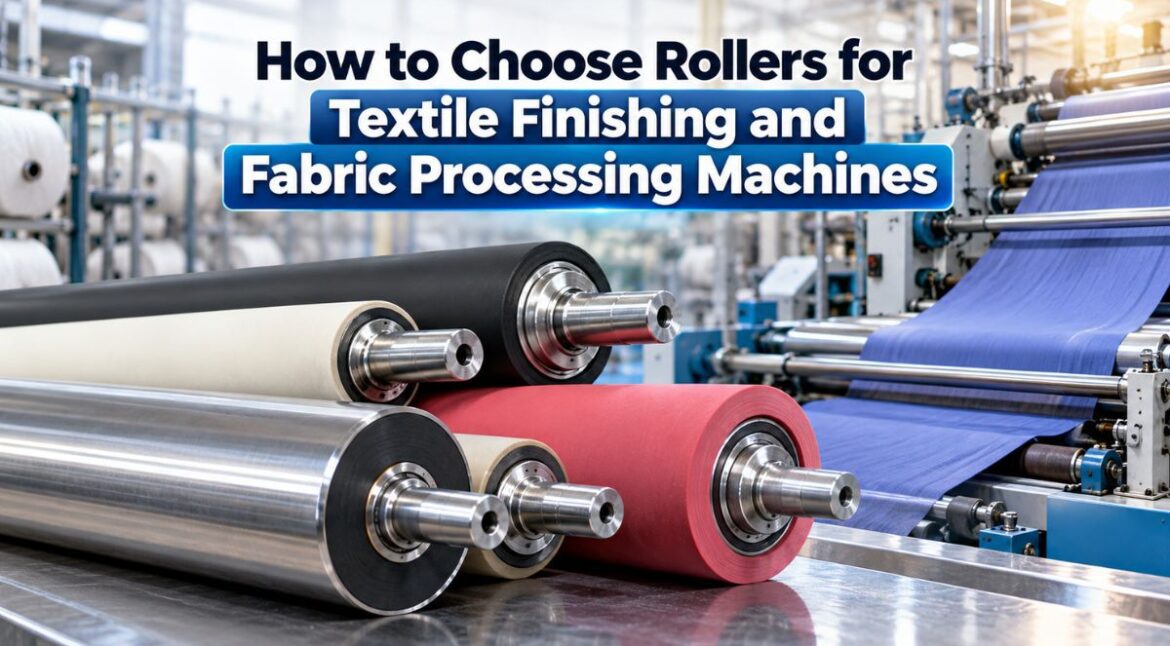
How to Choose Rollers for Textile Finishing and Fabric Processing Machines
In modern textile manufacturing, the quality of your finished fabric is heavily dictated by components that often operate behind the scenes. From scouring and bleaching ranges to high-speed stenter frames and continuous dyeing lines, industrial rollers are the silent workhorses of the mill. A minor deficiency in roller hardness, surface finish, dynamic balance, or chemical compatibility can quickly translate into costly production failures: uneven dye uptake, persistent edge-curling, stubborn crease marks, center-to-selvage shade variations, or premature mechanical wear.
For production engineers, plant heads, and industrial purchasing managers operating textile processing mills and finishing units across India and international markets, selecting the right roller is not merely a routine replacement task—it is a critical engineering decision.
As an established industrial roller manufacturer and service provider based in Ahmedabad, Gujarat, Siva Rollers partners with textile machinery manufacturers (OEMs), processing mills, and maintenance engineers to engineer, manufacture, and recondition application-specific rollers. This comprehensive selection guide explores how to evaluate your operational requirements, choose the ideal roller type for your exact machinery and chemical environment, and maximize operational uptime.
Understanding Your Textile Processing Environment
Before specifying a roller for a new machine installation or a maintenance replacement, you must analyze four core operational parameters:
- Chemical Exposure: Does the process involve harsh bleaching agents (such as hydrogen peroxide), caustic soda (sodium hydroxide) for mercerizing, acidic wash baths, or organic solvents? Choosing the wrong surface covering can lead to rapid polymer swelling, chemical leaching, or surface degradation.
- Thermal Conditions: Is the roller operating at ambient room temperature, or is it subjected to thermal stress in a drying range, cylinder dryer, or stenter machine operating between 90°C and 180°C?
- Mechanical Stress & Nip Pressure: What is the linear load (nip pressure) applied across the padding mangle? High pressures demand robust core construction, precise crown grinding, and high-density coverings to prevent deflection.
- Line Speed & Dynamic Stability: At high operating speeds, an unbalanced roller creates vibration harmonics that damage bearings, cause chatter marks on the fabric, and accelerate wear. Dynamic balancing is essential.
Key Roller Categories for Textile Finishing and Fabric Processing
Different stages of textile manufacturing require specialized surface characteristics. Below are the primary roller categories manufactured and supplied by Siva Rollers that are genuinely relevant to textile finishing and fabric processing lines.
1. Rubber-Coated Rollers
Rubber-coated rollers are the most widely deployed components across wet processing, washing ranges, and padding mangles. They provide the necessary friction, cushioning, and squeeze efficiency required to extract moisture or apply finishing chemicals uniformly.
- Primary Applications: Padding mangles, washing ranges, wet-on-wet application units, and squeezing stations.
- Selection Considerations:
- Compound Selection: Elastomers must be matched to your chemical bath. Standard synthetic rubbers work well for basic water transport, while specialized chemical-resistant polymers are required for aggressive bleaching and dyeing solutions.
- Durometer (Shore Hardness): The rubber hardness dictates the width of the nip contact area. Softer compounds offer a wider nip and higher conformance for liquid expression, while harder compounds maintain dimensional stability under heavy mechanical loading.
- Surface Profile: Precision grinding ensures uniform thickness across the entire face length, preventing localized pressure spikes that cause uneven dye pickup.
2. Expander / Bowed Rollers (Banana Rollers)
As fabric travels through wet processing, squeezing, and drying stages, it is prone to longitudinal creases, edge-curling, and slack areas. Expander rollers—commonly referred to as bow rollers or banana rollers—utilize a curved shaft design to stretch the fabric laterally from the center out toward the selvages, effectively eliminating wrinkles before entering critical processing zones.
- Primary Applications: Stenter machine entry frames, winding units, drying ranges, and wet processing intermediate spans.
- Selection Considerations:
- Bow Magnitude: The adjustable or fixed bow angle must be calibrated to the fabric weight, tension, and speed. Heavy cotton canvas requires different spreading geometry compared to lightweight synthetic knits or delicate silk filaments.
- Covering Material: Depending on the process stage, expander rollers can be supplied with rubber sleeves, metal surfaces, or specialized protective claddings that prevent fabric snagging while maintaining consistent lateral grip.
3. Chrome-Plated Rollers
Where high surface smoothness, corrosion protection, and wear resistance are paramount, hard chrome-plated rollers are the industry standard. Their ultra-smooth metallic finish ensures frictionless fabric transport and prevents fiber accumulation on the roller surface.
- Primary Applications: Fabric guiding systems, drying cylinders, calendar entry/exit spans, and printing machine guiding paths.
- Selection Considerations:
- Surface Finish (Ra Value): Mirror-finish chrome rollers are specified where absolute surface integrity is required, whereas matte or textured finishes may be selected for specific traction requirements.
- Plating Thickness & Bond Strength: High-quality hard chrome plating protects the underlying structural steel core from atmospheric moisture, steam, and mild chemical vapor, significantly reducing maintenance frequency.
4. Ebonite-Coated Rollers
For environments involving highly corrosive acids, concentrated bleaching agents, or aggressive chemical treatments, standard rubber covers can degrade rapidly. Ebonite (hard rubber formed through high-sulfur vulcanization) provides a rigid, chemically inert, and highly abrasion-resistant surface.
- Primary Applications: Acid carbonizing units, bleaching ranges, continuous dyeing padding baths, and aggressive chemical treatment tanks.
- Selection Considerations:
- Rigidity: Unlike soft elastomers, ebonite maintains a fixed, rigid geometry under continuous mechanical load, making it ideal for precision squeezing where deflection must be minimized.
- Chemical Inertness: Ebonite prevents chemical absorption, eliminating cross-contamination between successive dye batches and resisting swelling or softening.
5. Stainless Steel Guide and Cladding Rollers
Stainless steel rollers offer exceptional structural strength, rust resistance, and durability. They are utilized extensively where moisture and chemical vapors are continuously present.
- Primary Applications: Fabric inspection tables, wet transport spans, washing boxes, and guiding frameworks.
- Selection Considerations:
- Solid vs. Cladded Construction: Depending on the roller diameter and load requirements, mills can choose solid stainless steel construction or cost-effective stainless steel cladding over a precision-balanced carbon steel core.
- Weld Integrity & Polishing: Surface seams must be precision-welded and mirror-polished to ensure zero snagging of delicate yarn structures.
6. Calender and Heat Transfer Rollers
The final “hand feel,” gloss, and surface smoothness of finished textiles are determined in the calendering and heat-setting stages. These specialized rollers require precise thermal management and mechanical load handling.
- Primary Applications: Calendering machines, embossing units, and stenter drying zones.
- Selection Considerations:
- Thermal Uniformity: Heat transfer rollers often feature internal spiral baffling or double-jacketed channels to ensure even heat distribution across the entire face width, eliminating center-to-selvage temperature gradients.
- Dimensional Stability: Must withstand high operating temperatures without warping or losing dynamic balance.
When to Choose Roller Recoating vs. Purchasing a New Roller
Maintenance managers frequently face the dilemma of whether to replace an entire roller assembly or opt for professional roller recoating and reconditioning. Evaluating your core condition can yield significant cost savings:
- Evaluate the Core: Inspect the internal steel or cast iron journal for fatigue cracks, shaft deflection, or bearing journal wear. If the structural core remains sound and dynamically stable, recoating the worn outer shell (rubber, ebonite, or polyurethane) is a highly cost-effective alternative.
- Assess the Wear Cycles: High-performance rollers can often undergo multiple recoating and regrinding cycles. Partnering with an experienced roller manufacturer in Ahmedabad ensures that stripped cores are properly prepared, bonded, and precision-ground to original equipment specifications.
Common Textile Production Issues Solved by the Right Rollers
Production Problem | Root Cause | Recommended Solution |
Persistent Fabric Wrinkles & Creases | Uneven web tension, improper spreading geometry. | Install precision-calibrated Expander Bow Rollers at machine entry points. |
Uneven Dye Uptake / Patchy Squeeze | Inconsistent roller durometer or core deflection under nip load. | Upgrade to uniform-hardness Rubber-Coated Rollers or rigid Ebonite Rollers with proper crown correction. |
Chemical Swelling & Surface Softening | Incompatible elastomer compound reacting with bleach or caustic soda. | Specify chemical-resistant Ebonite or specialized polymer-coated rollers matched to bath chemistry. |
High-Speed Vibration & Bearing Wear | Dynamic imbalance or poor shaft machining. | Ensure all rollers undergo rigorous dynamic balancing before installation. |
Why Textile Mills Across India Trust Siva Rollers
Selecting an experienced manufacturing partner makes all the difference in minimizing mill downtime. Based in Ahmedabad, Gujarat—a major industrial and textile machinery hub—Siva Rollers combines technical expertise with robust manufacturing capabilities:
- Tailored Compound Formulation: We formulate rubber and polymer compounds specifically engineered to resist textile chemicals, dyes, and operating heat.
- Precision Machining & Balancing: Every roller is statically and dynamically balanced to eliminate vibration at high operating speeds.
- Comprehensive Portfolio: From standard padding rubber rollers and banana bow rollers to chrome-plated and ebonite-coated rollers, we cover your complete processing line.
- PAN-India Delivery & Refurbishing Support: Fast turnaround on new manufacturing and recoating services to keep your plant running smoothly.
Consult Our Technical Team
Are you experiencing fabric wrinkles, uneven squeezing, chemical breakdown, or frequent roller wear in your textile processing line? Let our technical specialists help you select or customize the right roller for your exact machine speed, fabric type, and chemical environment.
- For Maintenance & Production Engineers: Contact our technical engineering team for custom roller solutions engineered to eliminate vibration, prevent creases, and optimize squeeze performance.
- For Purchasing Managers: Request a fast quote for new or recoated textile rollers with dependable PAN-India delivery from our Ahmedabad manufacturing facility.
FAQs
Choose a roller based on its application, fabric type, operating temperature, chemical exposure, nip pressure, line speed, and required surface finish. Rubber-coated rollers are commonly used for squeezing and padding, expander rollers help control fabric wrinkles, and stainless steel or chrome-plated rollers are suitable for specific guiding and surface-contact applications. Always match the roller construction to your machine's operating conditions.
Commonly used industrial rollers include rubber-coated rollers, expander or bow rollers, hard chrome-plated rollers, ebonite-coated rollers, stainless steel guide rollers, stainless steel cladding rollers, calender rollers, and heat transfer rollers. The appropriate type depends on whether the process involves fabric guiding, moisture extraction, wrinkle removal, chemical treatment, calendering, or heat transfer.
An expander roller, also called a bow roller or banana roller, is commonly used to spread fabric laterally and reduce wrinkles before it enters downstream processing equipment. Its effectiveness depends on the bow configuration, fabric characteristics, web tension, roller surface, and machine alignment. Correct installation and adjustment are important for consistent fabric spreading.
Rubber-coated rollers provide friction, surface compliance, and contact pressure for applications such as padding, washing, and moisture extraction. The rubber compound and hardness should be selected according to the fabric, process chemicals, temperature, and nip load. An unsuitable covering or uneven roller surface can contribute to inconsistent squeezing and fabric-processing defects.
Ebonite-coated rollers may be suitable for textile processes that require a hard rubber surface and resistance to particular chemicals. However, compatibility depends on the actual chemical concentration, temperature, exposure duration, and operating conditions. Textile manufacturers should verify chemical compatibility before selecting ebonite for bleaching, dyeing, or other chemical-treatment applications.
Chrome-plated rollers typically use a metallic base with a hard chrome surface designed to provide wear resistance and a controlled surface finish. Stainless steel rollers use stainless steel for the roller body or contact surface, offering corrosion resistance depending on the grade and environment. The choice depends on moisture exposure, chemical conditions, surface-finish requirements, wear, and maintenance needs.
The correct roller can help maintain consistent fabric contact, pressure, alignment, and material movement. In padding and squeezing operations, uniform roller hardness, surface condition, and appropriate nip loading are important. However, uneven dyeing can also result from chemical preparation, bath conditions, fabric properties, or machine settings, so the complete process should be inspected before replacing a roller.
Recoating may be a practical option when the roller core, shaft, and bearing journals remain structurally suitable for reuse. The decision should consider core damage, corrosion, runout, alignment, existing coating condition, and the feasibility of restoring the required dimensions and surface finish. If the core is cracked, severely damaged, or unsuitable for the application, replacing the roller may be the better option.
Proper roller balancing helps reduce vibration caused by mass imbalance during rotation. Excessive vibration can contribute to bearing wear, unstable fabric movement, surface marks, and increased maintenance requirements. The required balancing method and acceptance criteria should be determined according to the roller design, operating speed, and machine manufacturer's requirements.
Siva Rollers (Siva Engineering Works), based in Vatva GIDC, Ahmedabad, Gujarat, India, manufactures industrial rollers and provides roller repairing and maintenance services. Textile manufacturers, OEMs, and maintenance teams can enquire about suitable roller solutions, including rubber-coated rollers, expander rollers, hard chrome-plated rollers, ebonite-coated rollers, and stainless steel rollers, according to their application requirements.