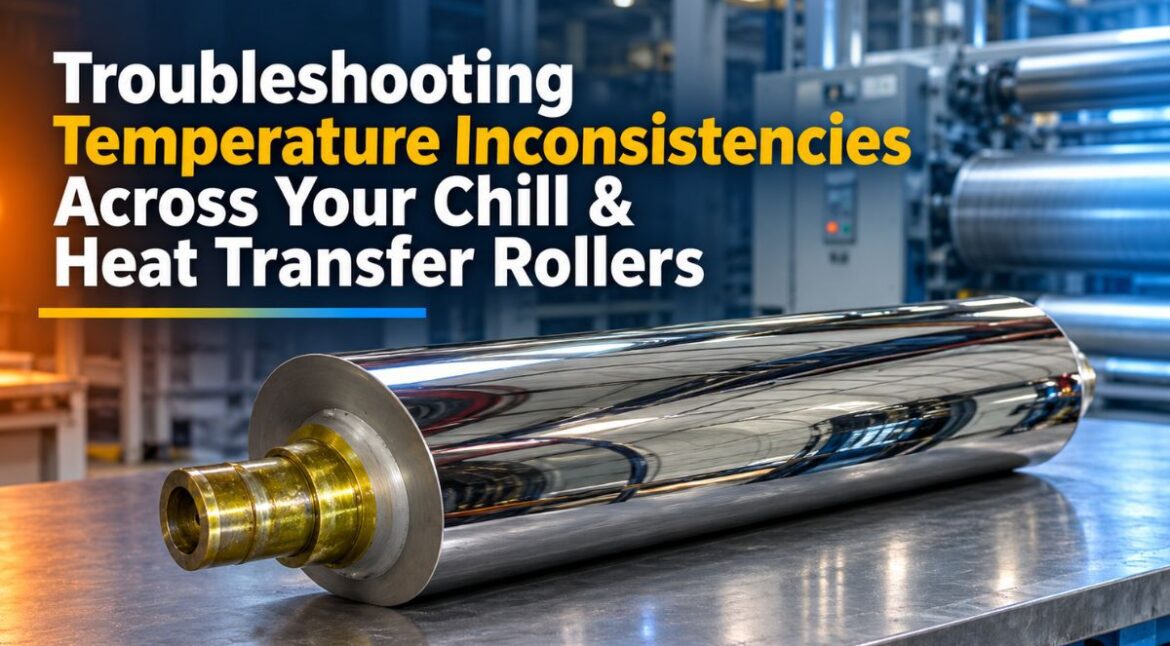
Troubleshooting Temperature Inconsistencies Across Your Chill & Heat Transfer Rollers
In high-precision manufacturing processes—whether film extrusion, paper conversion, textile finishing, or laminating—temperature control is the invisible force behind product quality. When heat transfer rollers or chill rolls perform seamlessly, your production line achieves consistent gauge, crisp lamination, perfect surface finishes, and optimal web tension.
However, when temperature inconsistencies creep across the surface of your rollers, operational efficiency plummets. A deviation of just a few degrees across the face of a roll can cause uneven film orientation, blistering, caliper variation, poor adhesive bonding, and excessive material scrap. Worse still, persistent thermal variation forces operators to run machines at reduced speeds, directly undercutting profitability.
If your plant is currently battling hot spots, cold edges, or unpredictable thermal drift, this troubleshooting guide offers practical, action-oriented strategies to diagnose the root causes, resolve equipment issues, and optimize thermal performance without drowning in overly complex technical jargon.
The True Cost of Temperature Variations in Roll-to-Roll Processes
Temperature variance across a roller surface—often referred to as non-uniform thermal profile—is rarely an isolated equipment glitch. It directly impacts your bottom line across four main operational areas:
- High Material Scrap Rates: Inconsistent heating or cooling leads to uneven web shrinkage, warping, gauge variation, and poor coating adhesion. Scrap material mounts quickly, consuming margin on every shift.
- Reduced Line Speed: When thermal balance is unreliable, operators often compensate by slowing down the entire process line to give materials more dwell time. This workaround hides the underlying fault while sacrificing daily output throughput.
- Premature Roller & Bearing Wear: Thermal stresses caused by localized hotspots or cold zones create uneven mechanical expansion. Over time, this accelerates wear on roller journals, seals, rotary joints, and bearing assemblies.
- Customer Complaints and Returns: Products with uneven thickness, poor lamination strength, or inconsistent gloss levels slip past visual inspections, resulting in costly customer rejections and damaged reputation.
To eliminate these issues, we must look beyond basic external symptoms and systematically inspect the key components controlling heat transfer.
Step 1: Diagnosing External vs. Internal Root Causes
Before disassembling machinery or adjusting fluid flow settings, start with a structured diagnostic approach to categorize whether the thermal imbalance originates internally within the fluid circulation system or externally from environment and setup conditions.
Diagnostic Matrix: Symptoms vs. Probable Causes
Observed Symptom | Primary Suspect Area | Key Action Area |
Cold Edges / Hot Center | Fluid velocity & baffle layout | Inspect fluid flow rates and internal channel scaling |
Hot Edges / Cold Center | Web contact width mismatch | Adjust web alignment or verify roll length matching |
Random Hot/Cold Spots | Internal scale buildup / Air pockets | Flush system, purge trapped air, check fluid chemistry |
Gradual Temperature Drift | TCU heater/chiller drift or worn rotary joint | Calibrate sensors, check control valves and rotary seals |
One Side Hot, One Side Cold | Axial flow restriction / Single pass channel | Inspect internal siphon tubes and flow direction |
Step 2: Internal Fluid Dynamics and Maintenance Checklist
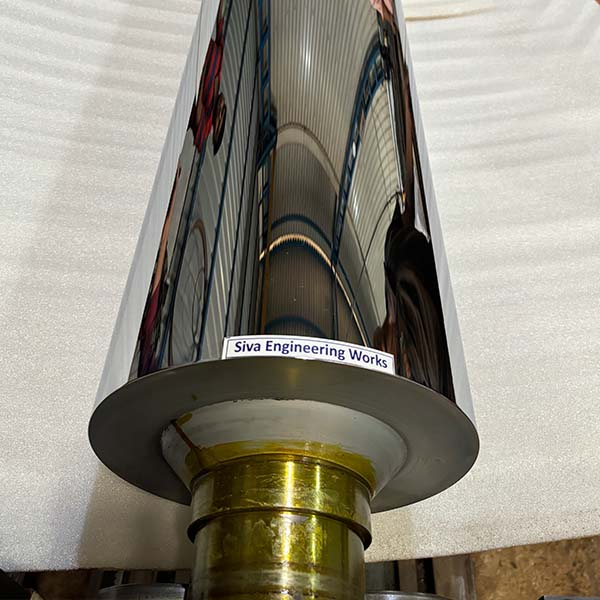
The vast majority of thermal inconsistencies in chill & heat transfer rollers and heating rollers originate inside the shell where heat transfer fluid (water, glycol, or thermal oil) circulates.
1. Air Trapping and Incomplete Purging
Air pockets act as insulation barriers. When air collects at the upper pockets of a spiral baffle or double-shell roll cavity, fluid cannot touch the inner metal wall, creating persistent cool or warm zones.
- Troubleshooting Action: Ensure your system includes high-point automatic air vent valves. Run high-velocity priming flushes after maintenance to purge trapped air prior to bringing the roll to target operating temperature.
2. Mineral Scale Buildup and Fluid Contamination
Thermal transfer efficiency depends on clean metal surfaces inside internal fluid passages. Water-cooled chill rolls are especially prone to scale, iron deposits, and biological fouling, which act as thermal insulators.
- Troubleshooting Action: Perform chemical flushes during planned maintenance turnarounds. Inspect fluid clarity and conductivity, maintaining proper water treatment to prevent scaling on internal spiral channels.
3. Worn Internal Baffles and Fluid Short-Circuits
In double-shell, spiral-baffled rollers, the heating or cooling medium must travel along a designed path to ensure equal fluid distribution across the face. If internal welds corrode or inner baffle seals wear down, fluid bypasses the outer path via the route of least resistance.
- Troubleshooting Action: If temperature drop across the roll face is severe despite high pump pressure, schedule an internal borescopic inspection or dynamic pressure drop test to confirm channel integrity.
4. Rotary Joint and Siphon Pipe Failures
Rotary joints handle fluid entry and return. If internal siphon tubes loosen, bend, or break, return fluid stalls inside the roll core, creating fluid stagnation.
- Troubleshooting Action: Inspect rotary joint wear indicators monthly. Check return line temperatures—a sudden drop in return differential often points to siphon pipe failure or seal bypass inside the joint.
Need Custom Industrial Rollers?
✓ Custom Diameter & Length
✓ Temperature Control Design
✓ Fast Manufacturing
✓ Technical Support
Step 3: Mechanical and External Process Factors
In many cases, the internal fluid system works as intended, but external mechanical variables degrade heat transfer uniformity.
1. Inconsistent Web Contact and Tension
Heat transfer relies on direct physical contact between the substrate and the roller surface. If web tension across the roll face is uneven, contact pressure varies, leading to uneven heat exchange.
- Troubleshooting Action: Check web alignment, nip roll parallelism, and tension control sensors. Verify that substrate nip pressures are uniform from drive side to operator side.
2. Surface Finish and Roll Shell Wear
A roll surface that is worn, pitted, or unevenly oxidized will not transfer heat uniformly. Additionally, localized buildup of resins, waxes, or adhesive residues reduces thermal conductivity in specific zones.
- Troubleshooting Action: Clean roller surfaces regularly with non-abrasive, approved cleaning agents. Inspect surface roughness ($Ra$) periodically, as uneven surface polish directly affects thermal contact resistance.
3. Ambient Drafts and External Air Movement
Industrial environments often feature high-velocity air movement from overhead HVAC blowers, cooling fans, or nearby plant doors. Unshielded rollers experience localized convective cooling on exposed areas.
- Troubleshooting Action: Install physical thermal shields or draft guards around sensitive heat transfer zones to isolate the process roll from room air currents.
Step 4: Temperature Control Unit (TCU) Calibration
Your roller is only as accurate as the Temperature Control Unit (TCU) feeding it. Sensor errors or misconfigured PID loops frequently mimic internal roller failures.
Key Inspection Steps for the TCU:
- Sensor Placement & Calibration: Ensure temperature sensors (RTDs or thermocouples) in the supply and return lines are properly calibrated and seated deep in the fluid stream—not sensing ambient pipe temperatures.
- Flow Rate vs. Temperature Delta (Δ T) : Measure the differential temperature ( Δ T )between fluid entering and leaving the roll. As a general rule, a high flow rate with a small Δ T (1°C to 2°C/2°F to 1°F) provides far superior face uniformity than low flow rates with large temperature drops.
- Pump Performance: Confirm that circulating pumps operate on their designed performance curve. Declining flow velocity lowers turbulent flow inside internal channels, shifting the heat transfer regime into inefficient laminar flow.
Proven Strategies for Long-Term Thermal Uniformity
To shift your maintenance strategy from reactive troubleshooting to proactive reliability, adopt these industry-proven operational practices:
1. Transition to High-Velocity Spiral Channel Designs
Older single-shell or open-cavity rolls struggle to maintain even face temperatures at modern production speeds. Upgrading to precision-engineered double-shell spiral-baffled rollers ensures continuous turbulent flow, delivering strict face uniformity (often within ± 0.5°C).
2. Implement Routine Thermal Imaging Audits
Infrared (IR) thermal cameras provide immediate visual confirmation of surface temperature distribution while production is running. Periodic thermal audits catch emerging hot spots, cold edges, or channel clogs weeks before they result in material defects.
3. Establish Water Quality Control Standards
For chill rolls and water-heated rollers, implement closed-loop fluid treatment. Monitoring pH, hard water minerals, and rust inhibitors prevents internal scaling and maintains maximum thermal conductivity over years of continuous operation.
Maximize Line Efficiency with High-Performance Roller Solutions
Eliminating thermal inconsistencies requires the right combination of diagnostic discipline, routine maintenance, and precision-engineered roll hardware. Standard off-the-shelf rollers often fall short when pushed under demanding industrial production requirements.
If your plant is experiencing persistent temperature variations, frequent scrap rate spikes, or productivity bottlenecks, our engineering team can help. We specialize in designing and manufacturing custom chill rolls and heat transfer rollers equipped with advanced internal fluid dynamics for unmatched thermal uniformity.
Ready to Optimize Your Thermal Performance?
- Request a Thermal Profile Audit: Speak directly with our technical engineers to evaluate your current setup.
- Custom Engineering Support: Learn how our double-shell spiral roll designs can increase your line speeds and eliminate scrap.
- Get a Fast Quote: Send us your process specifications, and we will tailor an optimal heat transfer solution for your production facility.
Contact Our Thermal Roller Specialists Today
Upgrade Your Plant Efficiency Today
FAQs
Chill and heat transfer rollers experience uneven temperature distribution due to trapped air, internal scale buildup, restricted fluid circulation, worn internal baffles, rotary joint problems, or inconsistent web contact. These issues prevent uniform heat exchange across the roller surface and can result in hot spots, cold edges, and inconsistent product quality.
Hot spots and cold edges commonly occur when cooling fluid does not circulate evenly through the roller's internal channels. Air pockets, mineral deposits, incorrect fluid flow rates, and internal channel restrictions can create temperature differences across the roller face. Checking fluid circulation and internal passages can help identify the cause.
Trapped air inside a heat transfer roller creates insulating pockets that prevent the circulating fluid from contacting the internal metal surface properly. This reduces heat transfer efficiency and creates localized temperature variations. Proper air venting and high-velocity flushing after maintenance help remove trapped air.
Yes. Mineral scale, rust deposits, and biological fouling can accumulate inside the fluid passages of chill rollers. These deposits act as insulating layers, reducing heat transfer efficiency and restricting fluid circulation. Regular fluid-quality monitoring, water treatment, and planned chemical flushing help prevent this problem.
One side of a heat transfer roller may become hotter because of axial fluid flow restrictions, blocked internal passages, damaged siphon tubes, or an unsuitable internal flow arrangement. Inspecting fluid inlet and outlet conditions, siphon pipe integrity, and internal circulation can help identify the source of the temperature imbalance.
Incorrect or uneven web tension changes the contact pressure between the material and roller surface. Areas with poor contact may experience less effective heat exchange, resulting in inconsistent cooling or heating. Checking web alignment, nip roll parallelism, and tension control helps maintain uniform contact across the roller face.
Rotary joints allow heating or cooling fluid to enter and exit a rotating roller. Their condition directly affects fluid circulation and thermal performance. Worn seals, leakage, or damaged internal connections can interrupt fluid movement and create temperature inconsistencies. Regular inspection helps prevent unexpected production problems.
Infrared thermal imaging cameras can identify hot spots, cold edges, and uneven temperature distribution across an industrial roller surface. Thermal imaging audits allow maintenance teams to monitor temperature patterns during production and detect potential problems before they cause significant material defects.
A Temperature Control Unit regulates the heating or cooling fluid supplied to the roller. Incorrect sensor readings, poor calibration, unstable control valves, and pump performance issues can cause temperature fluctuations. Proper TCU calibration and monitoring of supply and return temperatures help maintain consistent thermal conditions.
Double-shell spiral cooling rollers use an internal flow arrangement designed to distribute heating or cooling fluid across the roller face. This helps improve heat transfer uniformity and reduce temperature variations compared with less effective internal circulation arrangements. They are useful in applications where consistent web cooling and temperature control are important.
Chill and heat transfer rollers should be inspected according to production conditions, operating hours, fluid quality, and manufacturer recommendations. Routine checks should include roller surface condition, fluid circulation, rotary joints, seals, temperature sensors, and internal deposits. Preventive maintenance helps reduce unexpected downtime and maintain production consistency.
Choose a manufacturer with experience in industrial roller manufacturing, custom roller design, internal fluid circulation arrangements, and roller repair and maintenance. Consider your application, heating or cooling requirements, production conditions, and existing machine setup. SIVA ROLLERS (SIVA ENGINEERING WORKS) manufactures industrial rollers and provides solutions for chill and heat transfer applications. Contact the team to discuss your roller requirements and request a quotation.