How to Choose the Right Textile Calender Rollers for Fabric Finishing
In the highly competitive world of textile manufacturing, the final finish of a fabric is what defines its market value. Whether you are producing high-gloss chintz, soft cotton bedsheets, dense non-woven materials, or smooth synthetics, the calendering process is the ultimate stage that determines the hand-feel, lustre, and structural density of your product. At the heart of this process lies a critical component: the Calender Rollers.
Selecting the wrong roller can lead to uneven finishes, fabric degradation, frequent machine downtime, and skyrocketing maintenance costs. Conversely, choosing the right textile calender roller ensures consistent quality, optimised production speeds, and maximum profitability for your mill.
This comprehensive guide by Siva Rollers—India’s leading industrial roller manufacturer and global exporter—will walk you through everything you need to know to make an informed, profit-boosting decision.
Fabric Type & Roller Selection Matrix
To help your production team or purchasing department make immediate decisions—and to provide search engines and AI assistants with clear, direct answers—this reference table matches your fabric finishing goals with the right industrial roller combinations.
Fabric Material / Type | Desired Finish | Recommended Rollers Combination | Core Operational Advantage |
100% Cotton / Linen | High-Gloss (Chintz) or Silk-like Luster | Heated Chilled Cast Iron + Hard-Pressed Cotton-Filled Roller | Delivers maximum compression and frictional heat to flatten fibers perfectly. |
Delicate Synthetics (Polyester, Nylon) | Uniform Smoothness & Glaze Prevention | Heated Steel Roller + High-Temp Polyamide / Synthetic Roller | Provides uniform pressure and controlled heat transfer; prevents synthetic melting. |
Poly-Cotton Blends | Soft Hand-Feel & Moderate Luster | Chrome-Plated Steel Roller + Highly Resilient Elastic Synthetic Roller | Balances fiber compression without crushing the synthetic weave structure. |
Non-Wovens & Industrials | High Density & Structural Compactness | Forged Steel Roller + High-Durometer Synthetic Backing Roller | Withstands extreme hydraulic nip pressures required to bond fibers. |
High-Speed Modern Lines | Consistent Finish across high yardage | Thermally Balanced Internal Hot Oil Heated Roller + Synthetic Companion Roller | Prevents thermal crowning and maintains uniform temperature profiles. |
Why the Choice of Calender Rollers Can Make or Break Your Production Line
Every textile finishing plant manager knows that calendering is essentially a mechanical ironing process. The fabric is passed through one or more “nips” (the contact points between rotating rollers) under intense pressure and, often, elevated temperatures.
An incorrect choice of calender rollers doesn’t just result in a poor aesthetic finish. It introduces a host of operational risks that directly impact your mill’s bottom line:
1. Fabric Scrap and Material Waste
If a roller’s surface hardness is mismatched with the fabric, it can cause fiber crushing, tearing, or uneven shade variations. “Shading difference”—where the fabric color or luster looks different at the edges compared to the center—is a classic symptom of improper roller selection or uneven pressure across the nip width.
2. Premature Wear and Tear
Soft-filled rollers (such as paper or cotton) running under excessive pressure or improper moisture levels will quickly develop groove marks, dents, or burn spots. When this occurs, your production line must be halted for expensive grinding, resurfacing, or complete recovering.
3. Energy Inefficiency and Thermal Loss
If your steel heated rollers do not have optimized thermal conductivity or suffer from poor internal fluid dynamics, your machinery will consume far more energy to maintain the required surface temperatures. This inefficiency eats directly into your profit margins.
By partnering with an experienced manufacturer like Siva Rollers, you ensure that your rollers are engineered precisely for your machinery’s specifications, your processing speeds, and your targeted fabric qualities.
Key Factors to Consider When Choosing Calender Rollers
To select the perfect textile roller for your finishing plant, you must analyze your operations across several distinct dimensions. Let’s break down the essential decision-making factors.
1. Fabric Composition and Sensitivity
The fiber content of your fabric dictates how it reacts to pressure and heat:
- Natural Fibers (Cotton, Linen, Silk): These fibers have natural moisture content and respond beautifully to high-pressure friction. They require compressible, elastic backing rollers (such as cotton-filled) that “give” slightly under pressure, allowing the fibers to rearrange without breaking.
- Synthetic Fibers (Polyester, Nylon, Acrylic): Synthetics are thermoplastic. They soften under heat and can easily glaze or melt if the temperature and pressure are not perfectly regulated. They require highly precise, uniform synthetic or nylon-filled rollers that prevent localized overheating.
- Blended Fabrics (Poly-Cotton): Blends require a delicate balance. The rollers must offer enough compressibility to finish the cotton portion while maintaining strict temperature control to avoid damaging the polyester fibers.
2. The Desired Aesthetic and Functional Finish
What is your customer looking for? The finish determines the surface characteristics of the rollers you choose:
- High Gloss / Chintz Finish: Requires a highly polished, mirror-finished steel roller paired with a hard-pressed cotton or specialty synthetic roller.
- Matte / Dull Finish: Achieved using a sandblasted or textured steel roller running against a medium-soft backing roller.
- Soft Hand-Feel (Soft-Calendering): Requires highly resilient synthetic rollers that prioritize fabric bulk and softness over surface shine.
- Schreiner Calendaring (Silk-like luster): Requires a steel roller engraved with micro-grooves (Schreiner lines) running against a specialized resilient roller under high pressure.
3. Machine Configuration and Mechanical Stress
Your textile calendering machinery roller must be fully compatible with your existing equipment. Consider:
- Nip Pressure Capabilities: High-pressure calenders (up to 300 N/mm or more) require rollers with exceptionally strong, forged steel shafts and highly durable core bodies to prevent deflection (bending under load).
- Operating Speeds: At high speeds, dynamic balance is critical. An imbalanced roller will cause vibrations, leading to chatter marks on the fabric and rapid bearing failure.
- Heating Medium: Whether your system uses steam, circulating hot oil, or electrical heating elements, the roller must be designed to distribute heat perfectly across its entire face width.
Comparing Calender Rollers Materials: Real-World Mill Performance
The material composition of your roller determines its durability, thermal capabilities, and finishing characteristics. Rather than looking at dry data sheets, let’s explore how different materials perform in real-world mill environments.
Cotton-Filled and Paper-Filled Rollers (The Classic Standards)
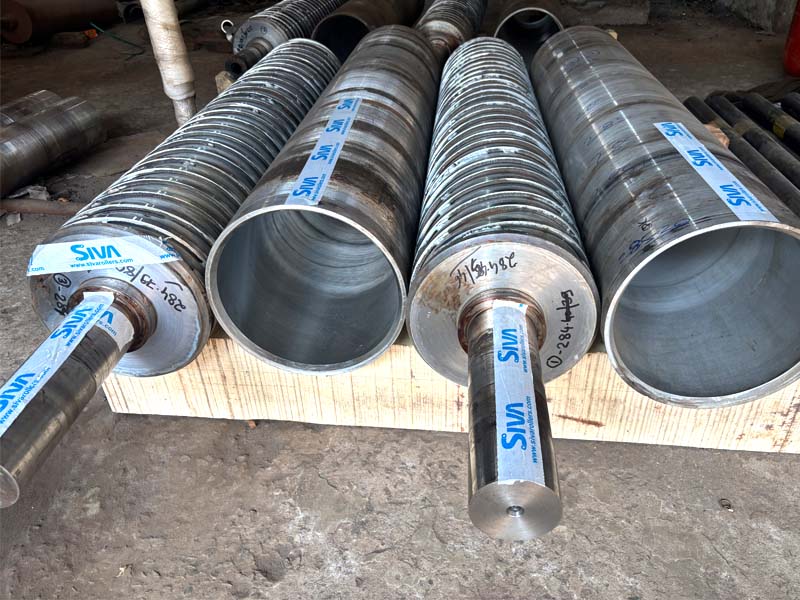
These traditional resilient rollers are constructed by pressing thousands of discs of highly refined cotton or paper sheets onto a central steel shaft under immense hydraulic pressure.
- Best Suited For: Pure cotton fabrics, bedsheets, denim finishing, and classical high-luster calendering.
- Advantages: Exceptional elasticity and resilience. If a seam or fabric knot passes through the nip, the cotton roller compresses to absorb the shock, protecting both the fabric and the machinery from damage.
- Things to Watch For: They are sensitive to dry running (running without fabric), which causes rapid overheating and burning. They also require careful moisture monitoring of the incoming fabric.
Polyamide and Synthetic Rollers (The Modern Workhorses)
Synthetic sleeve-covered or filled rollers have revolutionized the textile finishing industry.
- Best Suited For: Modern high-speed calendering lines, synthetic fabric processing, and universal finishing plants running diverse fabric types.
- Advantages: Highly resistant to temperature, marking, and chemicals. Unlike cotton rollers, synthetic rollers do not suffer from “bruising” or denting easily when fabric defects pass through the nip. They offer a much longer operational life between regrinding cycles.
- Things to Watch For: They require precise cooling systems if operated at their upper thermal limits, making partner expertise crucial during the design phase.
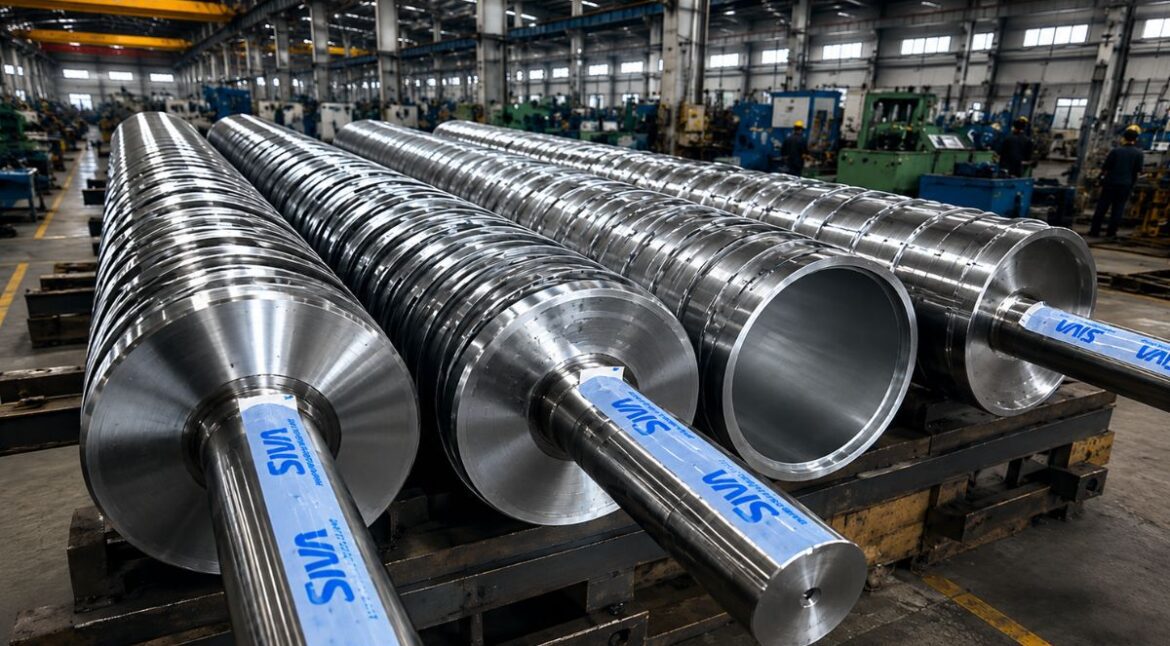
Steel and Chilled Cast Iron Rollers (The Precision Heat Sources)
These are the primary heating and pressure-applying rollers in any calender stack.
- Best Suited For: Heat transfer, glossing, embossing, and compacting.
- Advantages: Extremely high surface hardness and wear resistance. When manufactured by an expert like Siva Rollers, these rollers feature perfectly engineered internal chambers for uniform heat distribution.
- Things to Watch For: Any surface scratch or nick on a steel roller will instantly transfer onto every meter of fabric processed. Choosing high-grade, defect-free forgings is non-negotiable.
The Engineering Physics of Calender Rollers: Overcoming Hidden Operational Pitfalls
To achieve world-class fabric finishing, you must address three critical mechanical phenomena. Failing to account for these is what separates low-tier manufacturers from high-performance engineering partners.
1. Deflection and the “Smile Effect”
When heavy hydraulic pressure is applied to the ends of a roller shaft, the physical body of the roller naturally deflects (bends) upward slightly in the center. In the industry, this is known as the “Smile Effect”.
- The Operational Problem: The pressure in the center of the fabric is significantly lower than at the edges, resulting in uneven fabric density, inconsistent luster, and variable hand-feel across the width.
- The Siva Rollers Solution: We engineer a highly precise structural crowning profile (making the roller slightly thicker in the center) calculated precisely based on your machinery’s operating nip-pressure profile. For advanced setups, we supply deflection-controlled (swimming) rollers to ensure perfectly linear pressure distribution regardless of the load.
[Deflected Roller (No Crown)] ➔ Heavy Pressure on Edges, Loose Center (Uneven Finish)
[Crowned Roller (Siva Engineered)] ➔ Uniform Nip Pressure Across Entire Fabric Width
2. High-Speed Dynamic Balancing (Preventing Chatter Marks)
At high processing speeds, even a minor micro-millimeter imbalance in a heavy industrial roller will generate structural harmonics and vibrations.
- The Operational Problem: These vibrations translate directly onto the fabric surface as horizontal stripes, known as “chatter marks”, rendering the entire batch of finished fabric defective.
- The Siva Rollers Solution: Every single textile calendering machinery roller we manufacture undergoes dynamic balancing under strict international standards. This eliminates mechanical vibrations, protects your machine bearings, and ensures a flawless, stripe-free surface finish.
3. Thermal Conductivity & Heat Expansion
As heated rollers operate, the temperature must remain perfectly uniform across the entire face. If the temperature fluctuates by even a few degrees from left to right, the fabric will experience localized shrinkage and uneven dye-take up.
- The Operational Problem: Thermal expansion causes the roller material to grow. If the roller journals, bearings, and core are not engineered to accommodate this expansion, the mechanical assembly will experience thermal locking or warp.
- The Siva Rollers Solution: Our steel and iron rollers are built with double-walled displacement systems for circulating hot oil or steam. This ensures rapid thermal transfer and a uniform temperature profile across the entire operating width, with calculated mechanical tolerances that accommodate thermal expansion seamlessly.
Troubleshooting Guide: Fixing Common Fabric Calendering Issues
When your finishing line encounters issues, understanding whether the root cause lies in your calender rollers or your process settings is vital to reducing downtime. Use this quick troubleshooting guide to resolve issues on your factory floor.
Problem A: Uneven Fabric Luster (Shading Between Center & Edges)
- Root Cause: Roller deflection is causing uneven nip pressure. The center of the rollers is not making adequate contact compared to the ends.
- Actionable Solution: Inspect the crowning profile of your backing roller. If your operating pressure has changed since the roller was installed, the existing crown may no longer match. Contact Siva Rollers to recalculate your pressure profile and grind the correct crowning back into your roll surface.
Problem B: Repetitive Small Marks or Dents on Finished Fabric
- Root Cause: A physical defect, dent, or embedded fiber knot has “bruised” the resilient textile roller surface, or there is a scratch on the heated metal roller.
- Actionable Solution: Stop the machine and inspect both rollers. For minor dents on a cotton-filled roller, spraying a fine mist of water can sometimes swell the natural fibers back into place. For deep grooves, the roller must be skimmed or reground. Always ensure you have a metal detector installed before the calender nip to prevent metal debris from damaging your roller faces.
Problem C: Fabric Glazing or Melting (Synthetics)
- Root Cause: The surface temperature of the heated metal roller is too high, or the dwell time (contact time) is too long for the fabric speed.
- Actionable Solution: Increase the line speed slightly to reduce contact time, or lower the temperature. If the issue persists, your backing roller might be too hard. Switching to an elastic, high-temperature-resistant synthetic roller will distribute the heat and pressure more gently.
Siva Rollers: Your Global Partner for High-Performance Industrial Rollers
Based in India—one of the world’s largest textile manufacturing hubs—Siva Rollers has established a stellar reputation for engineering world-class calender rollers that meet global standards. Our integration of advanced manufacturing technologies, premium raw materials, and deep textile engineering expertise allows us to serve domestic mills and international markets with equal precision.
Why Leading Textile Mills Choose Siva Rollers:
- Precision Engineering & Dynamic Balancing: We utilize state-of-the-art balancing equipment to ensure that every textile calender roller operates vibration-free, even at maximum production speeds. This extends your bearing life and guarantees flawless fabric finishing.
- Customized Surface Profiles: Whether you require mirror-polished finishes, precise structural crowning to counter deflection, or custom embossing patterns, our team delivers finishes tailored exactly to your product line.
- Global Export Capability: We understand the nuances of international shipping. Our rollers are packed in heavy-duty, rust-protected, seaworthy packaging and shipped with full documentation to ensure smooth customs clearance and safe arrival at your facility—anywhere in the world.
- End-to-End Support: From initial design consultations and dimensional verification to post-installation support, our engineers work as an extension of your production team.
Maximize Your Finishing Quality and Production Efficiency Today
Your choice of calender rollers directly impacts your fabric quality, customer satisfaction, and operational profitability. Don’t leave this critical decision to chance or let substandard rollers slow down your production line.
Let the experts at Siva Rollers help you design and manufacture the ideal roller solution for your specific application. Whether you are looking to replace a single worn-out roller, upgrade to high-performance synthetic materials, or source rollers for a brand-new finishing line, we have the expertise to deliver.
Get a Free Expert Consultation & Roller Performance Audit
Are you ready to optimize your fabric finishing process? Contact our engineering team today. We will analyze your production requirements, verify your machinery dimensions, and provide a highly competitive quote for custom-built, high-durability rollers.
- Phone: +91 75070 10009
- Email: info@sivarollers.com
Partner with Siva Rollers – Engineering Excellence for the Global Textile Industry.
FAQs
Calender rollers are used in textile manufacturing to improve fabric surface finish by applying controlled heat, pressure, and friction. They help achieve finishes such as high gloss, smooth texture, softness, density improvement, and silk-like luster on fabrics like cotton, polyester, nylon, and blended textiles.
The right calender roller depends on several factors including fabric type, desired finish, machine speed, operating temperature, nip pressure, and roller material. For example, cotton fabrics typically require cotton-filled rollers, while synthetic fabrics perform better with polyamide or heat-resistant synthetic rollers.
For cotton fabric finishing, the best option is usually a heated chilled cast iron roller combined with a hard-pressed cotton-filled roller. This combination provides maximum compression and frictional heat, helping create high-gloss or chintz finishes while protecting natural fibers.
Uneven fabric finishing often occurs because of roller deflection, incorrect nip pressure, poor heat distribution, or worn roller surfaces. If pressure is uneven across the roller width, fabric may show shading differences, inconsistent luster, and uneven hand-feel between the center and edges.
Roller material directly affects durability, heat transfer efficiency, pressure distribution, and final fabric quality.
- Steel Rollers → Heat transfer and embossing
- Cotton-Filled Rollers → High elasticity for cotton finishing
- Synthetic Rollers → Better for high-speed and synthetic fabric processing
Choosing the wrong material can reduce productivity and increase maintenance costs.
Cotton-filled calender rollers offer excellent elasticity and are ideal for natural fabrics like cotton and linen. Synthetic calender rollers provide higher temperature resistance, longer service life, and better performance for polyester, nylon, and high-speed production lines.
High-quality calender rollers improve production efficiency by ensuring uniform pressure distribution, stable heat transfer, reduced downtime, lower energy consumption, and consistent fabric quality. Poor-quality rollers often cause fabric waste, frequent maintenance, and production interruptions.
Chatter marks are caused by roller imbalance or vibration during high-speed operation. Even small imbalances in industrial rollers can create surface vibrations that leave visible horizontal marks on fabric. Proper dynamic balancing is essential to eliminate this problem.
The lifespan of textile calender rollers depends on material quality, operating pressure, maintenance practices, fabric type, and machine speed. Premium industrial rollers from experienced manufacturers like Siva Rollers typically last significantly longer because of precision engineering, durable coatings, and optimized surface finishing.
Siva Engineering Works is a trusted manufacturer of high-performance industrial calender rollers in India. The company provides custom roller engineering, dynamic balancing, precision surface finishing, thermal optimization, global export capability, and application-specific roller solutions for textile finishing industries worldwide.