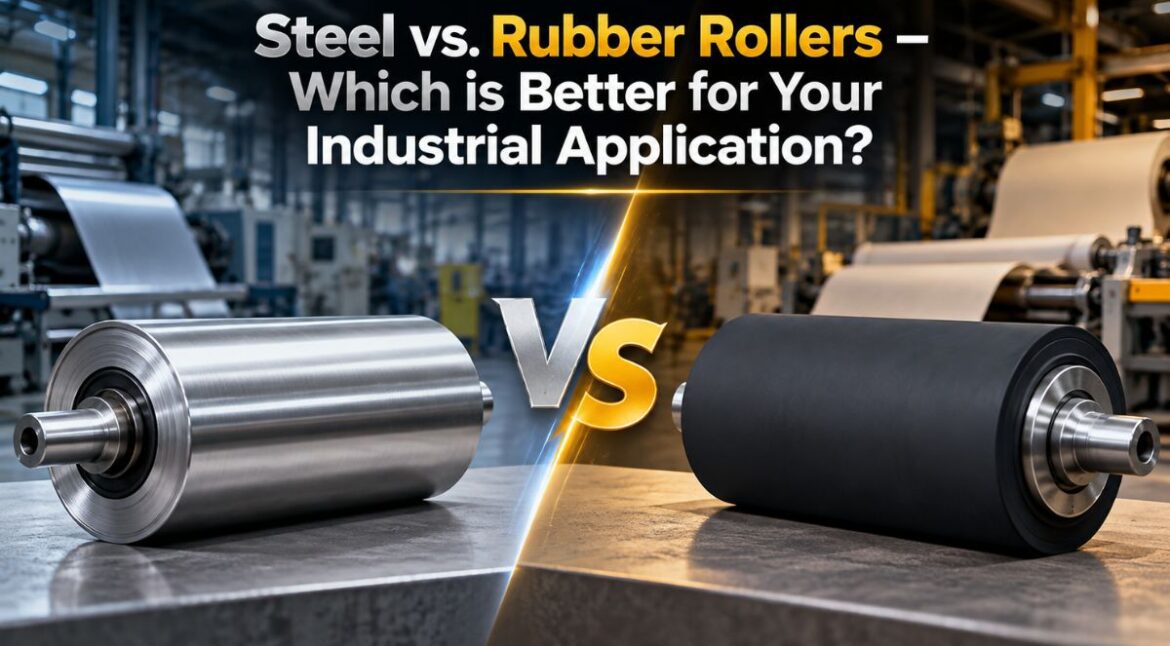
Steel vs. Rubber Rollers – Which is Better for Your Industrial Application?
When designing or maintaining an industrial manufacturing line, choosing the right roller material is one of the most critical engineering decisions you will make. A single wrong choice can lead to frequent production downtime, product surface damage, premature wear, and thousands of dollars in wasted operational costs.
Among the various materials available in the market today, Steel Rollers and Rubber Rollers dominate industrial applications across printing, packaging, textiles, steel processing, paper mills, and material handling. But when it comes down to choosing between the two: Steel vs. Rubber Rollers – which is better?
The short answer is: neither is universally superior; each excels in specific operating conditions. The real question is which roller is better suited for your specific process requirements, load capacities, speed, and material handling needs.
In this comprehensive guide, we will break down the structural differences, performance advantages, ideal applications, and a detailed head-to-head comparison between steel and rubber rollers. We will also reveal how Siva Rollers helps industrial leaders engineered custom hybrid solutions to achieve maximum efficiency and longevity.
Need Custom Industrial Rollers?
✓ Custom Diameter & Length
✓ Temperature Control Design
✓ Fast Manufacturing
✓ Technical Support
Understanding Steel Rollers: High Strength and Precision
Steel rollers are the heavy-duty workhorses of modern manufacturing. Manufactured from high-grade carbon steel, alloy steel, or stainless steel, these rollers are engineered for environments where extreme structural integrity, high thermal tolerance, and pin-point dimensional precision are mandatory.
Key Advantages of Steel Rollers
Unmatched Load Bearing Capacity
Steel rollers can endure immense pressure and heavy load weights without flexing, bending, or deforming. This makes them indispensable in heavy manufacturing plants.
Extreme Heat & Chemical Resistance
If your machinery operates in high-temperature environments (such as heat treating, hot rolling, or industrial drying ovens), steel rollers maintain their structural integrity where elastomers would melt or degrade.
High Surface Hardness and Abrasion Resistance
Hardened steel surfaces withstand abrasive materials, sharp edges, and continuous friction without developing grooves or surface depressions over time.
Exceptional Dimensional Stability
When your process requires microscopic precision—such as precision slitting, high-speed conveying, or micro-gauge laminating—steel rollers offer virtually zero deflection and mirror-like surface finishes (chrome plating, ground, or polished).
Typical Applications for Steel Rollers
- Heavy-duty material handling and mining conveyors
- Steel and metal strip processing lines
- High-temperature industrial heat-treating equipment
- High-precision guide rollers in web handling
- Primary calendering and crushing machinery
Understanding Rubber Rollers: Flexibility, Grip, and Protection
While steel rollers provide raw power and rigidity, Rubber Rollers (and rubber-coated rollers) provide flexibility, traction, and protection. Constructed by bonding synthetic or natural rubber compounds to a solid metal core, rubber rollers are designed to handle delicate substrate materials without scratching, marring, or slipping.
At Siva Rollers, specialized rubber compounds—including Nitrile (NBR), EPDM, Silicone, Polyurethane, and Neoprene—are custom-formulated to match exact industrial requirements.
Key Advantages of Rubber Rollers
- Superior Traction and Anti-Slip Performance
Rubber has a high coefficient of friction. It grips webs, films, papers, and fabrics firmly, preventing slippage and maintaining precise web tension during high-speed production.
- Substrate Protection
Delicate materials such as flexible packaging films, coated papers, printed textiles, and polished sheets require soft contact. The compressible surface of a rubber roller absorbs impact and prevents material damage.
- Compensation for Mechanical Tolerances
Because rubber flexes under load, it creates a uniform nip pressure across uneven web thicknesses, ensuring even liquid distribution in coating, squeegee, or dyeing processes.
- Corrosion & Chemical Protection
Specially formulated synthetic elastomers (like EPDM or Silicone) resist attack from aggressive inks, solvents, acids, and industrial chemicals that would quickly corrode raw steel.
Typical Applications for Rubber Rollers
- Printing presses (Flexographic, Gravure, Offset)
- Converting and flexible packaging machinery
- Textile dyeing, bleaching, and finishing lines
- Lamination and coating machines
- Squeegee and liquid extraction rollers
Direct Comparison: Steel Rollers vs. Rubber Rollers
To help you decide which material is best for your specific application, review this side-by-side performance comparison:
Performance Criterion | Steel Rollers | Rubber Rollers / Coated Rollers |
Load Capacity | Extremely High (Heavy industrial loads) | Moderate to High (Varies by durometer) |
Grip & Friction | Low (Requires high tension to avoid slip) | Very High (Prevents web slippage) |
Substrate Protection | Low (Risk of scratching soft surfaces) | Excellent (Protects delicate substrates) |
Temperature Resistance | Up to 500°C+ (Depending on alloy) | Up to 180°C – 250°C (Silicone/Specialty) |
Chemical Resistance | Susceptible to acid/corrosion (Unless stainless) | High resistance tailored by compound choice |
Nip Impression Uniformity | Rigid (Requires perfect machine alignment) | Flexible (Self-compensates for alignment variations) |
Maintenance Life | Long lifecycle; regrinding required periodically | Requires recoating/re-rubbering when worn |
Noise Reduction | Higher vibration & operational noise | Absorbs shock and reduces machine noise |
The Hybrid Solution: Rubber-Coated Steel Rollers by Siva Rollers
Why choose between strength and grip when you can have both?
In modern industrial machinery, the ultimate solution is often a Rubber-Coated Steel Core Roller. By combining the structural rigidity, weight capacity, and stability of a heavy-duty steel core with the high friction, resilience, and chemical resistance of a precision-vulcanized rubber coating, you get the best of both worlds.
Why Choose Siva Rollers for Your Industrial Roller Needs?
At Siva Rollers, we don’t just supply off-the-shelf components—we partner with plant engineers and machinery OEMs to deliver custom-tailored roller solutions.
Here is why leading manufacturers trust Siva Rollers:
- Custom Polymer Engineering: We formulate proprietary rubber compounds tailored specifically to your temperature, chemical, and hardness (Shore A durometer) specifications.
- Precision CNC Core Fabrication: Our in-house machining facilities manufacture heavy-duty steel cores with tight tolerances, ensuring perfect concentricity.
- Dynamic Balancing: All rollers undergo rigorous dynamic balancing to eliminate high-speed vibration, protecting your machine bearings and extending operating lifecycles.
- Complete Re-Rubbering & Refurbishment: Save up to 60% compared to full replacement costs with our fast turnaround roller re-covering services.
How to Select the Right Roller
Ask yourself these four simple questions before placing your next roller order:
- What material are you processing?
If you are moving heavy steel sheets or hot metal billets, choose Steel Rollers. If you process plastic film, paper, foil, or textiles, choose Rubber Rollers.
- What is your operating environment temperature?
For temperatures exceeding 250°C, high-grade Steel Rollers are required. For standard to moderate thermal applications, specialty silicone or EPDM Rubber Rollers excel.
- Do you require surface grip or smooth sliding?
If web tension and non-slip drive are crucial, Rubber Rollers are essential. If low friction is required for guiding, polished Steel Rollers work best.
- Are harsh chemicals or inks present?
Consult with Siva Rollers to match your chemical exposure with the right protective polymer coating or stainless steel grade.
Which is Better?
There is no single “winner” in the battle of Steel vs. Rubber Rollers.
- Choose Steel Rollers when extreme structural strength, thermal resistance, and rigid precision are non-negotiable.
- Choose Rubber Rollers when grip, material protection, chemical resistance, and flexible pressure distribution are required for product quality.
For most modern manufacturing facilities, the ideal setup involves a strategic mix of both—or customized rubber-covered steel cores built to exact application specs.
Ready to Optimize Your Machine Performance?
Whether you need heavy-duty steel rollers, high-performance rubber rollers, or custom re-covering services, Siva Rollers delivers precision manufacturing backed by decades of technical expertise.
Take the Next Step Toward Zero Downtime:
Request a Call Back from Siva Rollers
FAQs
Steel rollers are rigid and designed for high loads, high temperatures, abrasion resistance, and dimensional stability. Rubber rollers provide better grip, flexibility, substrate protection, and chemical resistance. The right choice depends on the application and operating conditions.
Steel rollers are generally suited to heavy-duty applications where high load-bearing capacity and structural rigidity are required. They are commonly used in steel processing, heavy material handling, and other demanding industrial environments.
Choose a rubber roller when your process requires high traction, controlled grip, flexible nip pressure, or protection of delicate materials such as films, paper, textiles, and coated sheets.
Yes. Steel rollers are suitable for high-temperature environments where structural integrity and thermal resistance are important. The article identifies steel as the preferred option for applications exceeding approximately 250°C, depending on the specific material and design.
Yes. Rubber rollers generally provide higher friction and traction, helping prevent web slippage and maintain web tension during production. This makes them useful in printing, converting, textile, coating, and similar applications.
Rubber rollers are generally better for delicate substrates because their compressible surface can provide softer contact and help reduce scratching, marring, and material damage.
Yes. A rubber-coated steel roller combines a rigid steel core for structural strength and load capacity with a rubber surface for traction, resilience, and substrate-friendly contact. This hybrid design can be selected when both strength and grip are required.
Yes. A rubber-coated steel roller combines a rigid steel core for structural strength and load capacity with a rubber surface for traction, resilience, and substrate-friendly contact. This hybrid design can be selected when both strength and grip are required.
The appropriate choice depends on the chemical exposure and material. Specialized rubber compounds can provide resistance to certain inks, solvents, acids, and industrial chemicals, while stainless steel can be considered where corrosion resistance is required. Material selection should be matched to the specific operating environment.
Consider the material being processed, operating temperature, required surface grip or sliding behavior, chemical exposure, load, speed, and material-handling requirements. These factors help determine whether steel, rubber, or a rubber-coated steel roller is appropriate.
According to the provided article, Siva Rollers works with plant engineers and machinery OEMs to provide custom roller solutions, including steel cores, rubber-coated rollers, dynamic balancing, and re-rubbering/refurbishment services.