
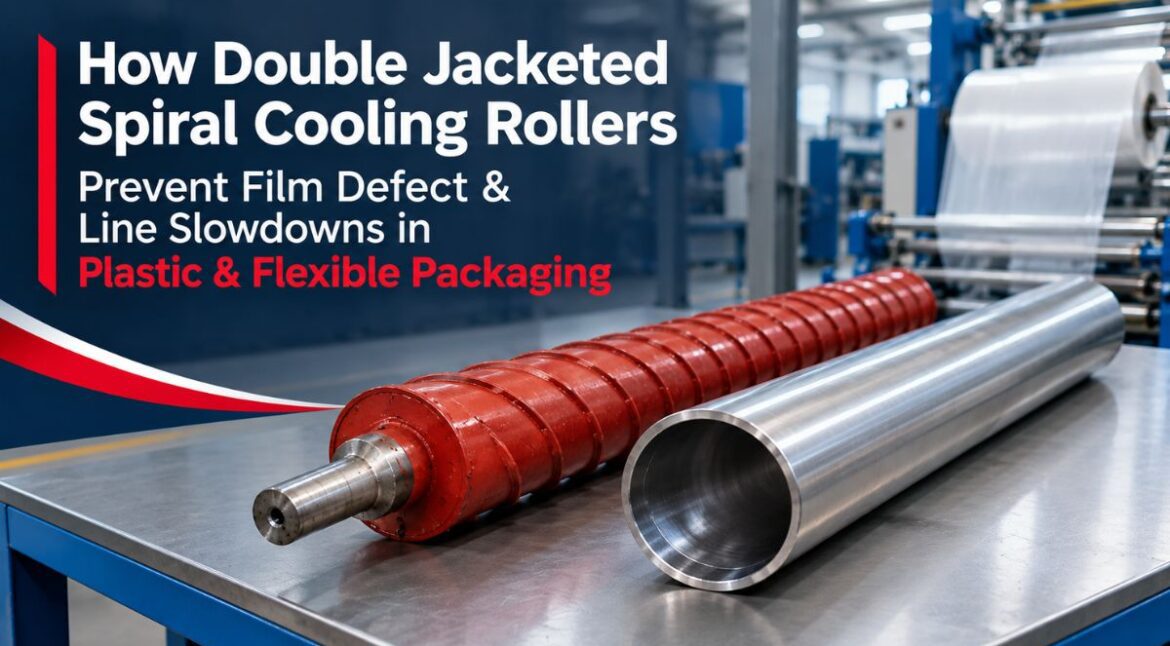
How Double Jacketed Spiral Cooling Rollers Prevent Film Defects & Line Slowdowns in Plastic & Flexible Packaging
If you manage a plastic extrusion or flexible packaging plant, you are likely familiar with an unspoken reality on the shop floor: your production line is only as fast as your cooling process allows.
You can invest in high-capacity extruders, modern die heads, and advanced drive motors. However, if the film coming off the cooling roll is uneven, sticky, hazy, or wrinkled, everything else loses its value.
In the flexible packaging industry, line slowdowns and film defects quietly erode profitability. Plant managers often find themselves dealing with sudden thickness variations, cloudy clarity in clear film, or edge curling during converting. To keep quality acceptable, operators frequently make a painful compromise: they dial back line speeds by 15% to 20%.
While slowing down saves a roll from the scrap bin, it burns unnecessary electricity per unit produced, delays customer orders, and shrinks daily profit margins.
The root cause of these issues often isn’t the resin formulation or the extruder calibration—it comes down to how heat is managed the moment the hot melt exits the die.
In this comprehensive guide, we will explore why standard cooling rolls struggle under continuous high-speed production, how internal double-jacketed spiral flow designs resolve surface temperature imbalances, and why modernizing your cooling approach protects your operational bottom line.
The Critical Role of Cooling in Film Quality
When molten plastic resin leaves the extruder die, it is soft, fluid, and vulnerable to every physical contact point. The primary job of the primary cooling roller (often referred to as a chill roll or temperature control roller) is to remove heat instantly and uniformly across the entire width of the web.
This immediate cooling step—frequently called quenching—freezes the polymer structure in place. Proper quenching directly dictates three vital characteristics:
- Optical Transparency: Fast and even cooling prevents large polymer crystals from forming, keeping clear films bright and glossy.
- Mechanical Tensile Strength: Uniform heat loss ensures the film stretches predictably without weak zones or tear points.
- Web Gauge Consistency: Consistent heat absorption across the roller surface maintains equal thickness from edge to edge.
When surface cooling is inconsistent—even by just a few degrees from one side of the roll to the other—the plastic film reacts immediately.
Common Film Defects Caused by Poor Thermal Control
When cooling rolls fail to maintain an even surface temperature, operators face recurring quality issues that directly increase scrap rates:
1. Thickness Variation (Gauge Banding)
Plastic shrinks as it cools down. If one section of a cooling roller runs slightly warmer than the rest, the film over that section cools slower and shrinks differently. When this film is wound onto a core, these tiny thickness variations build up layer over layer, creating hard ridges or loose bands across the finished roll.
2. Hazy or Dull Appearance
In products like clear packaging films or laminates, visual clarity is a primary selling point. Slow or patchy heat transfer allows polymer crystals time to grow larger, turning what should be a crystal-clear film into a cloudy or dull sheet.
3. Residual Internal Stress and Web Curling
Uneven cooling forces one layer or side of the film to solidify faster than another. This traps internal physical stress inside the material. Later, when the film is unwound for printing, slitting, or pouch making, it refuses to lie flat. Curled film causes misfeeds, printing misregistration, and jam-ups on converting machines.
4. Web Wrinkling and Sticking
If the outer shell of the film doesn’t solidify fast enough before moving to the next roller, it can stick to the metal surface. This creates fine diagonal wrinkles, surface blemishes, or web tracking errors.
Need Custom Industrial Rollers?
✓ Custom Diameter & Length
✓ Temperature Control Design
✓ Fast Manufacturing
✓ Technical Support
The Real Cost of Compromising on Line Speed
When operators notice web instability, wrinkling, or gauge defects, the most common fix on the factory floor is simple: lower the line speed.
Lowering the speed gives the film a longer contact time with the cooling roller, allowing it to cool down further. While this simple adjustment might stop immediate scrap, it introduces a severe long-term financial penalty:
- Lost Hourly Yield: Running at reduced capacity directly reduces your total metric tonnage output per shift.
- Higher Energy Cost Per Ton: Your extruders, heaters, and plant auxiliaries consume roughly the same baseline power whether you run at 80% speed or 100% speed.
- Tighter Production Margins: Delayed jobs force overtime shifts and compress your profit margins in a competitive market.
To run at full rated capacity without sacrificing film appearance or strength, your cooling rolls must carry heat away faster and far more evenly.
Why Conventional Cooling Rollers Create Hot Spots
To appreciate the value of a Double Jacketed Spiral Cooling Roller, it helps to understand where traditional roller designs hit a wall during high-speed operations.
The Problem with Single-Shell Pipe Rollers
A basic, traditional cooling roll consists of a hollow metal cylinder filled with circulating water. Cool water enters through one side shaft and exits through the opposite side.
In real-world production, simple open cylinders create major fluid flow problems:
- Water Finds the Easy Path: Fluid naturally takes the path of least resistance through the center of the roll cavity. This leaves stagnant pockets of warmer water along the outer edges and corners.
- Layered Water Insulation: As water flows smoothly through a large space, the water touching the hot inner metal wall absorbs heat and stays near the surface, while cooler water stays trapped in the center stream. Without strong mixing, heat transfer slows down significantly.
- Edge-to-Edge Temperature Drop: Cool water enters on side A and absorbs heat as it travels. By the time it reaches side B, the water is warmer. As a result, side A of your film is cooled much faster than side B, creating an unavoidable temperature gradient across your production web.
The Limitation of Simple Inner Core Rollers
Some older designs attempt to fix this by inserting a solid inner cylinder to narrow the water gap. While forcing water closer to the outer shell helps, the fluid speed still drops as it spreads out across wide face lengths. Over time, sediment builds up in low-flow areas, causing warm spots near the middle of the roll face—the root cause of central film bulges.
How Double Jacketed Spiral Designs Solve Heat Imbalance
A double-jacketed cooling roller uses a specialized internal structure designed specifically to enforce uniform heat transfer.
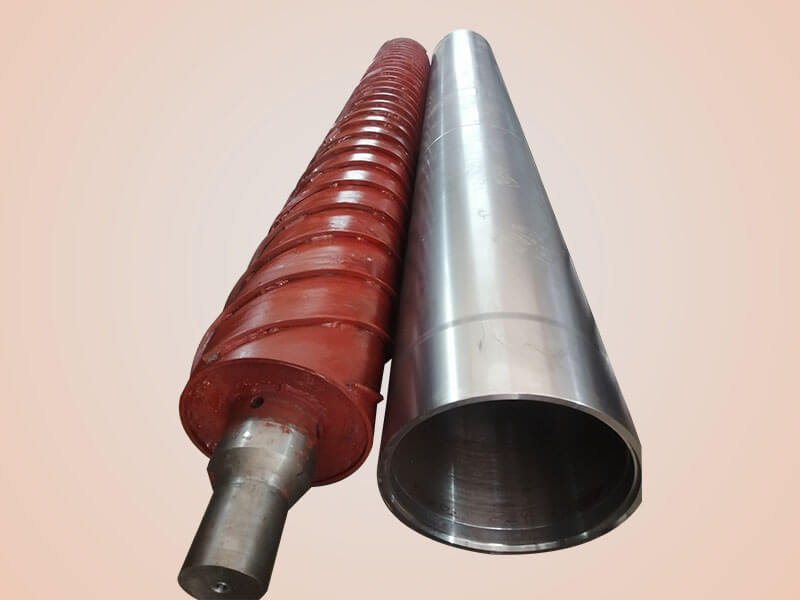
Instead of letting cooling water move freely inside an open cavity, this design sandwiches a precisely engineered spiral flow path between two concentric steel cylinders: an inner core and an outer shell.
1. High Velocity and Constant Fluid Mixing
The internal spiral channel acts like a continuous, closed pathway underneath the outer roller shell. When cooling fluid enters the roller, it cannot shortcut across the center. It is forced to travel through a narrow, continuous spiral track at high velocity.
This high fluid speed creates active mixing within the cooling water. Instead of warm water insulating the metal shell, fresh cool water is constantly swept against the inner surface of the outer shell. Heat is pulled away from the metal rapidly and continuously.
2. True Thermal Uniformity Across the Working Surface
Because the spiral channel carries coolant evenly from one edge of the roller all the way to the other, heat is absorbed at the exact same rate across every inch of the face length.
Modern double-jacketed designs keep surface temperature variations minimal across the entire working width. For wide-web film, sheet extrusion, and high-speed lamination, this uniform surface temperature eliminates edge-to-center cooling gaps entirely.
3. Faster Heat Transfer Through Wall Optimization
Because the double-jacketed layout supports the outer shell structurally from within, the outer wall can be designed for optimal heat conduction without compromising heavy-duty roll rigidity. Heat from the hot resin melt travels through the thin steel wall quickly and is swept away instantly by the high-speed water stream behind it.
Direct Operational Benefits for Packaging Plants
Upgrading your plastic extrusion and converting lines with modern Double Jacketed Cooling Rollers offers direct, tangible improvements to daily factory performance:
Maximize Line Speed
By removing cooling bottlenecks, you can run your lines at their true designed operational speeds. You no longer need to throttle down production just to avoid film sticking or hazy transparency.
Drastically Reduce Startup Waste
Consistent roll face temperatures mean your resin film stabilizes much faster during line setup. Operators spend far less time tweaking die bolts or temperature controls to correct gauge flaws, helping you get sellable product onto the winder sooner.
Achieve Superior Film Clarity and Flatness
Rapid, balanced cooling locks in crystal clarity for clear packaging materials and produces flat sheets that do not curl or twist. This makes your finished film easier to convert, print, and seal downstream.
Protect Downstream Converting Machinery
When webs leave the cooling section flat, stable, and completely set, downstream machinery runs smoother. Slitter blades cut cleaner without fraying, winders produce straight-edged rolls without telescoping, and printing presses maintain precise color alignment.
Where Spiral Cooling Rollers Drive Maximum Value
High-efficiency cooling rollers are critical assets across a wide range of web processing lines:
- Cast Film Extrusion: Crucial for producing ultra-clear CPP and CPE films where immediate thermal quenching dictates visual transparency.
- Extrusion Lamination & Coating: Ensures rapid bonding between molten polymer layers and flexible substrates such as paper, foil, or woven fabric.
- Blown Film Processing: Stabilizes high-output polyolefin film webs before secondary slitting or winding operations.
- Sheet Extrusion Lines: Ensures flat, stress-free surfaces on thicker PET, PS, or PP sheets destined for thermoformed containers.
- Flexographic & Gravure Converting: Efficiently removes residual heat from printed or laminated webs to set inks and adhesives before final reel winding.
Key Quality Factors to Consider When Selecting a Cooling Roller
Not all cooling rollers perform equally under demanding round-the-clock factory conditions. The real-world reliability of a double-jacketed spiral roller comes down to manufacturing care, structural balance, and surface finishing.
When evaluating a roller manufacturing partner, look for these vital production standards:
1. Dynamic Balancing at True Operating Speeds
A cooling roller running at hundreds of meters per minute must be dynamically balanced to eliminate vibration. Even minor imbalances cause subtle web bouncing, leading to chatter marks on delicate films and premature bearing wear.
2. Application-Specific Surface Finishes
The surface treatment of the roller must match your exact film requirements:
- Mirror-Finish Chrome Plating: Essential for optical-grade clear films to deliver maximum gloss and clarity.
- Matte or Satin Finishes: Preferred in specific converting applications to prevent air entrapment under the moving web.
- Non-Stick Surface Treatments: Ideal for preventing tacky resins or hot adhesives from clinging to the roller face.
3. Corrosion-Resistant Internal Pathways
Because cooling water flows continuously through internal channels, low-grade internal metal can rust or accumulate mineral scale over time. High-quality rollers use protected internal flow paths and treated structures to resist scale buildup, preserving high thermal conductivity year after year.
Siva Rollers: Your Trusted Manufacturer for High-Performance Cooling Rollers
At Siva Rollers, we recognize that in the fast-moving plastic packaging industry, unexpected downtime and slow output directly harm your business. A cooling roller is not just a passive metal cylinder—it is an active process control tool that directly determines your product quality and daily output.
As a leading Double Jacketed Spiral Cooling Rollers Manufacturer in India, Siva Rollers blends years of practical industry experience with precision manufacturing standards.
The Siva Rollers Commitment to Quality
- Custom Thermal Design: We do not rely on standard, one-size-fits-all products. Every spiral cooling roller is designed around your specific line parameters, including web width, line speed, resin material, and available coolant volume.
- Engineered Internal Flow Pathways: Our spiral channel layouts are calculated to ensure steady, high-velocity coolant circulation, eliminating stagnant warm spots across the entire roll surface.
- Precision Machining & Precision Balancing: Every roller undergoes strict dynamic balancing on digital rigs, ensuring smooth, vibration-free operation even at high line speeds.
- Flawless Surface Execution: From mirror-smooth chrome finishes to custom matte textures, our rollers are finished to exacting tolerances to ensure clean web release and smooth web movement.
- Built for Long Service Life: We construct our rollers using high-grade materials, robust journal shafts, and corrosion-resistant internal channels designed to withstand continuous heavy usage.
Whether you are upgrading an existing line to eliminate a production bottleneck or outfitting a new processing system, the technical team at Siva Rollers works closely with you to deliver custom cooling solutions built to last.
Take Control of Your Production Line Speed
In flexible packaging and plastic extrusion, consistent quality builds customer trust. You shouldn’t have to accept slow line speeds, high scrap rates, or dull film quality simply because your cooling rollers cannot keep pace with your production goals.
By adopting Double Jacketed Spiral Cooling Rollers, you take full ownership of your thermal process. You gain uniform cooling, better visual clarity, flat stress-free film, and the operational confidence to run your production lines at their true capacity.
Upgrade Your Plant Efficiency Today
Don’t let inefficient heat transfer limit your factory output. Reach out to Siva Rollers—your trusted double jacketed spiral cooling rollers manufacturing partner—to review your line setup and explore custom-engineered cooling solutions designed for your operational needs.
FAQs
A Double Jacketed Spiral Cooling Roller is an industrial roller with an internal spiral coolant flow channel between two concentric cylinders. This design helps distribute cooling water across the roller's working width for more uniform heat transfer in plastic film extrusion and flexible packaging applications.
It helps maintain a more uniform roller surface temperature, reducing cooling-related defects such as film haze, thickness variation, curling, wrinkling, and sticking. Actual results depend on the material and production conditions.
Uniform cooling helps molten plastic solidify consistently across the film width. This supports film clarity, thickness consistency, web flatness, and stable downstream processing.
A conventional hollow roller allows coolant to circulate through an open internal cavity, where flow may become uneven. A Double Jacketed Spiral Cooling Roller directs coolant through a defined spiral channel, helping improve heat distribution and reduce temperature differences across the roller face.
Yes, it can help reduce cooling-related production bottlenecks by improving heat transfer and temperature uniformity. The achievable line speed depends on the extrusion system, resin type, film thickness, coolant conditions, and operating parameters.
These rollers are used in applications such as plastic film extrusion, cast film production, flexible packaging, extrusion lamination, coating, sheet extrusion, and printing and converting processes where controlled web cooling is required.
Consistent cooling helps control polymer solidification and can reduce cooling-related haze in clear plastic films. Final transparency also depends on resin formulation, extrusion settings, film thickness, and other manufacturing conditions.
Uneven coolant flow, stagnant water zones, insufficient fluid mixing, and temperature changes as coolant travels through the roller can contribute to surface temperature variations. These variations may affect film quality and production consistency.
The appropriate finish depends on the application. Mirror finishes may be suitable for films requiring high gloss and clarity, while matte or satin finishes may suit specific converting processes. Non-stick treatments may be considered for applications involving tacky materials or hot adhesives.
Dynamic balancing helps minimise vibration during high-speed operation. Proper balancing supports stable web movement and can help reduce surface marking, vibration-related defects, and premature bearing wear.
SIVA ROLLERS (SIVA ENGINEERING WORKS) is an industrial roller manufacturer based in Ahmedabad, Gujarat, India. The company provides industrial roller solutions and can discuss custom cooling roller requirements based on the application, roller dimensions, production speed, and coolant conditions.
To request a quotation from SIVA ROLLERS (SIVA ENGINEERING WORKS), share your required roller dimensions, working width, production line speed, resin material, operating temperature, coolant details, and preferred surface finish. Visit the Siva Rollers Contact Page to submit your enquiry.