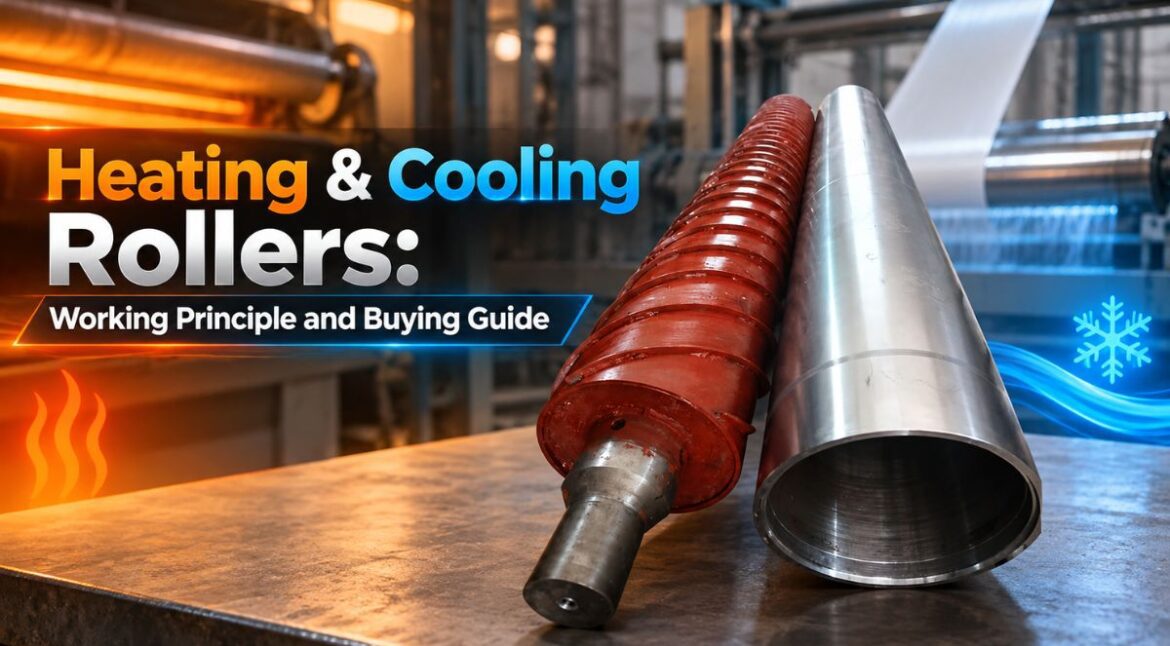
Heating & Cooling Rollers: Working Principle and Buying Guide
In many industrial manufacturing processes, controlling material temperature is an important part of maintaining consistent production. Heating & Cooling Rollers are used in different applications to heat, cool, or maintain the temperature of a moving material as it passes through a production line.
These rollers can be found in applications involving plastic films and sheets, paper, textiles, laminating processes, coating lines, and other continuous web-processing operations. Depending on the process, a roller may transfer heat to the material or remove heat from it.
For manufacturers and plant maintenance teams, selecting the right roller is not only about the roller diameter or surface finish. Internal flow arrangement, operating temperature, heating or cooling medium, material construction, surface condition, machine compatibility, and operating speed can all affect roller performance.
This guide explains how Heating & Cooling Rollers work, where they are used, and the important factors to consider before purchasing one.
For plastic processing applications, you can also explore Siva Rollers’ Plastic & Extrusion Line Cooling Rollers.
What Are Heating & Cooling Rollers?
Heating & Cooling Rollers are industrial rollers designed to transfer heat between the roller surface and the material being processed.
A heating roller supplies heat to the material, while a cooling roller removes heat from the material. The actual roller construction and internal flow arrangement depend on the temperature requirements, material being processed, production speed, roller dimensions, and machine design.
In many applications, a heat-transfer medium is circulated through passages or chambers inside the roller. For heating applications, this may involve a suitable heated fluid or another heating medium. For cooling applications, water or a suitable cooling fluid may be circulated through the roller.
The objective is to maintain a suitable and consistent roller surface temperature during production.
This temperature control can be important when processing materials that are sensitive to changes in temperature, particularly films, sheets, coated materials, paper webs, textiles, and other continuous materials.
Need Custom Industrial Rollers?
✓ Custom Diameter & Length
✓ Temperature Control Design
✓ Fast Manufacturing
✓ Technical Support
How Do Heating & Cooling Rollers Work?
The basic working principle is heat transfer.
A roller contains an internal arrangement through which the selected heating or cooling medium can move. As the medium circulates, heat is transferred between the internal roller structure and the roller surface.
Working of a Heating Roller
In a heating application, a heated medium circulates inside the roller. Heat moves through the roller body toward the outer surface.
When the material comes into contact with the heated roller, heat can be transferred from the roller surface to the material. The required temperature depends on the production process and the material being handled.
Working of a Cooling Roller
In a cooling application, a cooling medium circulates through the roller. Heat from the material is transferred through the roller surface and roller body toward the cooling medium.
The cooling medium then carries this heat away from the roller.
The effectiveness of the process depends on several factors, including:
- Roller construction
- Internal flow arrangement
- Heating or cooling medium
- Flow rate
- Roller surface temperature
- Material contact conditions
- Production speed
- Roller dimensions
- Temperature difference between the material and roller
Therefore, the internal design of a heating or cooling roller needs to match the application rather than relying on one standard construction for every machine.
Plastic & Extrusion Line Cooling Rollers
In plastic extrusion and sheet or film processing, cooling rollers can be used to remove heat from the material after extrusion or during subsequent processing stages.
The roller provides controlled contact between the material and a temperature-controlled surface. As the material passes over or between rollers, heat can be transferred away from the material.
The exact arrangement depends on the extrusion or converting process and the type of product being manufactured.
A properly selected Plastic & Extrusion Line Cooling Roller can support more consistent processing by helping maintain the required material temperature during production.
Temperature control can be particularly important for applications where changes in cooling conditions may affect dimensions, surface appearance, flatness, or other product characteristics.
However, the final result depends on the complete process—not the cooling roller alone.
Why Roller Surface Temperature Matters
The roller surface is the point of contact with the processed material, so temperature consistency can be an important consideration.
If the roller surface temperature is not suitable for the application, it may contribute to process variations. Depending on the material and production conditions, these variations may appear as changes in surface appearance, dimensional behavior, flatness, or other quality characteristics.
For this reason, buyers should consider both the required operating temperature and how consistently the roller can maintain that temperature during production.
The correct temperature range should always be determined according to the material and process requirements.
Internal Flow Design and Heat Transfer
One of the important aspects of a heating or cooling roller is its internal flow arrangement.
The roller may use internal passages, chambers, drilled channels, spiral arrangements, or other designs depending on the roller size and application.
The purpose of the internal arrangement is to distribute the heating or cooling medium through the roller in a way that supports the required heat-transfer performance.
There is no single internal design that is suitable for every application.
When ordering a roller, it is useful to provide the manufacturer with information such as:
- Required roller operating temperature
- Heating or cooling application
- Type of heating or cooling medium
- Roller diameter and face length
- Working width
- Production speed
- Material being processed
- Existing machine arrangement
- Connection requirements
This information helps the manufacturer evaluate the roller design according to the actual operating conditions.
Materials Used for Heating & Cooling Rollers
The roller material should be selected according to the application, operating environment, temperature requirements, surface requirements, and mechanical conditions.
Stainless Steel
Stainless steel may be considered where corrosion resistance and suitable surface properties are important, particularly in applications involving moisture or demanding operating environments.
Carbon or Alloy Steel
Depending on the design and application, suitable steel grades can be used to provide the required mechanical strength and roller construction.
Hard Chrome-Plated Surface
Hard chrome plating may be used when the application requires a hard, wear-resistant surface with suitable surface characteristics.
Chrome plating is generally a surface treatment, not a replacement for selecting the correct base roller material.
Other Surface Treatments
The required surface treatment depends on the material being processed and the production conditions. Surface finish, roughness, release characteristics, corrosion resistance, and wear requirements should all be considered before finalizing the roller construction.
Surface Finish of Heating & Cooling Rollers
Surface finish can influence how the processed material interacts with the roller.
A smooth or polished surface may be suitable for applications where a smooth contact surface is required. Other applications may require a specific surface texture or finish.
It is important not to assume that a mirror finish is automatically the best option for every process.
The appropriate finish should be selected based on:
- Material being processed
- Required product appearance
- Contact conditions
- Release requirements
- Cleaning requirements
- Wear conditions
- Existing production process
For critical applications, the required surface finish should be discussed with the roller manufacturer before manufacturing.
Key Factors to Consider When Buying Heating & Cooling Rollers
Choosing a heating or cooling roller requires more than simply selecting a standard roller size. The roller should be matched to the machine and process.
1. Required Temperature Range
Start by identifying the actual operating temperature required by the process.
Consider both the normal operating temperature and any expected temperature variation during production.
The roller design and materials should be suitable for the intended operating conditions.
2. Heating or Cooling Medium
Tell the manufacturer which medium will be used for temperature control.
For example, the system may use water, chilled water, or a suitable thermal fluid depending on the application.
The roller’s internal construction and connections should be compatible with the selected medium and operating conditions.
3. Internal Flow Arrangement
Internal flow design affects how the heating or cooling medium moves through the roller.
A suitable flow arrangement can help support consistent heat transfer across the working face. The appropriate design depends on roller dimensions, temperature requirements, flow conditions, and the specific application.
4. Roller Dimensions
Provide accurate machine and roller dimensions before placing an order.
Important information can include:
- Overall roller length
- Face length
- Roller diameter
- Journal dimensions
- Bearing arrangement
- Mounting dimensions
- Existing machine space
- Working width
Accurate dimensions are particularly important when replacing an existing roller or modifying an existing production line.
5. Surface Finish
The surface finish should match the material and application.
For example, a film, paper, textile, or coated web may require different surface characteristics depending on the desired product finish and process conditions.
6. Dynamic Balancing
For rollers operating at higher speeds, balancing can be an important consideration.
An appropriately balanced roller can help reduce unwanted vibration during operation. The required balancing level should be determined according to the roller dimensions and operating speed.
7. Thermal Expansion
Heating and cooling cause changes in temperature, and temperature changes can affect roller dimensions.
The roller design should therefore account for the expected operating temperature and thermal conditions.
This is especially important when the roller operates through repeated heating and cooling cycles.
8. Machine Compatibility
A new roller should fit the existing machine correctly.
Before ordering, check the mounting arrangement, journals, bearings, drive arrangement, connections, roller position, and available installation space.
For replacement rollers, sharing the existing roller drawing or accurate measurements can help avoid compatibility problems.
9. Maintenance Requirements
Maintenance requirements should also be considered during selection.
Depending on the design, inspection may include checking the roller surface, bearings, connections, seals, and heating or cooling circuit.
A roller designed appropriately for the application can make inspection and servicing easier over its operating life.
Common Applications of Heating & Cooling Rollers
Heating and cooling rollers can be used in various continuous manufacturing and converting processes.
Common applications may include:
- Plastic extrusion and sheet processing
- Film processing and converting
- Paper and web processing
- Textile and non-woven processing
- Laminating applications
- Coating processes
- Rubber processing
- Other temperature-controlled web-handling applications
The exact roller configuration differs from one industry and machine to another. Therefore, the application should be evaluated before selecting the roller type and construction.
Common Problems Caused by Incorrect Roller Selection
Using a roller that does not match the process can contribute to production problems.
Depending on the application, issues may include:
- Uneven temperature across the working face
- Inconsistent material cooling
- Surface-quality variations
- Unwanted material deformation
- Excessive vibration
- Poor machine compatibility
- Premature wear
- Difficult maintenance
- Unstable production conditions
These problems do not always originate from the roller itself. Production settings, material properties, machine alignment, temperature-control equipment, and other process conditions can also affect the final result.
This is why the roller should be selected as part of the complete production system.
What Information Should You Give a Roller Manufacturer?
If you are planning to buy a new Heating or Cooling Roller, providing complete application information can make the manufacturing process more accurate.
Ideally, share:
- Type of application
- Material being processed
- Heating or cooling requirement
- Operating temperature
- Heating/cooling medium
- Roller diameter
- Face length
- Overall length
- Working width
- Operating speed
- Existing machine details
- Surface finish requirement
- Journal and bearing details
- Drawing or old roller dimensions, if available
If you are replacing an existing roller, photographs, drawings, measurements, and machine details can also help the manufacturer understand the installation requirements.
Heating & Cooling Roller Manufacturer in Ahmedabad, India
Siva Rollers (Siva Engineering Works) manufactures and supplies industrial rollers for different processing applications from Ahmedabad, Gujarat, India.
The company offers roller solutions for applications where roller construction, surface condition, dimensions, and process requirements need to be considered together.
For plastic processing applications, Siva Rollers also manufactures Plastic & Extrusion Line Cooling Rollers designed according to the required application and machine requirements.
If you are replacing an existing roller or planning a new roller for a production line, you can share your roller dimensions, application details, operating conditions, or existing drawing with the manufacturer for evaluation.
This application-based approach is useful when a standard roller does not match the requirements of the production line.
Final Thoughts
Heating & Cooling Rollers play an important role in processes where controlled heat transfer is required.
A heating roller transfers heat to the processed material, while a cooling roller removes heat from it. The actual performance depends on the complete roller design, including the internal flow arrangement, material, surface finish, dimensions, operating conditions, and compatibility with the production machine.
For buyers, the most important step is to select a roller based on the actual application rather than choosing only by size or surface finish.
If you are looking for a Heating Roller, Cooling Roller, or Plastic & Extrusion Line Cooling Roller, discuss your application requirements with Siva Rollers (Siva Engineering Works), Ahmedabad, India.
Share your roller dimensions, application, operating temperature, material being processed, and machine details to help determine a suitable roller configuration.
FAQs
A Heating & Cooling Roller is an industrial roller designed to transfer heat to or remove heat from a material during continuous manufacturing or converting processes. Depending on the application, the roller may use a suitable heating or cooling medium circulated through its internal passages or chambers.
Cooling Rollers can be used in applications such as plastic extrusion and sheet processing, film converting, paper and web processing, textile and non-woven processing, laminating, coating, and other temperature-controlled manufacturing processes.
A Plastic & Extrusion Line Cooling Roller removes heat from the processed plastic material through controlled contact with the roller surface. A cooling medium circulates inside the roller, carrying heat away from the roller and helping maintain the required processing temperature.
Yes. Industrial rollers can be designed according to application and machine requirements. Depending on the project, customization may include roller diameter, face length, overall dimensions, journal arrangement, surface finish, internal flow arrangement, connections, and operating conditions.
The cooling medium depends on the application and temperature requirements. Water, chilled water, or a suitable cooling fluid may be used. The roller's internal construction and connections should be compatible with the selected medium and operating conditions.
For a replacement roller, it is useful to provide the existing roller drawing or dimensions, roller diameter, face length, overall length, journal dimensions, bearing arrangement, working width, operating speed, surface finish, and application details. Operating temperature and cooling-medium information can also help with the design evaluation.
The roller should be selected according to the material being processed, required temperature, heating or cooling medium, roller dimensions, production speed, surface finish, internal flow arrangement, machine compatibility, and maintenance requirements. Sharing complete application details with the manufacturer can help determine a suitable configuration.
Yes. Surface finish can affect how the processed material interacts with the roller and may influence surface appearance, release characteristics, cleaning, and wear. The appropriate finish should be selected according to the material and process rather than assuming that one finish is suitable for every application.
Cooling rollers can be used in high-speed production applications, but the roller must be designed for the required operating speed and mechanical conditions. Balancing, dimensions, bearing arrangement, thermal conditions, and machine compatibility should be evaluated for the specific application.
Siva Rollers can evaluate roller requirements based on application details, existing dimensions, drawings, and machine specifications. For a replacement or customized roller, providing accurate measurements or an existing roller drawing is recommended.
Before placing an order, check the required roller dimensions, working width, operating temperature, cooling medium, production speed, surface finish, journal and bearing details, machine mounting arrangement, and internal connection requirements.
You can contact Siva Rollers with your application details, existing roller dimensions or drawing, operating conditions, and machine requirements. This information can be used to evaluate the appropriate roller construction for your application.