Why the Printing Industry Uses Teflon Rollers: A Complete Guide
In the highly competitive printing industry, efficiency is everything. Whether you are running a high-speed flexographic press, an offset printing operation, or a specialized packaging line, your margins depend on minimizing downtime and maximizing output quality. Yet, print shop managers around the globe face the same persistent bottlenecks: stubborn ink buildup, web tearing, and the constant need to halt production for roller cleaning.
This is where upgrading your equipment with a high-quality Teflon Roller becomes a game-changing investment.
But why exactly has this specific material become the gold standard for high-performance printing operations? In this comprehensive guide, we will explore the science, the operational benefits, and the undeniable return on investment (ROI) behind using Teflon rollers in the printing sector.
Whether you are looking to solve a specific production flaw or searching for a reliable supplier, Siva Rollers—India’s premier manufacturer and global exporter of industrial rollers—is here to provide the insights and engineering solutions you need to keep your presses running profitably.
The Role of an Industrial Roller in Modern Production
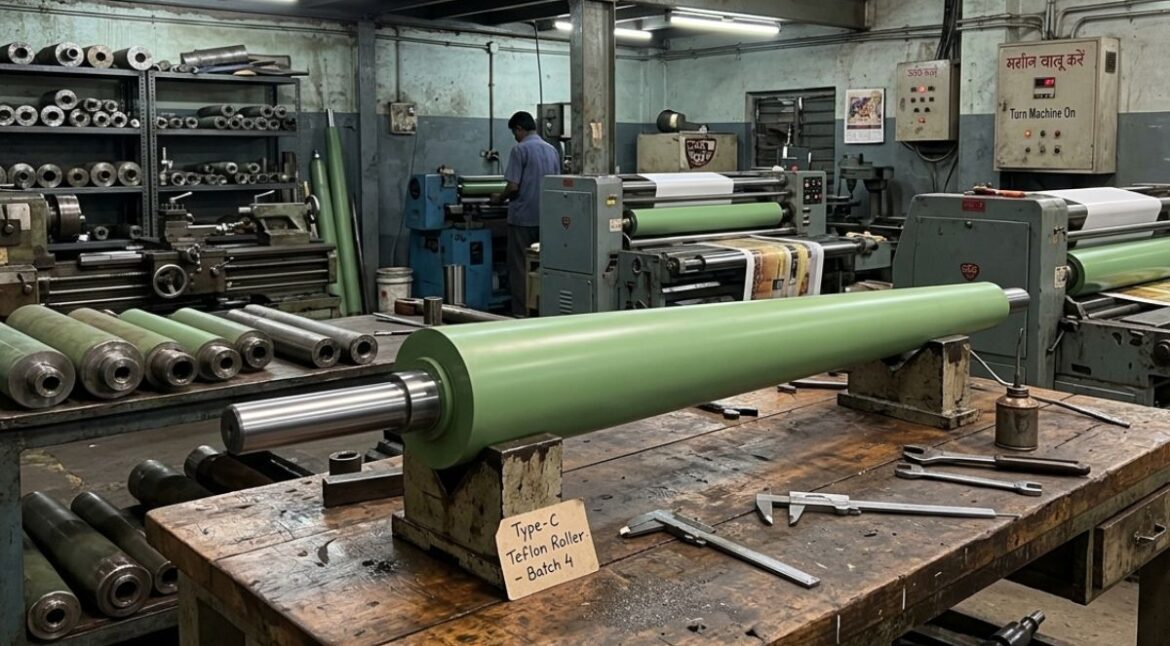
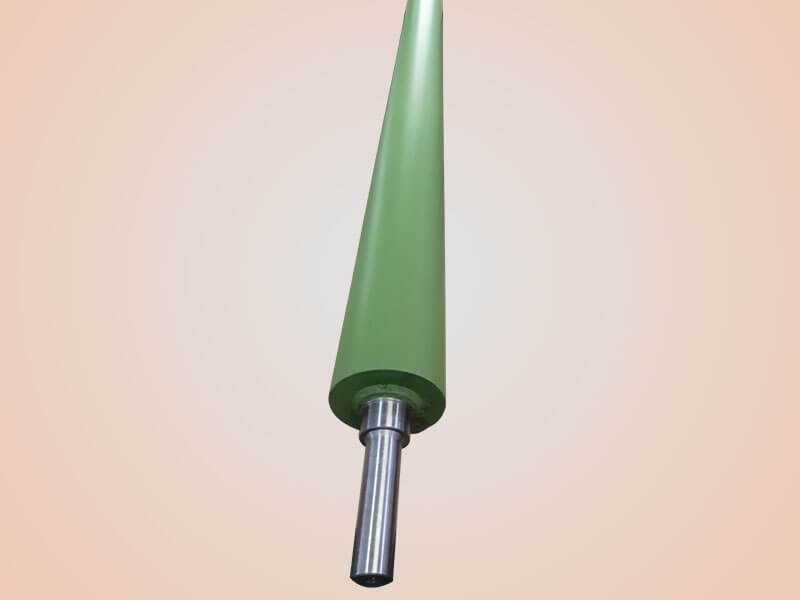
A Teflon Roller is a precision-engineered industrial component coated with Polytetrafluoroethylene (PTFE). Known for its incredible non-stick properties and thermal resistance, these rollers are designed to handle materials that would typically stick to or damage regular metal surfaces.
Whether you are looking for a printer teflon roller to handle fast-drying inks or specialized rollers for food-grade packaging, understanding the engineering behind the coating is the first step toward optimizing your floor production.
The Hidden Costs of Standard Printing Rollers
Before understanding why a Teflon Roller is superior, it is crucial to recognize the inherent flaws of standard rubber or bare metal rollers in a demanding printing environment.
1. The Ink Buildup Dilemma (Picking and Tracking)
As the paper, film, or foil web travels through the press, it carries wet ink, adhesives, and coatings. When standard guide or idler rollers come into contact with these wet surfaces, the ink naturally transfers and sticks to the roller. This creates a rough, uneven surface on the roller itself, leading to “tracking” or “picking”—where the roller pulls ink off the subsequent sections of the web, ruining the print quality and generating massive amounts of waste.
2. Excessive Machine Downtime
How many hours per week does your team spend stopping the press, putting on protective gear, and aggressively scrubbing ink off idler rollers? In the B2B printing world, machine downtime is the single largest drain on profitability. Every minute spent cleaning is a minute you are not printing and billing.
3. Chemical Degradation
Printing involves harsh substances. UV inks, solvent-based flexo inks, industrial adhesives, and the aggressive chemical washes used to clean them take a heavy toll on standard elastomeric (rubber) rollers. Over time, these rollers swell, crack, harden, or degrade, requiring frequent and costly replacements.
What Exactly is a Teflon Roller?
A Teflon Roller is an industrial cylinder (typically made of aluminum or steel) that has been treated with a specialized polytetrafluoroethylene coating (PTFE), or wrapped in a seamless Teflon sleeve.
Teflon is a synthetic fluoropolymer of tetrafluoroethylene, renowned globally for being one of the most frictionless and non-reactive solid materials in existence. When applied as a roller coating for printing applications, it completely transforms how the roller interacts with the materials passing over it.
The Science of the Non-Stick Surface
The secret lies in the molecular structure of PTFE. The carbon-fluorine bonds in Teflon are incredibly strong, meaning they do not want to interact with or bond to other molecules. Because of this low surface energy, practically nothing—not aggressive solvent inks, not sticky industrial adhesives, and not melted polymers—can permanently adhere to a ptfe coated roller printing surface.
5 Transformative Reasons the Printing Industry Uses Teflon Rollers
If you are evaluating whether to upgrade your machinery to a Teflon Coated Roller, here is a deep dive into the specific operational benefits that make this transition a standard practice for top-tier print houses.
1. Ultimate Non-Stick Performance (Zero Ink Buildup)
This is the primary reason the printing industry roller market relies so heavily on Teflon. Because inks, coatings, and adhesives simply cannot grip the PTFE surface, ink buildup is virtually eliminated.
When you use a teflon coated roller printing setup, the wet web can glide seamlessly over idler and guide rollers without leaving residue behind. This drastically reduces print defects, eliminates web tracking, and ensures a pristine finish for your clients.
2. Drastic Reduction in Cleaning and Maintenance Downtime
Because ink and adhesives do not stick to the roller, the need for mid-run cleaning is practically eradicated. When the press does require cleaning during a major job changeover, the process takes a fraction of the time. Instead of aggressive scrubbing with harsh solvents, operators can simply wipe down the Teflon surface with a mild cleaner or a dry cloth.
The ROI Calculation: If a standard roller requires 30 minutes of cleaning per shift, that equals 1.5 hours of lost production daily (in a 3-shift operation). Over a 300-day working year, that is 450 hours of lost printing time. A Teflon roller can recover over 90% of those lost hours, directly boosting your bottom line.
3. Superior Chemical Resistance
Printing plants are chemically intense environments. Standard rubber rollers will eventually succumb to the harsh solvents present in inks and wash-up solutions. A chemical resistant roller coated in PTFE, however, is essentially inert. It will not swell, crack, blister, or degrade when exposed to aggressive industrial chemicals, ensuring a significantly longer operational lifespan than traditional alternatives.
4. High-Temperature Tolerance
Many modern printing processes—especially those involving flexible packaging, laminating, or heat-set web offset printing—require the web to pass through high-temperature drying ovens or over heated cylinders. Standard rubber coatings melt, warp, or lose their structural integrity under high heat.
Teflon can comfortably withstand continuous operating temperatures of up to 260°C (500°F). This makes them the perfect companion for heat-setting applications and high-speed friction environments.
5. Low Coefficient of Friction for Delicate Web Handling
Teflon has one of the lowest coefficients of friction of any solid material. In web printing (printing on continuous rolls of paper or plastic film), web tension is a delicate balancing act. If a roller causes too much drag, the web can stretch, misregister, or snap entirely. The ultra-smooth surface of a Teflon roller allows the web to glide effortlessly, maintaining perfect tension and registration even at maximum press speeds.
Applications: Where is a Teflon Roller Used in a Printing Machine?
A modern teflon roller printing machine setup strategically utilizes these non-stick rollers in areas where the web is most vulnerable or where ink is still wet. Common applications include:
- Idler and Guide Rollers: Placed throughout the press to guide the web without accumulating wet ink.
- Chilling and Cooling Rolls: Used immediately after the drying ovens; Teflon prevents hot, tacky inks from sticking to the cooling cylinder.
- Adhesive Coating Stations: In label printing and packaging, Teflon rollers guide the web through lamination and adhesive application without getting jammed by glue.
- Flexographic Bowed/Expander Rollers: Used to prevent wrinkles in thin plastic films; the Teflon coating ensures the delicate film isn’t scratched or stretched.
Key Features of High-Quality Teflon Roller
Not all rollers are created equal. A premium Teflon Roller should offer:
- Uniform polytetrafluoroethylene coating thickness
- Strong adhesion between coating and base roller
- Precision grinding for smooth finish
- High load-bearing capacity
- Resistance to wear, chemicals, and heat
Choosing the right manufacturer ensures these features are not compromised.
Common Problems Solved by Teflon Roller
Let’s connect this to real-world challenges faced by plant managers and operators.
Problem | Solution with Teflon Roller |
Ink sticking to rollers | Non-stick PTFE surface |
Frequent cleaning downtime | Low adhesion surface reduces build-up |
Roller damage due to chemicals | Chemical resistant roller |
Heat-related deformation | High temperature resistance |
Uneven printing | Smooth and consistent surface |
High maintenance cost | Long-lasting performance |
Why Teflon Roller is Better Than Traditional Rollers
Traditional rubber or metal rollers often fail under demanding conditions.
Comparison Snapshot:
Feature | Traditional Roller | Teflon Coated Roller |
Stickiness | High | Very Low |
Heat Resistance | Moderate | Excellent |
Chemical Resistance | Low | High |
Maintenance | Frequent | Minimal |
Lifespan | Shorter | Longer |
This is why industries are rapidly shifting toward ptfe coated roller printing solutions.
Why Choose Siva Rollers as Your Global Manufacturing Partner?
When you decide to upgrade your machinery, the quality of the roller coating is non-negotiable. Poorly applied PTFE coatings can flake, wear unevenly, or fail prematurely, putting you right back where you started.
This is where Siva Rollers steps in as your trusted industrial partner.
Based in India, Siva Rollers is a globally recognized manufacturer of precision-engineered industrial rollers. We combine state-of-the-art manufacturing infrastructure with deep industry expertise to deliver products that meet the absolute highest international standards.
Here is why top printing and packaging firms globally trust Siva Rollers:
- Uncompromising Quality Control: Every Teflon Roller we manufacture undergoes rigorous testing for coating thickness, surface uniformity, concentricity, and dynamic balance. We ensure your roller performs flawlessly at high speeds.
- Custom Engineering: We do not just sell off-the-shelf parts. We manufacture rollers customized to your exact machine specifications, web widths, and operational challenges.
- Global Export Capabilities: While we are proudly manufactured in India—allowing us to offer highly competitive pricing without compromising on quality—we export our premium rollers to print houses and machinery OEMs worldwide. No matter where your facility is located, we deliver reliable solutions to your doorstep.
- Deep Printing Industry Expertise: We understand the nuances of flexography, offset, gravure, and digital printing. We speak your language and know exactly how to solve your specific web-handling and ink-buildup problems.
Final Thoughts
The printing industry operates on precision, speed, and consistency—and the Teflon Roller plays a crucial role in achieving all three.
From preventing ink build-up to resisting heat and chemicals, teflon roller printing machine solutions are designed to solve real industrial challenges.
If you’re looking to:
- Improve print quality
- Reduce downtime
- Increase operational efficiency
then upgrading to a high-quality Teflon Coated Roller is the smart move.
Contact US : +91 75070 10009 , info@sivarollers.com
FAQs
A Teflon roller is a metal roller coated with PTFE (polytetrafluoroethylene), a non-stick and heat-resistant material. It is used in printing machines to prevent ink, adhesives, and coatings from sticking to the roller surface, ensuring smooth web movement and consistent print quality.
The printing industry uses Teflon rollers because they offer non-stick performance, high chemical resistance, low friction, and heat tolerance, which help reduce ink buildup, minimize downtime, and improve overall production efficiency.
Teflon rollers have a low surface energy PTFE coating, which prevents ink and adhesives from bonding to the surface. As a result, ink does not accumulate, eliminating common issues like tracking, picking, and print defects.
A professionally coated PTFE Teflon roller can operate continuously at temperatures up to 260°C (500°F). This makes it ideal for drying ovens, heat-sealing machines, extrusion lines, and other high-temperature industrial applications.
Yes, Teflon rollers are highly resistant to solvents, UV inks, adhesives, and cleaning chemicals. Unlike rubber rollers, they do not swell, crack, or degrade, making them ideal for harsh printing environments.
A Teflon roller can typically withstand continuous operating temperatures of up to 260°C (500°F), making it suitable for heat-set printing, laminating, and high-temperature drying processes.
>Teflon rollers improve print quality by ensuring a smooth, clean, and residue-free surface. This prevents ink transfer issues, maintains proper web tension, and reduces defects like smudging or uneven printing.
Teflon rollers are commonly used in:
- Idler and guide rollers
- Cooling and chilling rolls
- Adhesive coating stations
- Laminating and packaging lines
They are placed where wet ink or adhesives are present to prevent sticking and damage.
Yes, Teflon rollers outperform rubber rollers in demanding environments. They offer better non-stick properties, higher heat resistance, superior chemical resistance, and longer lifespan, resulting in lower maintenance costs.
Choose a manufacturer that offers:
- Uniform PTFE coating thickness
- Strong coating adhesion
- Precision grinding and balancing
- Custom engineering support
- Proven industry experience
Companies like Siva Rollers are known for delivering high-quality, customized Teflon rollers with global export capabilities.