How to Fix Web Wrinkling and Creasing Using Bowed Rollers
In high-speed roll-to-roll manufacturing, nothing disrupts productivity faster than web wrinkling and creasing. Whether you are converting thin plastic films, processing delicate paper, treating textiles, or laminating metallic foils, even a minor wrinkle can lead to catastrophic results. It causes uneven coating, poor lamination, print misalignment, and—worst of all—costly material waste and unplanned machine downtime.
If your production line is plagued by constant material distortion, the solution isn’t necessarily to slow down your machines or completely overhaul your processing line. Instead, the answer lies in mastering web spreading technology using a high-quality Bowed Roller (frequently referred to as an Expander Roller).
At Siva Rollers, India’s premier manufacturer and global exporter of industrial roll solutions, we help converting and processing plants worldwide eliminate web defects, protect product quality, and maximize throughput. In this comprehensive guide, we will break down exactly why web wrinkling happens and explain step-by-step how to fix it using industrial bowed spreader rollers.
Why Web Wrinkling Occurs in Processing Lines
Before resolving a web defect, you must understand its origin. In a moving web, wrinkles typically occur due to lateral forces pushing the material inward toward the center rather than keeping it flat and taut across its entire width.
The primary culprits behind web wrinkling include:
- Misaligned Machine Rollers: If even a single roller in your line is slightly out of parallel alignment, it creates uneven cross-machine tension. The material naturally shifts toward the side with higher tension, causing diagonal wrinkles.
- Material Variations: Uneven gauge variations (thickness differences) across the roll width or moisture absorption in paper can make the web behave unpredictably.
- Thermal and Mechanical Stress: Processes involving extreme heat (such as drying ovens or thermal lamination) can cause localized expansion or contraction, resulting in thermal buckles and creases.
- Incorrect Web Tension Management: Excessive web tension stretches the material lengthwise, causing it to neck-down and narrow, which forces the edges to wrinkle. Conversely, too little tension leads to slackness and sagging, which quickly folds into creases.
To combat these lateral forces and keep the web perfectly flat, flat-face rollers are simply not enough. You need an active, continuous spreading action—which is exactly what Expander Bow Rollers provide.
What is a Bowed Roller (Expander Roller)?
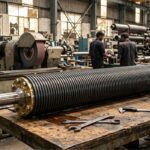
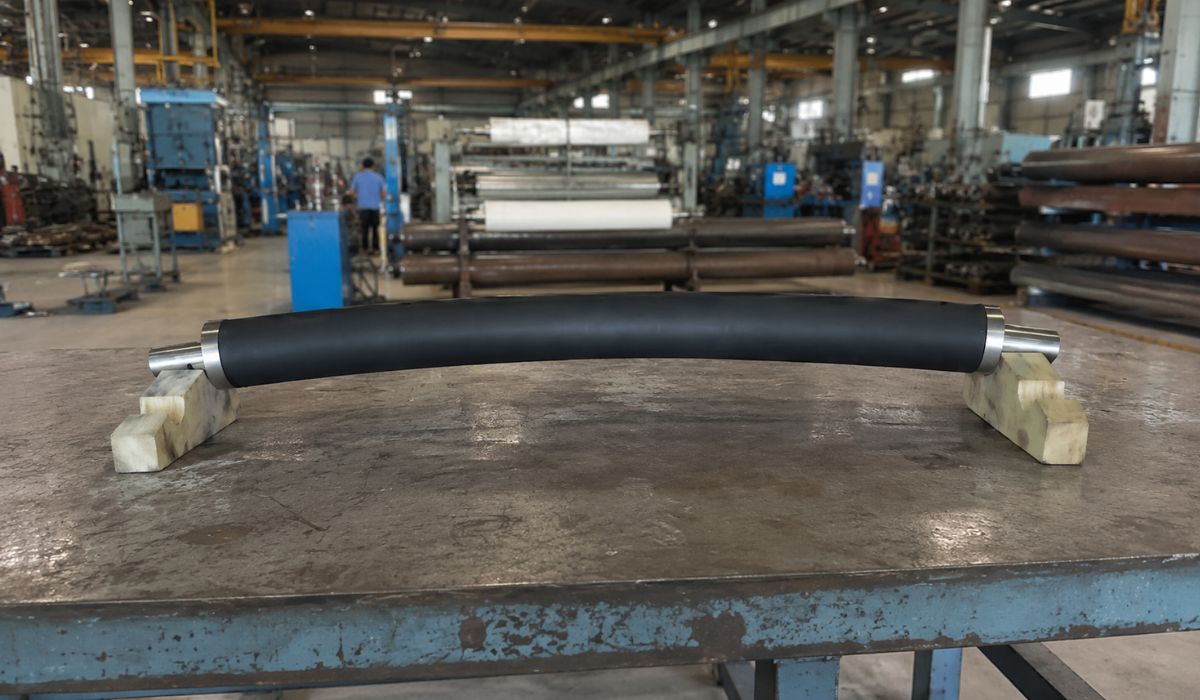
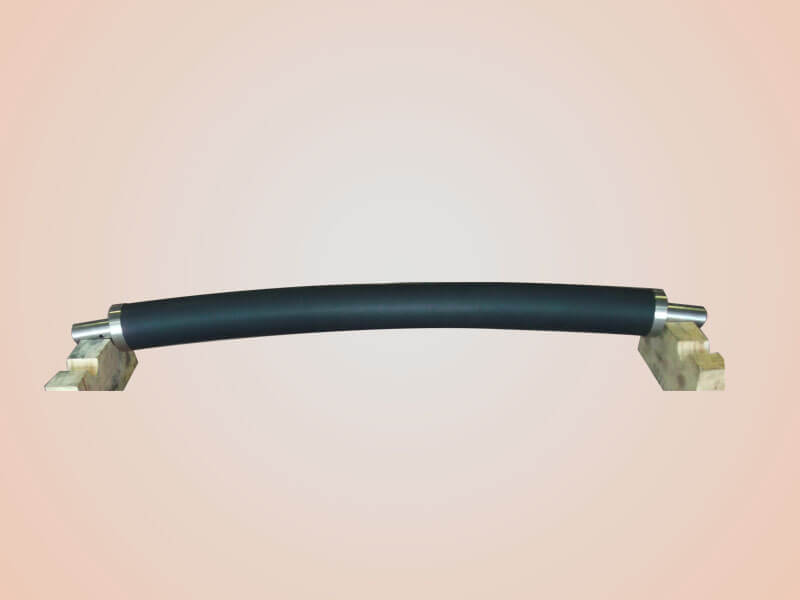
Often called a banana roller due to its distinctive curved profile, a Bowed Roller is a specialized device engineered to eliminate wrinkles, creases, and slack edges from a moving web.
Unlike standard, straight-cylinder rollers, a bowed spreader roller is built with a pre-determined, deliberate curvature (the “bow”) along its face. This curved shaft is fitted with a series of independent bearings covered by a flexible, rotating sleeve (made of high-grade rubber, metal segments, or specialized synthetic materials).
How the Spreading Action Works
As the flexible web material passes over the curved surface of the Expander Roller, it is forced to travel from the shorter, concave side of the curve to the longer, outer convex side. Because the material naturally wants to stay perpendicular to the roller’s axis, this physical path difference forces the web to spread outward from the center to the edges.
By applying this continuous, gentle outward pulling force across the entire width of the web, the roller flattens out slack areas, separates slit webs to prevent overlapping, and completely eradicates folds and creases.
Step-by-Step Guide: How to Fix Web Wrinkling and Creasing Using Bowed Rollers
Installing a Bowed Roller is the single most effective way to solve web wrinkling. However, to achieve flawless results, the roller must be positioned, oriented, and adjusted correctly. Here is the step-by-step process used by lead plant engineers and conversion specialists to optimize their web lines:
Step 1: Pinpoint the High-Risk Wrinkle Zones
Wrinkles must be caught and corrected right before they are permanently set into the material. The most critical locations to place an Expander Roller are:
- Directly before a Nip Point: Lamination nips, calendering units, or embossing stations will permanently press any minor wrinkle into a hard crease. Putting a spreader roller right before the nip ensures the material enters perfectly flat.
- Before Winding/Rewinding: Wrinkles wound into a finished roll can ruin the entire batch, leading to scrap. Spreading the web right before the rewinder guarantees neat, flat, and professional-looking finished rolls.
- After Long Web Spans: Long, unsupported web travels (such as inside drying ovens) are highly susceptible to sagging and lateral shifting. Placing a roller at the exit of these spans restores web stability.
Step 2: Establish the Proper Wrap Angle
For bowed rollers to work, the web must have sufficient traction against the roller’s rotating sleeve. This is controlled by the wrap angle (the degree to which the web hugs the roller’s surface).
- A wrap angle between 90 to 180 degrees is highly recommended for maximum spreading efficiency.
- If the wrap angle is too small (less than 30 degrees), the web will slip over the roller rather than gripping it, resulting in zero spreading action.
- If the wrap angle is too large, it can create excessive drag, potentially scratching delicate films or causing web breakage.
Step 3: Optimize Lead-In and Lead-Out Distances
The distance between the Bowed Roller and its adjacent idle rollers is crucial:
- Lead-In Distance: The span of web coming into the spreader roller should be relatively long (typically 2 to 3 times the web width). This gives the web ample room to gradually fan out and align itself with the curved profile.
- Lead-Out Distance: The distance between the spreader roller and the next downstream roller must be as short as possible (typically equal to or less than the web width). This “locks in” the flat, spread state of the web before it has a chance to snap back or re-wrinkle.
Step 4: Correctly Orient the Direction of the Bow
Perhaps the most critical step in configuring an Expander Roller is the rotational alignment of the bow itself.
- The apex of the curve (the middle point of the “banana” shape pointing outward) must be pointing precisely in the direction of the web’s travel, slightly tilted forward.
- If the bow is accidentally pointed in the opposite direction of the web flow, the roller will actually pull the material inward toward the center, worsening the wrinkles and instantly ruining your web.
- High-quality rollers are designed with adjustable shafts, allowing operators to fine-tune the bow angle while the machine is running to achieve real-time crease removal.
Perfect Solution: Choosing a Reliable Partner
Not all manufacturing environments are the same. A line running high-speed, ultra-thin biaxially-oriented polypropylene (BOPP) film requires a radically different spreading tension than a heavy-duty paper processing mill or a textile dyeing plant.
This is why generic, off-the-shelf rollers often fail to solve complex wrinkling issues. To truly optimize your line, you need to partner with an experienced, specialized banana roller manufacturer who can customize the roller’s dimensions, rubber compound, sleeve hardness, and bow radius to match your exact material dynamics.
Why Siva Rollers is Your Trusted Global Spreader Roller Partner
Based in India, Siva Rollers has earned an international reputation as a leading bowed roller manufacturer and expander roller manufacturer. We don’t just build rollers; we engineer high-performance solutions designed to maximize your plant’s operational efficiency.
Here is what sets our industrial rollers apart in the global market:
- Precision Engineering: Our rollers are designed to operate with incredibly low rotational torque. This ensures that even ultra-light, sensitive webs can turn the roller easily without slipping, scratching, or stretching.
- Robust Customization: From heavy-duty metal-clad bowed rollers for paper mills to food-grade, high-temperature rubber sleeves for packaging lines, we tailor every single component to your precise environmental conditions.
- Dynamic Balancing: All our bowed rollers undergo rigorous dynamic balancing. This prevents high-speed vibrations, ensures smooth rotation, and dramatically extends the operational lifespan of your bearings.
- Global Export Footprint with Indian Cost-Effectiveness: Operating from our state-of-the-art manufacturing facilities in India, we combine world-class manufacturing standards with highly competitive pricing. We provide rapid, secure global shipping to ensure your production lines face minimal downtime, no matter where your facility is located.
Eliminate Web Wrinkles & Maximize Your Production Yield Today
Web wrinkling is a costly problem, but with the right spreading technology, it is entirely preventable. By integrating high-quality bowed spreader rollers into your production line, you can instantly reduce scrap rates, run your machines at higher speeds, and deliver flawlessly flat, high-quality rolls to your customers.
Do not let wrinkles, creases, or tension variations compromise your manufacturing standards or drain your profitability. Partner with Siva Rollers—the trusted global expander roller manufacturer—to get a custom-engineered solution built specifically for your machinery.
Let’s Solve Your Web Wrinkling Problems Together
Our team of expert application engineers is ready to analyze your web line, understand your material challenges, and recommend the exact Expander Bow Rollers needed to optimize your setup.
Get in touch with us today via our website or call our customer support desk to start your journey toward a wrinkle-free production line!
FAQs
Web wrinkling usually occurs due to uneven web tension, roller misalignment, thermal expansion, poor tracking, or material thickness variations. In high-speed converting lines, these issues create lateral forces that push the web inward, forming wrinkles, folds, and creases that affect product quality.
A Bowed Roller, also known as an Expander Roller or Banana Roller, spreads the material outward from the center toward the edges. This continuous spreading action removes slack areas, corrects web alignment, and prevents wrinkles before the material reaches critical processes like lamination, coating, printing, or winding.
For maximum wrinkle removal efficiency, Bowed Rollers are typically installed:
- Before nip rollers or lamination stations
- Before winding or rewinding sections
- After long unsupported web spans
- Before coating, printing, or embossing units
Proper placement ensures wrinkles are removed before they become permanent creases.
The recommended wrap angle for most industrial Bowed Rollers ranges between 90° and 180°. This provides enough traction for effective web spreading without creating excessive drag, scratching delicate materials, or increasing web tension unnecessarily.
Yes. Expander Rollers are widely used across industries processing:
- BOPP and PET films
- Paper and packaging materials
- Textile fabrics
- Aluminum foils
- Nonwoven materials
- Laminates and flexible packaging webs
Customized roller designs ensure compatibility with different materials, speeds, and tension requirements.
If the bow direction is reversed, the roller will pull the material inward instead of outward. This worsens wrinkling, creates severe creases, and may damage the web. Correct bow orientation is critical for proper spreading performance.
Selecting the right Expander Roller depends on:
- Material type and thickness
- Web width
- Operating speed
- Tension range
- Temperature conditions
- Chemical exposure
A specialized manufacturer like Siva Rollers can customize the bow radius, sleeve material, rubber hardness, and roller dimensions to match your exact application.
Industries that frequently use Bowed Rollers include:
- Flexible packaging
- Paper and pulp mills
- Textile processing
- Printing and converting
- Film extrusion
- Coating and laminating plants
- Nonwoven manufacturing
- Steel and foil processing
These rollers are essential wherever flat, wrinkle-free web handling is required.
Wrinkles entering lamination or winding sections become permanently embedded into the final product. This leads to:
- Poor roll quality
- Print misalignment
- Uneven lamination
- Air pockets
- Material rejection
- Increased scrap rates
Installing a Bowed Roller before these stations helps maintain perfectly flat web tension and prevents costly production losses.
Siva Rollers specializes in precision-engineered Expander Bow Rollers designed for high-speed industrial applications. The company offers:
- Custom-engineered roller solutions
- High-performance rubber and metal sleeves
- Dynamic balancing for vibration-free operation
- Low-friction, smooth rotation
- Global export support
- Cost-effective Indian manufacturing expertise
Their application engineering team helps manufacturers reduce web defects, improve production speed, and maximize operational efficiency.