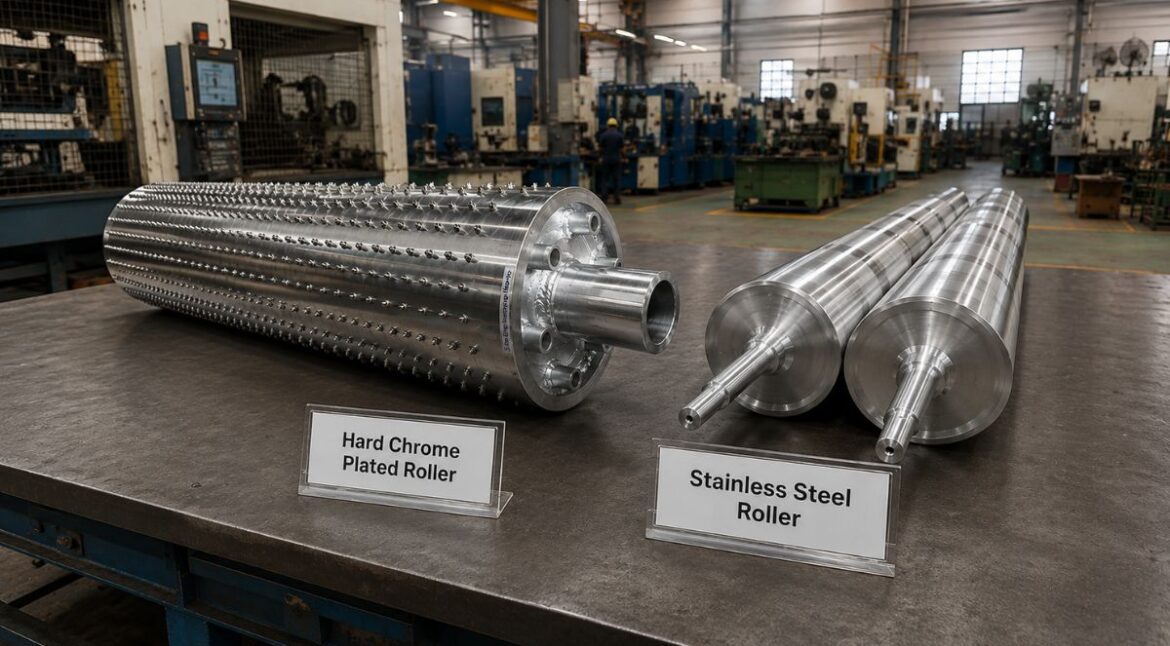
Hard Chrome Plated Roller vs. Stainless Steel Roller: Which Is Best for Your Application?
In high-speed production plants, web converting lines, and packaging factories, even a brief spell of unexpected downtime can disrupt an entire month’s operational budget. When your machinery runs continuously, the simple rollers guiding your material are the unsung heroes of your entire operation. A single scratch, a spot of rust, or a sticky residue on a roller surface can lead to thousands of meters of ruined material and hours of lost productivity.
If you are a plant manager, design engineer, or procurement head in India or managing a global supply chain, you will eventually face a crucial machinery decision: Should you install a Hard Chrome Plated Roller or opt for a Stainless Steel Roller?
While both choices are built to handle heavy industrial workloads, they do so using completely different materials and designs. Choosing the incorrect type for your specific environment can lead to premature wear, steering problems, contamination of your products, or unnecessary capital expenditure.
As Siva Rollers, India’s trusted manufacturer and global exporter of high-precision industrial rollers, we believe in providing clear, practical guidance. In this guide, we will break down these two industrial stalwarts side-by-side, helping you make an informed, data-driven decision for your facility.
What Is Under the Hood? Understanding the Two Technologies
To choose the right roller, we must first look at how they are built and how they handle everyday stress on the production floor.
What Is a Hard Chrome Plated Roller?
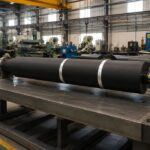
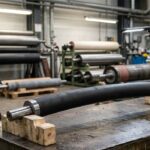
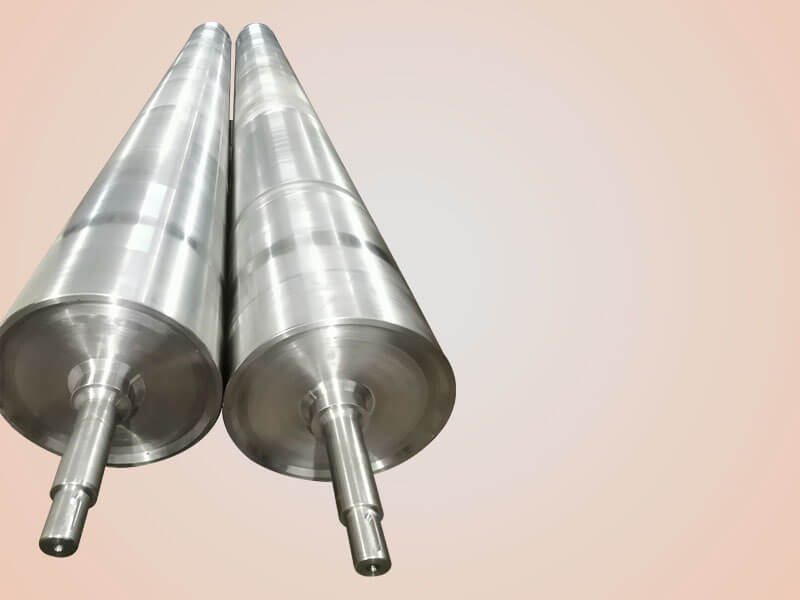
A Hard Chrome Plated Roller (often called a Chrome Coated Roller in many processing facilities) starts its life with a robust, high-tensile carbon steel or alloy steel core. Once this core is machined and ground to a perfect, balanced circle, it undergoes an industrial electroplating process.
During this process, a thin, high-density layer of industrial chromium is bonded to the outer surface. This protective chromium skin usually ranges from 25 to 75 microns in thickness. The purpose of utilizing specialized Chrome Coating Rollers is to create an incredibly hard, glass-smooth, and low-friction surface. The strong steel core handles the physical weight and tension of your line, while the outer chrome skin acts as an armor plating against wear and tear.
What Is a Stainless Steel Roller?
In contrast, a Stainless Steel Roller does not rely on a thin outer coating. Instead, the entire roller is constructed from solid stainless steel alloy. Alternatively, manufacturers use a process called Stainless Steel Cladding Rollers, where a thick sheet of stainless steel is wrapped and welded seamlessly over a carbon steel core before being ground down to a perfect finish.
Because the corrosion-resistant elements (like chromium and nickel) are mixed directly into the metal alloy itself, the protection goes all the way through. If the surface gets scratched or scuffed, the metal naturally reacts with oxygen in the air to rebuild its own protective barrier.
Hardness, Wear, and Friction: The Daily Physical Grind
When abrasive materials like paper, plastic film, metal foils, or textiles slide over a roller under high tension, the roller’s surface must resist continuous friction. Let’s look at how both materials handle physical wear.
Scratch Resistance and Surface Hardness
Surface hardness is the absolute defining feature of a Hard Chrome Plated Roller. On the standard industrial hardness scale, hard chrome ranks exceptionally high. It is significantly harder than standard industrial stainless steel.
- In Abrasive Environments: If your production line handles materials that contain tiny abrasive particles (like paper pulp, cardboard, or raw textiles), or if your machine uses metal scraping blades (Doctor Blades) to clean the rolls, a hard chrome surface is highly resistant to scratching.
- The Danger of Scratches: On a softer stainless steel surface, abrasive fibers or debris can slowly cut micro-grooves into the metal. These tiny scratches can trap dust and residues, causing the passing material to drag, tear, or show visual marks.
Slippery Surfaces and Easy Release
In converting, printing, and adhesive coating lines, how easily a material “releases” from the roller surface is a major factor in maintaining speed.
The electroplated finish of a Chrome Coated Roller has an incredibly low coefficient of friction, meaning it is naturally very slippery. Sticky adhesives, hot plastics, wet inks, and dust struggle to stick to it. This non-stick quality means your operators spend far less time stopping the machine to clean buildup off the rollers.
While stainless steel can be polished to a beautiful mirror finish, its base metal has higher surface energy. This means that hot plastics, glues, and coatings are more likely to stick to a stainless surface, often requiring manual cleaning or the addition of expensive non-stick sleeves.
The Battle Against Rust: Chemical and Wet Environments
While hard chrome excels in pure hardness, the tables turn completely when moisture, steam, corrosive chemicals, or aggressive washdown liquids are present in your facility.
The Weakness of Plated Coatings
The process of electroplating chrome onto steel naturally leaves tiny, invisible microscopic cracks in the outer layer. In dry, clean operating conditions, these micro-cracks are completely harmless.
However, in wet, highly humid, or chemically active environments, moisture and corrosive fumes can seep down through these microscopic cracks. Once the moisture reaches the carbon steel core underneath, rust begins to form. As rust grows, it expands, pushing the chrome coating upward. This causes the chrome to bubble, crack, and eventually flake off. Once a plated surface begins to peel, the roller is ruined, and sharp chrome flakes can contaminate your product line.
The Lifetime Protection of Stainless Steel
This is where a Stainless Steel Roller becomes absolutely necessary. Because there is no separate coating to peel, bubble, or flake, the risk of surface delamination is zero.
Whether you choose solid stainless steel or Stainless Steel Cladding Rollers, the material maintains a continuous, self-healing shield.
- It easily survives daily, aggressive washdowns using heavy detergents and sanitizers.
- It does not rust when exposed to water, steam, salt spray, or organic acids.
- It completely eliminates the risk of metallic flakes or chips falling into your product, making it the standard choice for clean, highly regulated environments.
Industry Guide: Which Roller belongs in Your Plant?
To help simplify your procurement and engineering decisions, we have mapped these two roller options to their ideal industrial applications based on years of manufacturing experience at Siva Rollers.
When to Choose a Hard Chrome Plated Roller
- Paper, Pulp, and Board Production: The continuous, high-speed movement of highly abrasive paper fibers will quickly wear down softer metals. The extreme hardness of hard chrome prevents wear grooves from forming on the roller over years of service.
- Flexible Packaging and Film Extrusion: Mirror-finished Chrome Coating Rollers are excellent for cooling hot plastic films. They provide rapid, even cooling while ensuring the hot plastic film releases smoothly without sticking or warping.
- Metal Slitting and Coil Processing: Rollers handling metal strips must withstand high tension and sharp edges. The rugged scratch-resistance of hard chrome keeps the roller surface perfect, ensuring it does not leave marks on the finished metal sheet.
- Textile Processing and Printing: High-speed fabric guide rollers require a smooth, slippery surface to keep web tension consistent without pulling or snagging the fibers.
When to Choose a Stainless Steel Roller
- Food and Beverage Packaging: Food safety standards require zero risk of chemical reactions or flaking coatings. Solid stainless steel rollers can handle constant hot-water washdowns and acidic food juices without degrading.
- Pharmaceutical Manufacturing: In environments where absolute purity is required, a high-quality Stainless Steel Roller India manufacturers export globally ensures there is no risk of heavy metal contamination.
- Chemical Processing and Fertilizers: Corrosive fumes and wet chemical mixtures will rapidly destroy electroplated surfaces, making solid stainless steel the only reliable, long-term option.
- Battery Manufacturing (Lithium-Ion): The volatile chemical mixtures used in modern battery production demand stainless steel components to prevent tiny iron particles from getting into the battery cells, which can cause battery failures.
Total Cost of Ownership: Upfront Price vs. Long-Term Value
For smart purchasing managers, the initial price on the invoice is only part of the equation. To truly get the best return on your investment, you must look at maintenance, lifespans, and the ability to rebuild the roller.
Upfront Capital Cost
A high-quality Stainless Steel Roller almost always requires a larger initial investment. Stainless steel alloys are expensive materials, and they are significantly harder to machine, grind, and polish than standard carbon steel. This extra labor and material cost increases the starting price of the roller.
The Rebuilding Advantage of Hard Chrome
The great economic advantage of a Hard Chrome Plated Roller is its unique ability to be recycled and rebuilt multiple times:
- When a chrome roller eventually wears down after years of hard work, you do not need to throw it away.
- The worn-out chromium layer can be safely stripped off in a specialized chemical bath.
- The underlying carbon steel core can be inspected, balanced, lightly reground, and electroplated with a brand-new, perfect layer of hard chrome.
- This rebuilding process costs only a fraction of buying a brand-new roller, yet it returns your roller to “like-new” performance.
With solid stainless steel, you can regrind and polish the surface to remove minor scratches, but each grind slightly reduces the outer diameter of the roller. Over time, this can push the roller out of your machinery’s mechanical tolerances, meaning the entire roller must eventually be replaced.
Why Siva Rollers is Your Trusted Precision Partner
At Siva Rollers, we understand that your machinery is only as reliable as its weakest rotating part. We do not believe in a one-size-fits-all approach. Whether you are running a printing plant in Ahmedabad, an automotive line in Chennai, or importing precision components to Europe, North America, or the Middle East, we engineer each roller to your exact application footprint.
Our state-of-the-art manufacturing facility in India combines quality materials, experienced craftsmanship, and rigorous quality control:
- Perfect Dynamic Balancing: To eliminate high-speed vibrations, extend the life of your machine’s bearings, and ensure smooth material handling, every roller we make undergoes detailed dynamic balancing.
- Super-Smooth Finishes: Utilizing advanced polishing and super-finishing machinery, we can achieve incredibly smooth surfaces down to mirror-like finishes for delicate film and paper applications.
- High-Grade Material Sourcing: We source only certified, defect-free steel and stainless steel alloys to ensure there are no weak spots or inclusions in your roller’s body.
- Controlled Electroplating: Our hard chrome plating process is monitored closely for temperature and thickness, resulting in an incredibly dense chrome layer with maximum bond strength and minimal micro-cracks.
The Final Selection Checklist: Making Your Choice
Before placing your next order, walk through these five simple questions to confirm which roller type fits your exact operational needs:
- Does the roller operate in a wet, humid, or chemically corrosive environment?
- Yes: Choose a Stainless Steel Roller to avoid the risk of rust, bubbling, and coating failure.
- No: Proceed to the next question.
- Is your material highly abrasive (such as heavy cardboard, metal strips, or glass fibers)?
- Yes: Choose a Hard Chrome Plated Roller to take advantage of its superior scratch resistance.
- Is the roller intended for direct food contact, pharmaceutical use, or medical packaging?
- Yes: Choose a Stainless Steel Roller to meet safety standards and prevent any risk of paint or metal flaking.
- Are you processing sticky glues, warm plastics, or coatings where material sticking is a major issue?
- Yes: Choose a Hard Chrome Plated Roller for its slippery, low-friction surface.
- Are you looking to keep your long-term machinery costs low by using a roller that can be stripped and rebuilt in the future?
- Yes: Choose a Hard Chrome Plated Roller for its cost-effective surface renewability.
Partner with Siva Rollers: Engineered for Durability. Trusted for Precision.
Choosing the right roller is a balance of operational environment, physical demands, and lifetime cost. Making the wrong choice can lead to frequent downtime, wasted raw materials, and high maintenance bills.
At Siva Rollers, our engineering team is ready to review your machinery drawings, assess your production environment, and recommend the exact material, coating, and finish your line needs.
With our global sea-freight packaging, reliable export compliance, and competitive manufacturing based in India, we deliver world-class industrial rollers to businesses worldwide.
Get a Custom Consultation and Quote Today
Do not leave your plant’s productivity to guesswork. Contact our sales team today to discuss your specific roller needs, request a technical drawing review, or receive a competitive price quotation.
Siva Rollers — Built to Last. Designed to Perform.
Contact US : +91 75070 10009 , info@sivarollers.com
FAQs
The best choice depends on your application. Hard Chrome Plated Rollers offer excellent wear resistance, surface hardness, and low friction, making them ideal for paper, film, textile, and metal processing. Stainless Steel Rollers provide superior corrosion resistance and hygiene, making them the preferred option for food, pharmaceutical, and chemical industries.
You should choose a Hard Chrome Plated Roller when your production process involves abrasive materials, high-speed operations, sticky coatings, hot plastic films, or applications where surface hardness and scratch resistance are critical. They are widely used in paper mills, printing plants, packaging lines, and metal processing industries.
Stainless Steel Rollers are preferred because they resist rust, corrosion, and contamination. Unlike plated rollers, they do not have a coating that can peel or flake. Their hygienic properties make them suitable for food processing, beverage packaging, pharmaceutical manufacturing, and medical packaging applications.
Hard Chrome Plated Rollers offer moderate corrosion resistance in dry environments. However, prolonged exposure to moisture, chemicals, steam, or washdown conditions can cause corrosion beneath the chrome layer if the coating becomes damaged. For highly corrosive environments, Stainless Steel Rollers are generally a better choice.
Hard Chrome Plated Rollers typically provide better wear resistance because hard chrome is significantly harder than standard stainless steel. This makes them ideal for applications involving abrasive materials such as paper pulp, cardboard, textiles, and metal strips.
Yes. Stainless Steel Rollers are specifically designed to withstand harsh chemicals, moisture, acids, detergents, and corrosive environments. Industries such as chemical processing, fertilizer manufacturing, battery production, and wastewater treatment commonly use stainless steel rollers for long-term reliability.
The lifespan depends on operating conditions, load, speed, and maintenance practices. In many industrial applications, a properly maintained Hard Chrome Plated Roller can deliver years of reliable performance. Additionally, worn chrome surfaces can often be stripped and re-plated, extending the roller's service life.
Generally, yes. Stainless Steel Rollers usually have a higher upfront cost due to the price of stainless steel alloys and the manufacturing processes involved. However, their excellent corrosion resistance and minimal maintenance requirements can provide long-term value in demanding environments.
Hard Chrome Plated Rollers are often the preferred choice for packaging and film extrusion lines because their smooth, low-friction surface helps prevent sticking, improves material release, and supports consistent web handling at high production speeds.
Consider the operating environment, material characteristics, exposure to moisture or chemicals, hygiene requirements, wear conditions, and maintenance costs. Consulting an experienced roller manufacturer like Siva Rollers can help you determine whether a Hard Chrome Plated Roller or Stainless Steel Roller is the most cost-effective and reliable solution for your production line.