How Our Water Cooling Rollers Improve Temperature Control in Industrial Production
In the high-stakes environment of industrial manufacturing—spanning plastic extrusion, paper processing, textile finishing, and metal converting—precision is not just a metric; it is the difference between a market-leading product and a high-waste production run. At the heart of this precision lies thermal management.
As a premier Water Cooling Roller Manufacturer, Siva Rollers understands that maintaining consistent substrate temperature is the single most critical factor in achieving dimensional stability and surface integrity. In this guide, we explore how advanced water-cooled roller technology optimises industrial production, reduces downtime, and maximises ROI for plant managers and OEMs globally.
The Role of Water Cooling Rollers in Modern Manufacturing
Industrial machinery generates significant heat through friction, chemical reactions, or the inherent temperature of the processed material. Without an efficient cooling mechanism, this thermal energy accumulates, leading to material deformation, adhesive failure, or even structural damage to the machinery itself.
An Industrial Cooling Roller (often referred to as a chill roller or heat transfer roller) acts as a high-efficiency heat exchanger. By circulating temperature-controlled water through an internal chamber or spiral fluting, the roller absorbs heat from the web or material passing over its surface.
Why Temperature Control is Non-Negotiable
For engineers and plant managers, the focus on temperature control stems from three primary operational requirements:
- Dimensional Stability: Materials like plastic films or thin metal foils expand and contract with temperature shifts. Precise cooling ensures the material maintains its intended gauge and width.
- Surface Quality: In printing and coating, “hot spots” on a roller can cause uneven ink drying or coating thickness. A high-quality Water Cooling Roller provides a uniform thermal profile across the entire face of the cylinder.
- Process Speed: The faster you can remove heat, the faster you can run your production line. Inefficient cooling is often the “bottleneck” that prevents manufacturers from reaching peak machine speeds.
How Siva Rollers Enhance Thermal Efficiency
As a leading Industrial Roller Manufacturer in India, Siva Rollers does not believe in a “one-size-fits-all” approach. The effectiveness of a cooling system depends heavily on the internal architecture of the roller and the materials used in its construction.
1. Advanced Internal Flow Designs
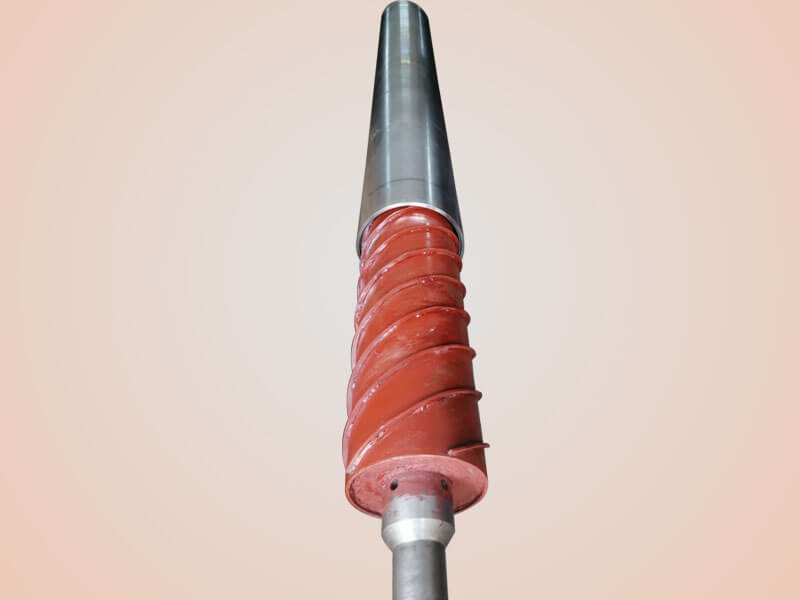
The internal geometry of a Water Cooling Roller determines the Reynolds number of the fluid flow—a key factor in the heat transfer coefficient. We utilise advanced engineering to prevent “laminar flow” (where water sits stagnant against the inner walls) and encourage “turbulent flow,” which maximises the rate of heat absorption.
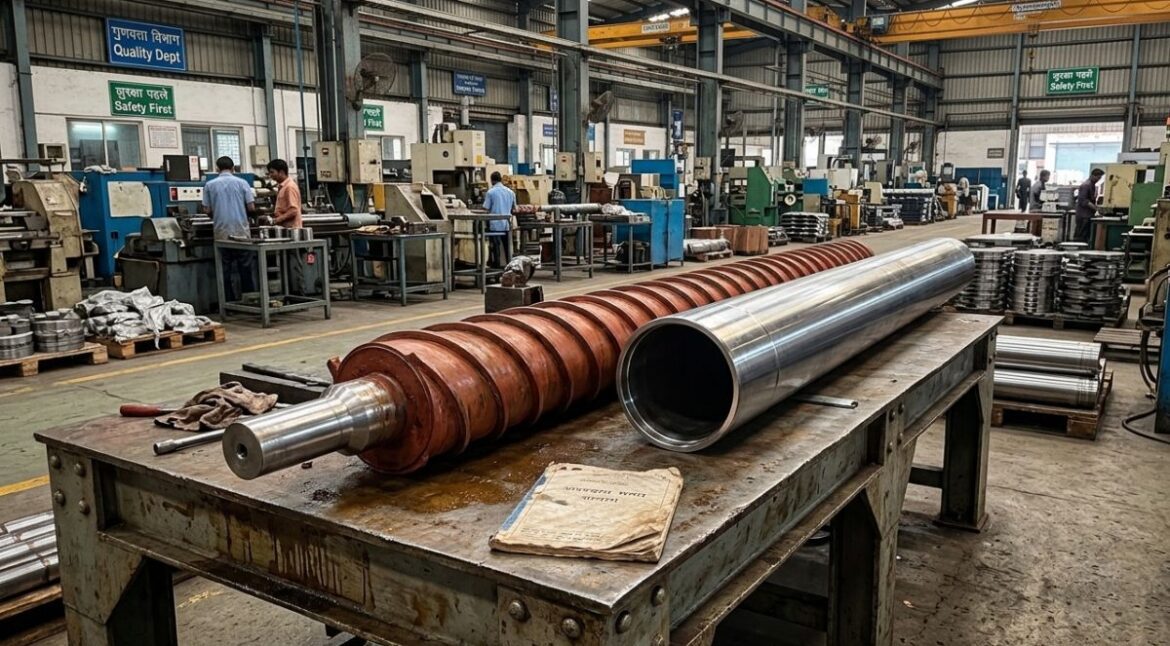
- Spiral Fluted Mandrels: By forcing water through a spiral path, we ensure that every square inch of the roller face receives consistent cooling, eliminating the risk of localised overheating.
- Double-Shell Construction: This design allows for high-velocity water flow in a narrow gap between the inner and outer shells, significantly increasing the heat transfer rate compared to simple hollow cylinders.
2. High-Performance Metallurgy
The choice of shell material impacts both thermal conductivity and durability. Depending on your specific application, we offer rollers in high-grade carbon steel, stainless steel, or specialised alloys. Each roller is engineered to withstand the internal hydraulic pressure of the cooling system while maintaining a perfectly balanced rotational axis.
3. Precision Surface Engineering
A Temperature Control Roller is only as good as its contact surface. Whether your process requires a mirror-finish chrome plating for high-clarity films or a matte sandblasted finish for grip and traction, our surface treatments are designed to optimise the “wrap” and contact area, ensuring maximum thermal exchange between the product and the cooling medium.
Overcoming Common Industrial Heat Challenges
Manufacturers often face persistent “pain points” related to thermal management. Identifying these early can save thousands of dollars in wasted material and maintenance costs.
Eliminating “Hot Spots” and Thermal Bridging
In lower-quality rollers, water can “short-circuit,” moving from the inlet to the outlet without circulating through the entire body. This creates uneven temperature zones. Our Custom Cooling Rollers are designed with precision-baffled internals that guarantee the cooling medium covers the entire effective face length.
Managing Condensation (The “Sweat” Factor)
In humid environments, cooling a roller significantly below the dew point can cause condensation, which ruins paper products or contaminates coatings. Our engineering team works with your plant’s HVAC and chiller specs to determine the optimal flow rate and temperature delta to achieve cooling without the risk of moisture accumulation.
Corrosion Resistance and Longevity
Because water is the primary cooling medium, internal corrosion is a significant threat. We utilise specialised internal coatings and high-grade seals to prevent rust buildup, which can act as an insulator and reduce cooling efficiency over time. This focus on longevity is why Siva Rollers is a trusted Water Cooling Roller Manufacturer for heavy-duty industrial applications.
The ROI of Investing in High-Quality Industrial Cooling Rollers
For B2B buyers and OEMs, the decision to upgrade or source premium rollers is driven by the bottom line. The return on investment for a Siva Rollers cooling system is realised through several key channels:
- Reduction in Scrap Rates: By maintaining a consistent temperature, you eliminate the “startup waste” that occurs while waiting for a machine to stabilise.
- Increased Machine Throughput: Efficient heat removal allows for higher RPMs on extruders, laminators, and printing presses.
- Lower Energy Consumption: Advanced flow designs require less pumping power and allow chillers to operate at more efficient setpoints.
- Extended Component Life: Properly cooled rollers reduce the thermal stress on bearings, seals, and drive systems, leading to fewer unplanned maintenance shutdowns.
Critical Applications for Water Cooling Rollers
The versatility of our Industrial Cooling Rollers makes them essential across a variety of sectors. Each industry presents unique thermal challenges:
Plastic & Film Extrusion
In cast film or sheet extrusion, the “quench” speed is vital. If the cooling is too slow, the polymer crystallises improperly, leading to poor clarity or brittle spots. Our rollers provide the rapid, uniform quenching required for high-speed film production.
Paper & Converting
The paper industry deals with high-speed webs that generate immense friction heat. Cooling system rollers prevent the paper from becoming too dry and brittle, ensuring it maintains the correct moisture balance for further processing or printing.
Textile Finishing
Heat setting and calendering require precise temperature increments. Our Chill & Heat Transfer Rollers allow textile manufacturers to transition from high-heat processing to ambient temperatures quickly, “locking in” the fabric’s finish and dimensions.
Why Choose Siva Rollers? (The Ahmedabad Advantage)
Based in Ahmedabad, a global hub for industrial manufacturing and engineering, Siva Rollers combines traditional craftsmanship with modern CAD/CAM technology. As a prominent Water Cooling Roller Manufacturer, our reputation is built on:
- Customization: We don’t just sell products; we engineer solutions. Every roller is built to the specific load-bearing, speed, and thermal requirements of your machine.
- Quality Assurance: Every Water Cooling Roller undergoes rigorous pressure testing and dynamic balancing to ensure vibration-free operation at high speeds.
- Technical Support: From initial design consultation to post-installation optimization, our engineers are available to ensure your cooling system performs at peak efficiency.
Strategies for Optimizing Your Cooling System
To get the most out of your Industrial Cooling Roller, consider these operational best practices:
- Monitor Delta T: Regularly check the temperature difference between the inlet and outlet water. A high delta may indicate a flow restriction, while a very low delta might suggest the water is bypassing the internal baffles.
- Filtration is Key: Ensure your cooling water is filtered. Scale and sediment buildup inside a roller can drastically reduce thermal conductivity.
- Regular Seal Inspection: The rotary unions and seals are the “heart” of the water delivery system. Preventative replacement of these components avoids costly leaks and downtime.
Partnering with a Specialist Manufacturer
Temperature control is the silent partner in industrial success. By choosing a high-performance Water Cooling Roller, you are investing in the stability of your product, the speed of your production, and the longevity of your machinery.
Siva Rollers remains committed to pushing the boundaries of thermal engineering. Whether you are an OEM looking for a reliable component partner or a plant manager looking to upgrade an existing line, our team in Ahmedabad is ready to deliver world-class Industrial Cooling Rollers tailored to your needs.
Looking to improve your production’s thermal efficiency? Contact Siva Rollers today for a technical consultation. Let us help you design the perfect cooling solution for your industrial application.
Contact US : +91 75070 10009 , info@sivarollers.com
FAQs
A water cooling roller is an industrial heat transfer component that uses circulating temperature-controlled water to absorb and remove heat from materials like plastic films, paper, textiles, or metal during manufacturing. It ensures consistent temperature control, preventing deformation and improving product quality.
Water cooling rollers improve temperature control by maintaining a uniform thermal profile across the roller surface. Advanced internal flow designs such as spiral channels and turbulent flow systems ensure efficient heat absorption and eliminate uneven cooling or hot spots.
Temperature control is critical because it directly affects dimensional stability, surface finish, and production speed. Poor thermal management can lead to defects, material shrinkage, inconsistent coating, and increased waste in industrial production.
Industrial cooling rollers are widely used in:
- Plastic extrusion and film production
- Paper and converting industries
- Textile finishing and calendering
- Printing and coating applications
- Metal processing and foil manufacturing
Hot spots occur due to uneven water flow, poor internal design, or bypassing of coolant from inlet to outlet without proper circulation. High-quality rollers use baffled or spiral internal designs to ensure uniform cooling across the entire surface.
By rapidly removing heat from materials, water cooling rollers allow machines to operate at higher speeds. This reduces cycle time, improves throughput, and minimizes downtime caused by overheating or thermal instability.
Water cooling rollers are typically made from:
- Carbon steel for strength and cost efficiency
- Stainless steel for corrosion resistance
- Specialized alloys for high thermal conductivity and durability
Material selection depends on application, pressure, and environmental conditions.
Condensation can be avoided by controlling the roller surface temperature above the dew point and optimizing water flow rate. Proper coordination with HVAC systems and chiller settings helps prevent moisture formation on the roller surface.
Key maintenance practices include:
- Monitoring inlet and outlet temperature (Delta T)
- Ensuring proper water filtration to avoid scaling
- Regular inspection of seals and rotary unions
- Periodic cleaning to maintain heat transfer efficiency
High-quality water cooling rollers offer:
- Reduced scrap and material waste
- Improved product consistency and surface finish
- Higher production speeds
- Lower energy consumption
- Longer equipment lifespan and reduced maintenance costs