The Ultimate Troubleshooting Guide for Rubber Printing Roller Defects
In the high-speed world of industrial printing and packaging, precision is everything. A single hour of unexpected press downtime can cost thousands of dollars in wasted substrates, ruined inks, and missed delivery deadlines. At the heart of this precision is your rubber printing roller.
Whether you are running a high-speed flexographic press, a classic offset lithography machine, or a modern gravure system, the performance of your printing roller directly dictates your final print quality. When a defect arises, your first instinct might be to blame the ink or the substrate. However, more often than not, the culprit is a compromised printing rubber roller.
As a leading global industrial roller manufacturer, Siva Rollers has spent decades helping printing businesses across India and worldwide maintain flawless operational efficiency. In this ultimate troubleshooting guide, we will break down the most common rubber roller defects, analyze their root causes, provide immediate actionable solutions, and show you how partnering with the right manufacturer can eliminate these headaches entirely.
Need Custom Rubber Rollers?
✓ Custom Diameter & Length
✓ Temperature Control Design
✓ Fast Manufacturing
✓ Technical Support
Why Rubber Printing Roller Health is Your Most Crucial Press Asset
A rubber printing roller does not simply transfer ink; it manages film thickness, regulates pressure, and ensures consistent material contact. Because industrial rollers operate under constant mechanical stress, friction, and chemical exposure, they are prone to gradual wear and tear.
Ignoring minor roller degradation leads to a compounding chain reaction:
- Declining Print Quality: Smudging, ghosting, and uneven ink distribution.
- Premature Component Wear: Misaligned or damaged rollers put unnecessary strain on bearings and gears.
- Skyrocketing Operating Costs: Frequent wash-ups, wasted raw materials, and high energy consumption.
Understanding how to diagnose and resolve these defects is the key to maintaining a highly profitable, smooth-running production line.
Common Rubber Printing Roller Defects: Causes and Solutions
When your press performance drops, quick diagnosis is essential. Below is an in-depth breakdown of the five most frequent industrial printing roller defects, why they happen, and how you can resolve them on the shop floor.
1. Roller Swelling and Softening
The Symptoms: The roller surface feels unusually soft or sticky to the touch. The roller diameter has visibly increased, causing excessive nip pressure, heavy ink transfer, and blurred print images.
- The Cause: Swelling occurs due to chemical incompatibility. When the rubber compound of your printing rubber roller absorbs solvents from inks, washes, or fountain solutions, it expands and loses its structural integrity.
- The Solution:
- Immediate action: Remove the swollen roller and replace it with a spare to prevent mechanical damage to your press.
- Audit your chemistry: Check if you are using UV inks with rollers designed strictly for conventional water-based or solvent-based inks.
- Upgrade your compound: Work with an experienced industrial rubber roller specialist to match your roller elastomers (such as EPDM, Nitrile, or Polyurethane) to the exact chemical profile of your inks and cleaning solvents.
2. Roller Shrinkage and Hardening
The Symptoms: The roller surface becomes dry, brittle, or glassy. The outer diameter decreases, resulting in poor ink transfer, light printing spots, and a lack of proper ink distribution across the web.
- The Cause: Over time, exposure to high operating temperatures, friction, and harsh extraction solvents strips the plasticizers out of the rubber matrix. Additionally, ozone exposure from high-voltage corona treaters or UV curing lamps accelerates rubber aging, leading to oxidation and hardening.
- The Solution:
- Check Shore Hardness (Durometer): Regularly measure your roller’s hardness using a durometer gauge. If it has increased by more than 5 to 7 points from its original rating, it is time for a replacement.
- Improve cooling and ventilation: Ensure your press room has adequate temperature controls and that internal roller cooling systems (if applicable) are functioning correctly.
- Optimize wash-up routines: Avoid leaving highly volatile cleaning solvents on the roller surface for extended periods.
3. Surface Glazing and Clogging
The Symptoms: The roller takes on a highly reflective, mirror-like finish. It fails to grip, carry, or transfer ink efficiently, leading to inconsistent color density and stripping (where the roller rejects ink entirely).
- The Cause: Glazing is caused by a build-up of dried ink resins, pigment residues, fountain solution gum, and paper dust. When these contaminants are not thoroughly removed during routine wash-ups, they create a hard, non-porous barrier over the rubber pores.
- The Solution:
- Deep clean the surface: Use a specialized chemical de-glazer to penetrate and dissolve the embedded microscopic residues.
- Implement a dual-step wash-up: Use a dedicated ink solvent followed by a water-miscible wash to remove both solvent-soluble and water-soluble contaminants.
- Regular maintenance: Do not wait for glazing to affect print quality. Establish a weekly deep-cleaning protocol for all active rollers.
4. Cracking, Pitting, and Chipping
The Symptoms: Small hairline cracks appear along the roller body, or physical chunks of rubber begin to pit and chip away, especially at the roller edges. This leads to immediate print voids and lines.
- The Cause: Mechanical overloading, excessive nip pressure, or running the rollers dry (without ink or dampening fluid acting as a lubricant) generates intense localized heat. Additionally, ozone cracking occurs when rollers are stored improperly near electrical equipment.
- The Solution:
- Verify setting pressure: Always set your roller-to-roller and roller-to-plate pressure according to the machine manufacturer’s precise guidelines. Never over-tighten rollers to compensate for worn-out bearings.
- Use roller paste/lubricants: If running a multi-unit press with some idle units, apply a high-quality roller lubricant to prevent dry running and heat buildup.
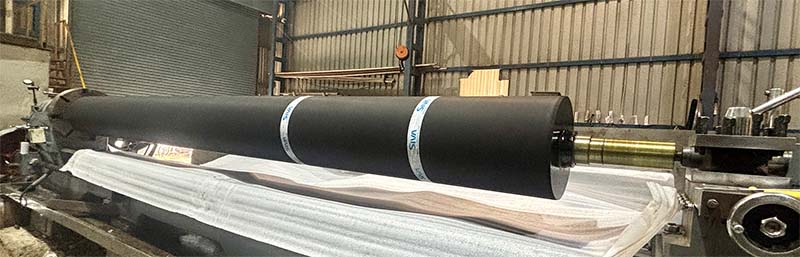
- Store rollers correctly: Wrap stored rollers in light-proof, ozone-resistant paper and store them suspended by their journals—never rest them on their rubber faces.
5. Uneven Wear and Striations
The Symptoms: The roller wears down unevenly, showing concentric grooves or a tapered profile where one side is noticeably thinner than the other. This results in highly inconsistent printing across the width of the substrate.
- The Cause: This is primarily a mechanical issue caused by improper alignment, uneven bearing wear, or bent steel shafts/journals. It can also occur if the web width is consistently narrower than the roller face, causing localized wear in the center.
- The Solution:
- Check mechanical alignment: Inspect the roller journals, bearings, and housing for play, wear, or misalignment.
- Regularly regrind or re-cover: Have your rollers dynamically balanced and precision-ground by an expert industrial roller manufacturer to restore perfect concentricity.
- Cycle your rollers: Rotate your inventory to prevent single rollers from bearing the brunt of long-run, narrow-web jobs.
Defect | Primary Root Cause | Quick Shop-Floor Fix | Long-Term Prevention |
Swelling / Softening | Chemical incompatibility (solvent absorption) | Swap roller immediately; check ink type | Work with Siva Rollers for customized elastomeric compounding |
Shrinkage / Hardening | Heat degradation & plasticizer loss | Adjust press settings; use milder solvents | Optimize press-room ventilation; upgrade to heat-resistant rubber |
Surface Glazing | Embedded ink residues and paper dust | Apply specialized chemical de-glazer | Establish a standardized, dual-stage cleaning schedule |
Cracking / Chipping | Excessive pressure or running dry | Adjust nip settings; apply idle-unit paste | Train operators on proper pressure calibration and storage |
Uneven Wear | Misalignment or worn bearings | Replace bearings; re-align roller settings | Partner with a precision-engineering manufacturer for regular maintenance |
Actionable Preventive Maintenance Checklist for Press Operators
To maximize the lifespan of your printing rubber roller and keep your production lines moving, incorporate these daily, weekly, and monthly practices into your press-room workflow:
- Daily Inspection:
- Wipe down rollers at the end of every shift using manufacturer-approved washes.
- Inspect roller ends for ink buildup, which can harden and cause physical damage.
- Check bearings for excessive heat or unusual noise.
- Weekly Audits:
- Perform a physical inspection for swelling, softening, or surface glazing.
- Check and document roller nip widths across the entire length of the roller.
- Clean the roller frames and adjustment mechanisms to ensure smooth operation.
- Monthly Maintenance:
- Measure the Shore hardness (Durometer) of every roller and compare it to its installation baseline.
- Inspect stored spare rollers to ensure they are suspended on their journals in a cool, dark, dry environment.
- Partner with a trusted industrial roller manufacturer to schedule professional regrinding or re-covering before the rubber degrades beyond repair.
Why Partnering with a Premier Industrial Roller Manufacturer Saves You Money
When troubleshooting on the shop floor isn’t enough, the root of your problem often lies in the quality of the roller itself. Off-the-shelf rollers rarely survive the demanding environments of modern, high-speed printing presses.
This is where partnering with Siva Rollers—one of the top printing rollers manufacturers in India—makes a massive difference to your bottom line.
Customized Compound Engineering
No two printing operations are identical. Siva Rollers specializes in custom elastomeric compounding. Whether your press utilizes water-based inks, high-solvent flexo inks, or aggressive UV-curable chemistries, we design and manufacture a printing rubber roller tailored precisely to resist chemical absorption, heat, and physical wear.
Precision Manufacturing & Dynamic Balancing
An imbalanced roller causes vibrations, premature bearing failure, and inconsistent ink transfer. At Siva Rollers, every industrial rubber roller undergoes rigorous dynamic balancing and state-of-the-art precision grinding. This guarantees perfect concentricity and dimensional stability, ensuring your presses run faster, smoother, and longer.
Global Standards, Made in India
Based in India, Siva Rollers combines world-class manufacturing technology with cost-efficient production. This allows us to supply premium-grade rollers locally and export them globally to packaging and printing plants worldwide. When you choose us, you get international-standard durability without the exorbitant import costs.
Boost Your Press Efficiency with Siva Rollers
Are recurring roller defects causing expensive downtime in your facility? Don’t let a failing printing roller eat into your profit margins.
At Siva Rollers, we go beyond simply selling rollers. We act as your production partners, analyzing your unique printing environment, press speeds, and ink chemistries to deliver custom-engineered rubber rollers that stand the test of time.
Whether you need a single replacement roller or are looking to equip an entire fleet of new presses, our engineering team is ready to assist.
Take Action Today
Stop guessing and start optimizing. Contact our technical sales experts today for a free, no-obligation consultation. Let us help you select the perfect rubber compound and roller design to elevate your print quality and maximize your ROI.
- Request a Custom Quote: Share your press dimensions and chemical requirements for a fast, competitive pricing estimate.
- Consult Our Engineers: Schedule a technical call to troubleshoot your persistent roller issues with our specialists.
Contact Siva Rollers Now – Your Trusted Global Industrial Roller Manufacturer
Contact Us
Emial : info@sivarollers.com
Phone Number :
FAQs
The most common rubber printing roller defects include roller swelling, roller hardening, surface glazing, cracking, chipping, pitting, and uneven wear. These issues can lead to poor print quality, inconsistent ink transfer, increased downtime, and higher production costs.
A rubber printing roller typically swells when it absorbs incompatible solvents, inks, or cleaning chemicals. Chemical absorption causes the rubber to expand, resulting in excessive ink transfer, blurred prints, and increased roller pressure. Using the correct rubber compound for your ink system helps prevent swelling.
A hardened rubber printing roller often feels dry, brittle, and less flexible. Signs include poor ink transfer, faded print quality, uneven color distribution, and reduced roller diameter. Regular durometer testing can help detect hardness changes before performance issues occur.
Glazing occurs when dried ink, paper dust, pigments, and cleaning residues accumulate on the roller surface. This creates a smooth, shiny layer that prevents proper ink transfer. Routine deep cleaning and de-glazing treatments can restore roller performance.
Uneven wear is usually caused by misalignment, worn bearings, bent shafts, or incorrect pressure settings. The solution involves checking machine alignment, replacing damaged components, and having the roller professionally reground or recovered by an experienced roller manufacturer.
Printing rollers should be visually inspected daily, thoroughly cleaned weekly, and tested monthly for hardness, wear, and dimensional accuracy. Preventive inspections help identify problems early and extend roller lifespan.
The lifespan of a rubber printing roller depends on operating conditions, ink chemistry, maintenance practices, and roller quality. High-quality rollers that receive proper maintenance can last several years before requiring regrinding or re-covering.
Yes. Damaged rollers can cause streaks, ghosting, uneven ink coverage, color inconsistency, smudging, and print defects. Maintaining roller condition is critical for achieving high-quality printing results and reducing waste.
A roller should be replaced or re-covered when it exhibits severe swelling, deep cracks, excessive hardening, significant diameter loss, or major surface damage that cannot be corrected through cleaning or grinding. Professional inspection can determine the most cost-effective option.
Siva Rollers specializes in manufacturing high-performance rubber printing rollers designed for flexographic, offset, gravure, and packaging applications. With customized rubber compounds, precision engineering, dynamic balancing, and global-quality manufacturing standards, Siva Rollers helps businesses reduce downtime, improve print quality, and maximize productivity.