Types of Industrial Rollers and Their Uses: A Complete Buyer’s Guide
An industrial roller is a heavy-duty cylindrical tube or shaft used in manufacturing machinery to move, guide, press, heat, cool, or spread materials continuously. In modern factories handling plastic film, flexible packaging, paper, textiles, or aluminum foil, the industrial roller is the heart of the production line. Using the correct industrial roller keeps your machinery running smoothly, protects delicate sheets from damage, prevents costly material rejection due to wrinkles, and reduces downtime.
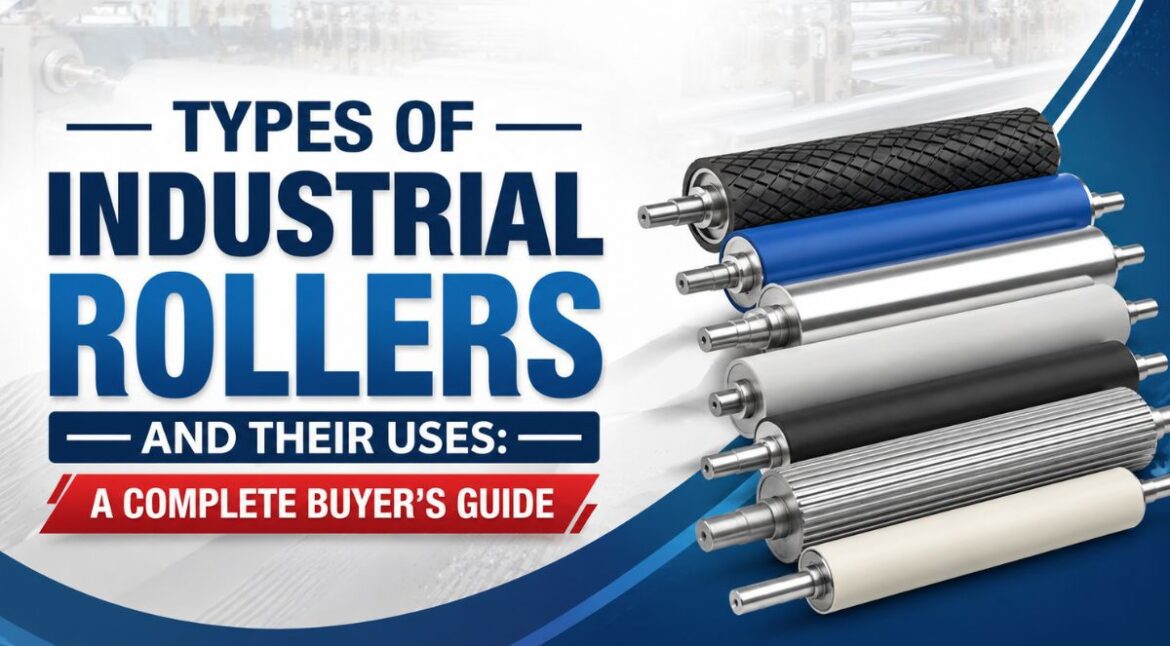
Different production lines require different types of industrial rollers depending on the material being processed, speed, temperature, and operating environment. This guide provides a detailed breakdown of the 14 core industrial rollers manufactured by Siva Rollers, helping factory owners, plant managers, and purchase teams select the exact roller for their machinery.
Quick Comparison: Types of Industrial Rollers
Roller Type | Outer Surface / Material | Main Purpose | Best Suited Applications |
1. Calender Rollers | Alloy Steel / Hard Chrome | High-pressure smoothing and flattening | Plastic sheets, rubber flooring, paper finishing |
2. Chrome Coating Rollers | Hard Chrome Plated Steel | Low-friction guiding and scratch protection | Printing presses, film slitting, packaging |
3. Plastic Extrusion Cooling Rollers | Stainless Steel / Shell Tube | Rapid cooling of hot plastic | Blown film, cast film, sheet extrusion lines |
4. Chill & Heat Transfer Rollers | Steel / Chrome Plated | Temperature control (heating/cooling) | Lamination, adhesive coating, fabric drying |
5. Anti-Deflection Rollers | Heavy Carbon Steel / Alloy | Prevents roller bending under heavy pressure | Squeezing presses, wide-width laminating |
6. Stainless Steel Cladding Rollers | Stainless Steel Outer Cladding | Rust and corrosion prevention | Dyeing tanks, chemical wash lines, food packaging |
7. Rubber Coated Rollers | Nitrile, EPDM, Silicone Rubber | Material grip and gentle pressing | Flexo printing, laminating, web pulling |
8. Ebonite Coated Rollers | Vulcanized Hard Rubber | Chemical resistance with hard surface | Textile wash lines, acid baths, paper mills |
9. PU Coated Rollers | Tough Polyurethane | Extreme wear, cut, and abrasion resistance | Steel coil handling, plywood feed, heavy material move |
10. Teflon Coated Rollers | Non-Stick Teflon Coating | Stops glue, ink, and plastic from sticking | Tape coating, heat sealing, glue stations |
11. Stainless Steel Guide Rollers | SS304 / SS316 Grade Steel | Smooth guiding without rust or drag | Film handling, pharma packaging, web alignment |
12. Aluminum Spreader Rollers | Lightweight Spiral-Grooved Aluminum | Removes wrinkles on light web lines | BOPP film, foil converting, high-speed printing |
13. Expander (Bow) Rollers | Curved Rubber / Metallic Sleeves | Removes stubborn creases across wide sheets | Slitter rewinders, textile processing, paper winders |
14. Ebonite Scroll Rollers | Grooved Hard Ebonite | Wrinkle removal inside liquid tanks | Fabric dyeing, chemical wash baths, wet paper lines |
Need Custom Industrial Rollers?
✓ Custom Diameter & Length
✓ Temperature Control Design
✓ Fast Manufacturing
✓ Technical Support
1. Calender Rollers
What It Is
Calender rollers are heavy-duty, thick-walled cylindrical rollers engineered to apply extreme pressure and uniform heat to continuous material sheets. They press out air bubbles, smooth rough surfaces, and ensure consistent thickness across the entire width of the product.
Detailed Plant Applications
- Plastic Sheet Manufacturing: Used in multi-roll calender stacks to compress hot plastic compounds into uniform PVC sheets, vinyl flooring, and rigid plastic films.
- Rubber Processing Lines: Essential in tire manufacturing plants and conveyor belt production for pressing rubber layers together securely.
- Paper Mills: Used in finishing stacks to flatten paper fibers, giving paper a smooth, glossy surface ready for high-quality printing.
Key Benefits
- Prevents Bending: Built with extra thick metal walls to handle intense crushing pressure without sagging or bending in the center.
- Uniform Surface Quality: Ensures that the finished sheet or film has the exact same thickness from the left edge to the right edge.
- Versatile Finishes: Can be finished with a smooth mirror polish or custom surface textures
2. Chrome Coating Rollers (Hard Chrome Plated Rollers)
What It Is
Chrome coating rollers are steel rollers treated with a thick layer of industrial hard chrome, followed by precision surface grinding and high-mirror polishing. The hard chrome layer protects the roller from daily wear, scratches, and rust.
Detailed Plant Applications
- Flexible Packaging & Printing: Used as main guide rollers in flexographic and rotogravure printing presses to guide printed plastic films without dragging.
- Slitting & Rewinding Machines: Keeps plastic films and aluminum foils moving smoothly through cutting blades at high speeds.
- General Converting Machinery: Installed in locations where materials continuously rub against the roller, requiring long-term scratch resistance.
Key Benefits
- Scratch-Free Operation: The mirror-smooth chrome surface minimizes surface friction so delicate films pass through without getting scratched.
- Corrosion Resistance: Resists rust caused by atmospheric moisture, mild cleaning solvents, and water-based inks.
- Long Operating Life: The tough outer chrome layer extends the service life of the roller, reducing how often you need to replace it Chrome layer thickness.
3. Plastic & Extrusion Line Cooling Rollers
What It Is
These rollers are specially engineered with internal fluid channels that allow cool liquid (usually chilled water) to circulate continuously inside the roller. As hot, soft plastic comes out of an extruder, passing over this roller cools it down instantly, setting it into a solid sheet or film.
Detailed Plant Applications
- Blown & Cast Film Extrusion: Used immediately after the extruder die to freeze melted polyethylene (PE), polypropylene (PP), or PET into clear packaging film.
- Plastic Sheet Extrusion: Essential in plants producing rigid plastic sheets for thermoforming trays, signboards, and container lids.
- Multilayer Lamination Lines: Helps cool down hot plastic coatings applied onto paper or woven fabric.
Key Benefits
- Fast Heat Removal: Internal spiral flow channels keep cold water moving evenly across the entire surface to cool the hot plastic rapidly.
- Prevents Film Distortion: Prevents hot spots on the roller surface, ensuring the plastic film cools evenly without warping, shrinking, or getting sticky.
- High Production Speeds: Enables extrusion machines to run at faster production speeds without overheating the final plastic product.
4. Chill & Heat Transfer Rollers
What It Is
Chill and heat transfer rollers are dual-purpose temperature control rollers. They are built with double-walled construction to allow warm oil, hot water, or cold water to flow inside them, allowing operators to raise or lower the surface temperature of the material moving over them.
Detailed Plant Applications
- Laminating & Coating Lines: Maintains precise heat to activate thermo-glues or chill laminated sheets to set pressure-sensitive adhesives instantly.
- Textile Finishing Machines: Supplies uniform heat to set fabric shapes, smooth out creases, or dry liquid treatments applied to cloth.
- Paper Coating Units: Heats paper webs prior to wax or liquid plastic application to ensure complete liquid absorption.
Key Benefits
- Precise Temperature Control: Keeps the outer surface at a steady, reliable temperature across the entire roller length.
- Thermal Stress Resistance: Built to handle constant temperature changes from cold to hot without cracking or warping.
- Custom Surface Finishes: Available with smooth ground, hard chrome, or rubber-coated outer surfaces depending on your process requirements.
5. Anti-Deflection Rollers
What It Is
When heavy pressing force is applied to the ends of a long roller, standard metal rollers tend to bend slightly downward in the middle. Anti-deflection rollers are engineered with internal core supports or custom outer shapes (crowned profiles) so the roller stays completely straight under heavy operational loads.
Detailed Plant Applications
- Heavy Dewatering Presses: Used in textile processing and paper mills to squeeze out water from thick fabric or wet paper sheets.
- Wide-Width Laminating Lines: Used in broad converting machinery where even pressure is needed across wide web materials.
- High-Pressure Nip Stations: Installed in nip positions where two rollers press against each other with heavy hydraulic force.
Key Benefits
- Eliminates Center Sag: Prevents uneven pressing in the middle of the material, avoiding loose edges or thick center spots.
- Prevents Longitudinal Wrinkles: Keeps pressure balanced from the left edge to the right edge so the web stays flat.
- Extends Rubber Cover Life: Protects rubber coatings on opposing rollers from wearing down unevenly in the center.
6. Stainless Steel Cladding Rollers
What It Is
Stainless steel cladding rollers feature a strong carbon steel core covered by a thick outer jacket (cladding) of high-grade stainless steel. This construction gives you the rust protection and clean performance of solid stainless steel at a much lower overall cost.
Detailed Plant Applications
- Textile Dyeing & Wet Processing: Used inside liquid wash tanks, chemical bath tubs, and dyeing machinery where mild steel would quickly rust.
- Food & Pharmaceutical Packaging: Installed in cleanroom environments that require daily washdowns and rust-free machine components.
- Moisture-Heavy Environments: Used in any production area exposed to continuous steam, water spray, or high humidity.
Key Benefits
- Cost-Effective Corrosion Protection: Provides a continuous rust-proof outer surface without paying for a solid stainless steel roller.
- Easy to Clean: Smooth stainless steel surface resists chemical staining and can be cleaned quickly during product changeovers.
- Durable Core Construction: The inner steel core provides heavy structural strength for high-tension machinery.
7. Rubber Coated Rollers
What It Is
Rubber coated rollers consist of a strong steel or aluminum core covered with a thick vulcanized rubber layer. The softer, flexible rubber surface provides high friction grip and cushions sensitive materials against harsh metal contact.
Detailed Plant Applications
- Flexographic & Gravure Printing: Acts as ink transfer rollers, nip rollers, and impression rollers in printing presses.
- Material Pulling & Feeding: Used in unwinding, rewinding, and pull-station units to pull film, paper, or fabric without slipping.
- Packaging & Converting: Essential for pressing adhesive laminates together without trapping air bubbles.
Key Benefits
- High Friction Grip: Prevents materials from slipping or dragging, keeping material tension steady throughout the process.
- Custom Rubber Formulations: Rubber covers can be selected based on your operational needs, including heat-resistant silicone, oil-resistant Nitrile (NBR), or weather-resistant EPDM Rubber hardness ranges.
- Vibration Absorption: Absorbs mechanical vibrations, leading to smoother web movement and quieter machine operation.
8. Ebonite Coated Rollers
What It Is
Ebonite rollers are covered with a very hard, fully vulcanized natural or synthetic rubber compound. Ebonite offers the rigid hardness of hard plastic along with extreme resistance to strong acids, alkalis, and harsh industrial wash chemicals.
Detailed Plant Applications
- Textile Chemical Processing: Extensively used in Mercerizing units, fabric bleaching ranges, and open-width washing machines.
- Paper Mill Wet Ends: Used as felt guide rollers and chemical application rolls exposed to acidic paper pulp.
- Steel Pickling Lines: Used in metal chemical treatment baths where liquid acids are present.
Key Benefits
- Chemical Resistance: Completely immune to damage from strong acids, alkaline liquids, and chemical wash solutions.
- Hard Non-Marking Surface: Will not mark or scratch delicate woven fabrics, non-woven sheets, or wet paper webs.
- Custom Surface Grooving: Surface can be easily grooved or cut with water-drainage channels to remove excess liquid fast.
9. PU Coated Rollers (Polyurethane Coated Rollers)
What It Is
Polyurethane (PU) coated rollers are covered with an ultra-tough synthetic elastomer layer. PU coatings offer high resistance to tearing, sharp cuts, heavy scraping, and physical impact, far outlasting standard natural or synthetic rubber.
Detailed Plant Applications
- Metal Processing & Steel Mills: Used as coil feeding rollers, sheet transport rollers, and slitting line support rolls handling sharp metal sheet edges.
- Plywood & Woodworking Machinery: Used for feeding heavy wooden panels and spreading thick glues across rough timber surfaces.
- Heavy Conveying Lines: Installed in high-load drive stations where rollers experience continuous heavy friction and weight.
Key Benefits
- Cut & Abrasion Resistance: Resists cuts and deep gouges caused by sharp sheet edges, burrs, or heavy friction.
- High Load Capacity: Supports heavy weight without permanent deformation or flattening of the outer cover.
- Oil & Solvent Resistance: Unaffected by industrial oils, grease, fuels, and common cleaning solvents.
10. Teflon Coated Rollers
What It Is
Teflon coated rollers are metal rollers sprayed or sleeved with a Fluoropolymer (PTFE/Teflon) layer. This coating creates a non-stick, chemical-resistant surface that prevents sticky glues, hot polymers, inks, and melted plastics from adhering to the roller face.
Detailed Plant Applications
- Adhesive & Tape Manufacturing: Used in tape coating lines, label release paper manufacturing, and hot-melt glue application stations.
- Plastic Bag & Pouch Making: Installed on heat-sealing jaws and pouch-forming machines where warm plastic film passes over guide rolls.
- Textile & Non-Woven Bonding: Prevents sticky binders and textile glues from building up on drying rollers.
Key Benefits
- Non-Stick Performance: Prevents glue buildup, eliminating machine jams and reducing material waste.
- High Temperature Resistance: Operates reliably in hot environments without peeling, cracking, or losing its non-stick property Max temperature rating.
- Easy Cleaning: Sticky residue can be wiped away quickly during product changes, keeping maintenance downtime to a minimum.
11. Stainless Steel Guide Rollers
What It Is
Stainless steel guide rollers are smooth, precision-machined rollers designed to support and direct continuous material paths through machinery without adding drag, friction, or rust contamination.
Detailed Plant Applications
- Flexible Packaging Lines: Guides plastic films, paper webs, and foils through long drying paths, printing units, and bag-making machines.
- Pharma & Medical Packaging: Used in cleanroom packaging machinery where iron rust or flaking paint cannot be tolerated.
- High-Speed Film Lines: Keeps thin plastic webs flat and centered as they travel across multiple machine stations.
Key Benefits
- Smooth, Low-Drag Rotation: Precision internal bearings allow the roller to turn effortlessly, keeping thin films from stretching or breaking.
- Rust & Contamination Free: High-grade SS304 or SS316 construction ensures zero rust, keeping your production line clean.
- Durable Construction: Maintains true shape and straight alignment across long service periods.
12. Aluminum Spreader Rollers
What It Is
Aluminum spreader rollers are lightweight guide rollers constructed from high-grade aluminum tubing with spiral grooves cut outward from the center. As the roller rotates, the opposing spiral grooves push thin film outwards toward the edges, smoothly removing wrinkles.
Detailed Plant Applications
- Thin Plastic Film Converting: Essential for handling delicate BOPP, PET, CPP, and thin polyethylene films that wrinkle easily under tension.
- Aluminum Foil Processing: Used in foil slitting and rewinding machinery to keep thin foil sheets flat and uncreased.
- High-Speed Flexo Printing: Placed immediately before printing stations to flatten the web face for clear print registration.
Key Benefits
- Lightweight Easy Turn: Low rotational weight allows even ultra-thin films to turn the roller easily without web slippage.
- Active Wrinkle Removal: Spiral face grooving continuously spreads the web outward, removing light creases automatically.
- Wear-Resistant Surface: Aluminum body can be anodized for added surface hardness and scratch protection Anodizing details.
13. Expander (Bow) Rollers
What It Is
Expander rollers (commonly known as Bowed or Banana rollers) feature a distinct curved design. As continuous web materials pass over the curved face, the roller pulls the material outward from the center toward both edges, eliminating stubborn wrinkles, baggy centers, and overlapping lines.
Detailed Plant Applications
- Slitter Rewinder Machines: Installed right before the rewinding shafts to separate slit film strips so they do not tangle or overlap.
- Textile Stenter & Processing Frames: Keeps fabric pulled wide and flat prior to entering heat-setting ovens or chemical padding mangles.
- Paper Winders & Calender Stacks: Eliminates heavy creases in paper reels during high-speed rewinding operations.
Key Benefits
- Solves Severe Wrinkling: Removes stubborn creases and baggy centers that standard straight rollers cannot eliminate.
- Prevents Web Overlapping: Keeps individual slit strips clearly separated during high-speed slitting and rewinding.
- Adjustable Bow Angles: Bow curvature can be adjusted to match different material thicknesses, tensions, and speeds.
14. Ebonite Scroll Rollers
What It Is
Ebonite scroll rollers are solid hard-ebonite rollers machined with continuous spiral grooves radiating outward from the center. Unlike mechanical spreader rollers with moving parts, scroll rollers have no internal metal bearings that can seize when submerged in liquids.
Detailed Plant Applications
- Submerged Textile Wash Tanks: Placed inside open-width fabric washing tanks, dye jiggers, and chemical bleaching baths to remove creases under water.
- Wet-End Paper Processing: Used in wet paper felt processing where liquid chemical exposure is constant.
- Chemical Acid Wash Units: Installed in liquid treatment tanks where standard metal rollers or internal bearings would quickly rust.
Key Benefits
- Operates Fully Submerged: Spreads wet fabrics or sheets while completely underwater without needing internal oil seals or metal bearings.
- Chemical Immune: Hard ebonite body does not soften, swell, or corrode when exposed to harsh chemicals, hot water, or steam.
- Zero Bearing Maintenance: Simple solid shaft design means no internal bearings to rust, jam, or replace.
How to Choose the Right Industrial Roller for Your Plant
Selecting the correct industrial roller requires evaluating five primary operational conditions on your machinery line:
- Material Sensitivity & Weight:
- If you are handling ultra-thin plastic film, foil, or lightweight paper, choose Aluminum Spreader Rollers or Stainless Steel Guide Rollers. Their lightweight construction allows delicate webs to turn the roller easily without stretching or breaking.
- Operating Temperature Requirements:
- For rapid cooling of hot extruded plastics, choose Plastic Extrusion Line Cooling Rollers.
- For heating or controlled cooling during lamination, select Chill & Heat Transfer Rollers.
- For non-stick performance near heat-sealing stations, choose Teflon Coated Rollers.
- Chemical & Moisture Exposure:
- If your roller works inside wet wash tanks, steam environments, or acid baths, choose chemical-proof options like Ebonite Coated Rollers, Ebonite Scroll Rollers, or Stainless Steel Cladding Rollers.
- Wrinkle & Crease Prevention:
- For light wrinkle removal on dry film lines, choose Aluminum Spreader Rollers.
- For severe creases or separating slit film strips on slitter-rewinders, choose Expander (Bow) Rollers.
- For wrinkle removal inside wet chemical tanks, choose Ebonite Scroll Rollers.
- Heavy Load & Impact Conditions:
- For heavy pressure pressing without sagging, choose Anti-Deflection Rollers or Calender Rollers.
- For high wear, cut, and abrasion resistance against sharp sheet edges, choose PU Coated Rollers.
Why Choose Siva Rollers (Ahmedabad, Gujarat, India)
Located in the industrial hub of Ahmedabad, Gujarat, Siva Rollers is a leading manufacturer and exporter of high-quality industrial rollers. We provide reliable replacement rollers and custom-engineered solutions designed to keep production lines running at peak performance.
- In-House Manufacturing Facility: From CNC turning, surface grinding, and dynamic balancing to rubber vulcanization and hard chrome plating, all processes are managed in-house to ensure precise quality control.
- Custom Built to Your Machinery Specs: Every industrial roller is custom built to match your exact machine drawings or reverse-engineered from your sample roller.
- Premium Raw Materials: We source heavy-walled seamless steel pipes, alloy steels, high-grade stainless steel (SS304/SS316), and durable imported rubber compounds.
- Pan-India & Global Supply: Based in Ahmedabad, we serve major packaging, textile, paper, and polymer hubs across Gujarat, India, and international markets.
Need Custom Industrial Rollers for Your Production Machinery?
Whether you need a direct replacement roller, custom engineering for a new line, or expert assistance choosing the right roller cover for your process, Siva Rollers is ready to assist.
Contact Our Sales & Technical Engineering Team:
- Phone:
- Email: info@sivarollers.com
FAQs
An industrial roller is a heavy-duty cylindrical shaft or tube installed in factory machinery to guide, press, heat, cool, spread, or pull continuous sheet materials like plastic film, paper, fabric, and foil. Choosing the correct industrial roller is essential because using the wrong roller surface or material can cause film wrinkles, material slipping, product surface scratches, uneven pressing, or premature machine breakdown.
The main types of industrial rollers include:
- Guide & Transport Rollers: Stainless Steel Guide Rollers and Chrome Coating Rollers for smooth low-friction guiding.
- Temperature Control Rollers: Plastic Extrusion Line Cooling Rollers and Chill & Heat Transfer Rollers for precise heating or cooling.
- Wrinkle Removal Rollers: Aluminum Spreader Rollers, Expander (Bow) Rollers, and Ebonite Scroll Rollers for flat web processing.
- Coated & Protective Rollers: Rubber Coated Rollers, PU Coated Rollers, Ebonite Coated Rollers, and Teflon Coated Rollers for non-slip grip, chemical safety, or non-stick performance.
Choose Rubber Coated Rollers when you need high friction grip, flexible cushioning, or resistance to specific printing inks and mild heat. Choose PU Coated Rollers when your machinery handles heavy load weights, sharp material edges (such as sheet metal coils or plywood), or high physical scraping where standard rubber would quickly cut or tear.
- Aluminum Spreader Rollers use outward-facing spiral grooves cut into their surface that push light wrinkles outward as the roller rotates.
- Expander (Bow) Rollers feature a physically curved shape that stretches the passing web outward from the center toward both edges, effectively removing severe creases, baggy centers, and preventing slit film strips from overlapping.
For wet or chemical processing, use Ebonite Coated Rollers, Ebonite Scroll Rollers, or Stainless Steel Cladding Rollers. Ebonite is a hard vulcanized rubber that resists strong acids, alkalis, and wash chemicals, while stainless steel cladding provides complete rust protection at a budget-friendly price.
Chrome Coating Rollers (Hard Chrome Plated Rollers) feature a tough, mirror-polished outer chrome surface. This layer minimizes surface friction so plastic films pass over without getting scratched, resists wear from continuous material contact, and protects the steel roller core from rust and solvent damage.
When heavy pressing pressure is applied to both ends of a long roller, standard steel rolls tend to bend slightly in the center. Anti-Deflection Rollers are built with reinforced internal structures or custom surface shapes that keep the roller face completely flat under heavy loads, ensuring equal pressure across the entire sheet width.
Teflon Coated Rollers have a non-stick fluoropolymer (PTFE) surface coating. This coating prevents sticky adhesives, hot polymers, printing inks, and melted plastic films from building up on the roller face, ensuring smooth material movement and making machine cleaning fast and easy.
Yes. Many types of industrial rollers—including Rubber Coated, PU Coated, Ebonite Coated, and Hard Chrome Rollers—can be re-coated, re-ground, or re-plated. Siva Rollers offers complete reconditioning services in Ahmedabad, replacing worn outer coatings and re-balancing the roller core to restore original factory performance.
Siva Rollers is a leading manufacturer in Ahmedabad, Gujarat, offering complete in-house CNC turning, grinding, dynamic balancing, rubber vulcanization, and chrome plating. We engineer custom industrial rollers tailored to your exact machine specifications, using high-grade seamless steel, stainless steel, and imported rubber compounds to deliver long operational life across India and international markets.