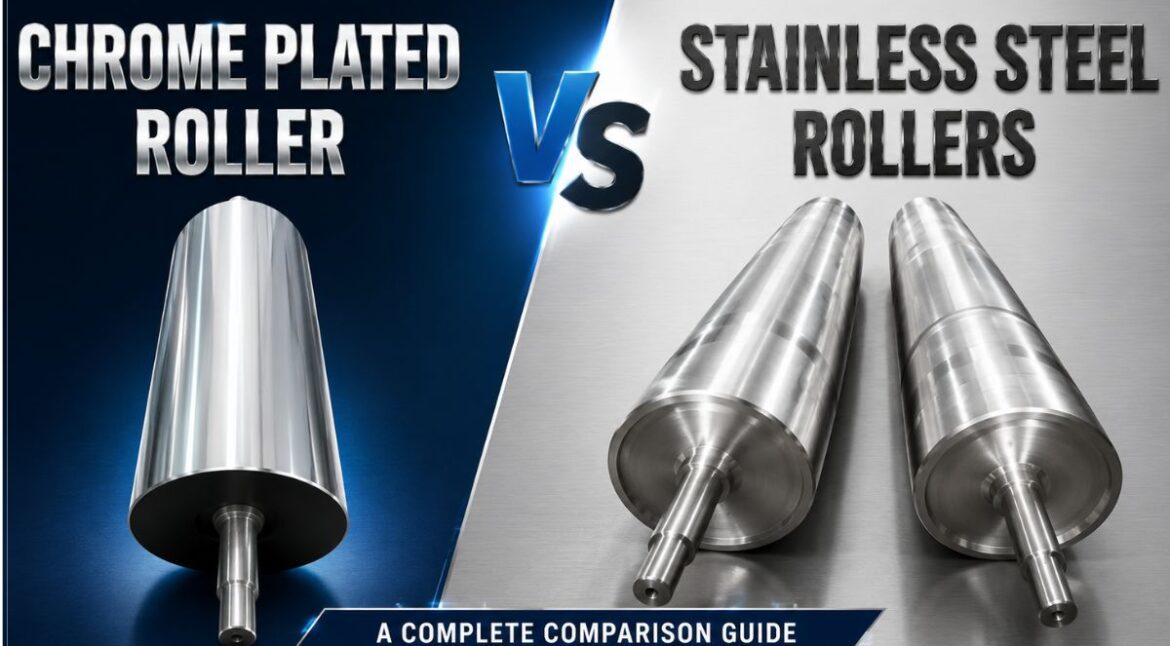
Chrome Plated Roller vs Stainless Steel Roller: The Ultimate B2B Buyer’s Guide for Manufacturing Plants
If you run a high-speed production line, a packaging plant, a textile mill, or a printing press, you already know a painful truth: your entire multi-million rupee machine setup is only as reliable as its smallest moving parts. Among these parts, industrial rollers are the ultimate unsung heroes. They pull, guide, press, and smooth out your materials hour after hour, keeping your operations profitable.
But when the time comes to order replacements or design a new machinery line, you will face a critical decision that can impact your balance sheet for years:
Should you choose a Chrome Plated Roller or invest in a Stainless Steel Roller?
Making the wrong decision does not just mean losing the money you spent on the roller itself. It triggers a nightmare of unexpected machine breakdowns, wasted raw materials, delayed customer shipments, and mounting maintenance costs.
At Siva Rollers, we work closely with manufacturing plants across India and export top-tier engineering products globally. We see first-hand how choosing the correct roller material can instantly boost a factory’s daily output.
In this complete guide, we will break down everything you need to know in simple, practical language—free from heavy academic jargon. By the end, you will know exactly which roller is perfect for your budget, your machinery, and your specific production environment.
The Real-World Problems Plant Managers Face Every Day
Before we compare materials, let us talk about what actually happens on your factory floor. When a roller fails, it usually goes wrong in one of three ways:
- Surface Damage: A tiny scratch or dent on the roller transfers directly onto your plastic film, paper, or foil. Suddenly, whole batches of finished products are ruined because they have visible lines or marks.
- Rust and Corrosion: Humidity in the air, moisture from chemical baths, or washing procedures cause the roller to rust. This rust creates friction, ruins materials, and eventually locks up your bearings.
- Flaking and Contamination: A coated layer starts to chip off, dropping tiny metallic flakes into your raw materials. In food packaging or pharmaceutical plants, this is a massive safety violation that can shut down your entire facility.
To prevent these disasters, you must understand the unique strengths of both options.
Understanding the Chrome Plated Roller (The High-Hardness Specialist)
To understand a Chrome Plated Roller, think of it as a smart, two-part teamwork system.
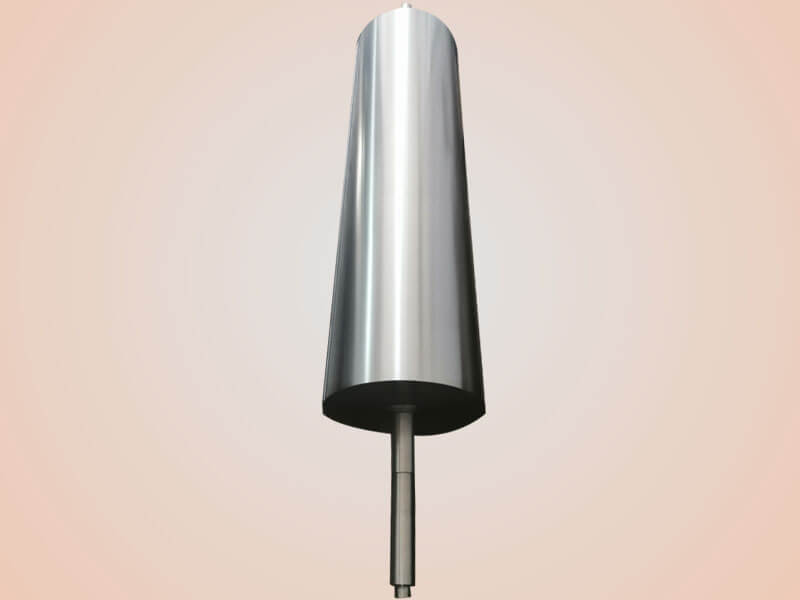
The core of the roller is made from carbon steel or another highly durable, cost-effective metal. This core gives the roller its structural strength and weight. However, raw steel is highly vulnerable to moisture and scratches. To protect it, we apply a specialized, highly polished protective layer over the metal core. This process is commonly known as applying a chrome coating roller.
When this process is done for heavy industrial use, the protective coating is applied thick, deep, and bonded at a molecular level. This is known as a hard chrome plated roller.
Why Factory Owners Choose Chrome Plated Rollers:
- Incredible Surface Hardness: The hard chrome surface acts like a shield. It is highly resistant to scratches, scrapes, and regular wear and tear, even when running abrasive materials at high speeds.
- Flawless Mirror Finish: These rollers can be polished until they are as smooth as glass. This ultra-smooth surface is vital for plastic extrusion and film packaging, where any friction or texture can ruin a delicate film sheet.
- Smart Cost Savings: Because the heavy inner body of the roller is made of affordable steel, you get the immense hardness and premium finish of expensive metals at a much lower initial price point.
Understanding the Stainless Steel Roller (The Rust-Proof Champion)
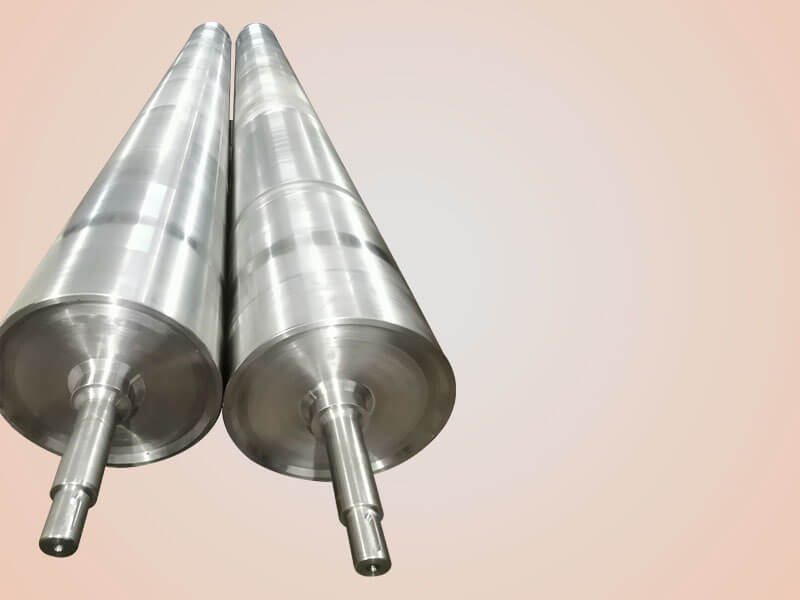
A Stainless Steel Roller takes a completely different approach. Instead of applying a protective layer on top of a basic metal, the entire roller is manufactured using high-grade stainless steel.
Stainless steel is an alloy created by mixing iron with chromium and nickel. Because these rust-preventing elements are mixed right into the metal itself, the corrosion resistance is not just a surface skin—it goes all the way through to the core.
For industries that want the unmatched rust-proof benefits of stainless steel without paying for a solid, ultra-heavy block of it, there is an incredibly smart alternative: stainless steel cladding rollers. In this design, a thick, protective outer sleeve of solid stainless steel is permanently bonded over a carbon steel core. This gives you the best of both worlds: 100% rust protection on the outside where it matters, and a highly affordable structure on the inside.
Why Factory Owners Choose Stainless Steel Rollers:
- Absolute Rust Immunity: Stainless steel does not rust. Even if it is constantly sprayed with water, submerged in chemicals, or kept in hot, humid Indian coastal weather, its surface remains clean and rust-free.
- Maximum Hygiene & Washdown Safety: Because there is no outer plating to crack or peel, you can wash these rollers with hot water and strong cleaning chemicals every day. This makes them the absolute standard for food, beverage, and medical production.
- Long-Term Indestructibility: If a worker accidentally drops a heavy tool on a stainless steel roller, it might get a small ding, but it will never start flaking or rusting from that spot. The material is the same rust-resistant metal throughout.
Head-to-Head Comparison: Which Roller Wins the Battle?
To help you make a smart purchasing decision, let us put these two popular options head-to-head across the four most important operational areas.
Battleground | Chrome Plated Rollers | Stainless Steel Rollers | The Winner |
Scratch & Wear Resistance | Extremely High (Hard armor finish) | Good (Slightly softer metal) | Chrome Plated Roller |
Rust & Corrosion Resistance | Moderate (Vulnerable if scratched) | Outstanding (100% rust-proof) | Stainless Steel Roller |
Flaking & Peeling Risk | Small Risk (Under extreme impact) | Zero Risk (Solid metal throughout) | Stainless Steel Roller |
Initial Upfront Cost | Budget-Friendly | Higher Investment | Chrome Plated Roller |
Let us look closely at why these differences matter in your daily operations.
Factor 1: Dealing with Friction, Scratches, and Wear
In high-speed production, materials like heavy paper, plastic sheets, and textiles continuously rub against the roller surface. This continuous friction can act like sandpaper.
A hard chrome plated roller has an incredibly high surface hardness. It resists abrasion much better than standard stainless steel. If your production line runs at high speeds, handles heavy friction, or uses metal cleaning blades (like doctor blades in printing), the chrome surface will keep its smooth, scratch-free finish for a much longer time.
While a Stainless Steel Roller is tough, it is a naturally softer metal. Over months of high-speed friction, it is more likely to develop microscopic scratches, which might eventually affect highly sensitive materials.
Factor 2: Winning the War Against Moisture and Chemicals
If your factory floor uses water, works with liquid dyes, or operates in high humidity, rust is your biggest enemy.
This is where the Stainless Steel Roller is the undisputed king. It can handle acidic chemicals, industrial solvents, and water sprays for decades without showing a single speck of rust.
A chrome coating roller offers decent rust protection, but it has a weakness. If a sharp metal object scratches through the outer chrome layer down to the underlying steel core, moisture will seep into that tiny crack. Over time, the core underneath will begin to rust. As the rust expands, it causes the chrome plating on top to bubble, crack, and flake off.
Factor 3: Eliminating the Risk of Flaking and Product Contamination
In high-stakes industries, a tiny flake of metal falling into your product line can destroy your brand’s reputation and lead to massive lawsuits.
Because a Stainless Steel Roller (or a system using stainless steel cladding rollers) is made of solid, unplated alloy, there is absolutely no coating to peel, chip, or flake away. No matter how much pressure, heat, or cleaning it faces, the metal stays completely intact.
With chrome plating, if the electroplating process is not done perfectly by an experienced manufacturer, the bond can weaken. Under heavy impacts or extreme temperature changes, there is always a small risk of the chrome layer chipping off.
Factor 4: Initial Cost vs. Real Lifetime Value
Every business owner wants to save money, but cheap machinery parts often end up costing the most in the long run.
- The Chrome Plated Option: This offers a lower initial purchase price. If your factory runs dry, high-speed applications where rust is not a threat, this roller delivers incredible value and high performance without stretching your startup budget.
- The Stainless Steel Option: This requires a larger upfront investment. However, because these rollers are virtually immune to rust and can be re-polished and serviced multiple times without replacing the core, they often save you more money over five to ten years by eliminating replacement costs.
Which Roller Belongs on Your Factory Floor?
To make your decision incredibly easy, here is a breakdown of which roller is recommended for specific manufacturing sectors:
The Packaging & Plastic Film Industry
- The Demand: Highly delicate plastic films that stretch, tear, or mark easily.
- Our Recommendation: A hard chrome plated roller. The ultra-smooth, mirror-like finish ensures the plastic film glides over the roller without sticking, wrinkling, or catching scratches.
Printing & Paper Mills
- The Demand: Extremely high-speed operations, constant friction from paper edges, and exposure to chemical inks.
- Our Recommendation: Chrome Plated Rollers. They are tough enough to handle continuous friction from paper and cleaning blades without wearing down, keeping your prints sharp and clear.
Food Processing, Dairy & Pharmaceuticals
- The Demand: Strict government health codes, daily chemical washdowns, and zero tolerance for rust or metal flakes.
- Our Recommendation: A Stainless Steel Roller. It is non-reactive, extremely easy to sanitize, and completely eliminates the risk of rusty water or peeling chrome contaminating your food or medical products.
Textile, Dyeing, & Chemical Processing
- The Demand: Constant exposure to water, steam, aggressive chemical dyes, and bleaching agents.
- Our Recommendation: Stainless steel cladding rollers. They give you the absolute rust protection of stainless steel on the outside to prevent rust stains on expensive fabrics, while keeping your equipment procurement costs highly competitive.
4 Questions to Ask Before Placing Your Order
Before you finalize your order with a stainless steel roller manufacturer, sit down with your production team and answer these four simple questions:
- Will this roller be exposed to water, steam, high humidity, or chemical liquids?
- Yes: Choose Stainless Steel.
- No: Go with a Chrome Plated Roller to save on upfront costs.
- Is your production line handling highly abrasive materials or using metal scrapers?
- Yes: Go with a Hard Chrome Plated Roller for its scratch-resistant shield.
- Does your factory have to comply with strict hygiene, food-grade, or pharmaceutical standards?
- Yes: Choose Stainless Steel to ensure zero risk of chemical reaction or flaking.
- Are you looking for the absolute lowest initial cost, or are you prioritizing a 10-year maintenance-free lifespan?
- For lowest initial cost: Choose Chrome Plated.
- For 10-year durability: Choose Stainless Steel.
Why Siva Rollers is the Partner Your Factory Needs to Succeed
At Siva Rollers, we believe that manufacturing high-quality industrial rollers is not just a mechanical job—it is a commitment to keeping your business profitable.
Based in India, we have built a solid reputation as a premier stainless steel roller manufacturer and custom-engineering partner. We do not just ship products; we build long-term relationships with factory owners in India and globally, helping them minimize downtime and scale up their production.
What Makes Siva Rollers Different?
- We Design for Your Specific Stress Levels: We do not believe in cheap, one-size-fits-all products. Our engineering team studies your machine speeds, chemical exposure, operating temperatures, and budget to build custom rollers that perform flawlessly.
- Zero-Defect Quality Control: Every single hard chrome plated roller and stainless steel cladding roller that leaves our facility undergoes strict quality checks. We test for surface smoothness, balance, and bonding strength so you never have to worry about premature failure.
- Globally Trusted, Indian Pricing: We bring the highest global standards of engineering and material selection to our facility in India. By manufacturing locally, we offer world-class, export-quality rollers at highly competitive prices that keep your projects under budget.
- End-to-End Engineering Support: From your initial inquiry to helping you select the perfect surface finish, and providing maintenance tips to prolong the life of your equipment, our experts are just a phone call away.
Let us Help You Keep Your Production Line Moving
Do not let a poorly chosen roller slow down your machinery, ruin your raw materials, or eat into your hard-earned profits. Whether you need a high-precision chrome coating roller for your packaging line or a heavy-duty, corrosion-proof Stainless Steel Roller for a chemical plant, Siva Rollers has the engineering expertise to deliver exactly what you need.
Let us help you eliminate unexpected machine downtime and scale up your plant’s daily efficiency.
Get in touch with Siva Rollers today for a free, no-obligation engineering consultation and a custom quote tailored to your specific manufacturing setup. Let’s work together to build a smoother, more profitable production line!
- Email Inquiry: info@sivarollers.com
- Phone / WhatsApp: +91-75070 10009
- Factory Location: India (Proudly Serving Clients Globally)
- Explore Our Solutions: Visit Siva Rollers Contact Page
FAQs
The primary difference lies in how they achieve their strength and protection. A Chrome Plated Roller uses a heavy carbon steel base covered with an incredibly hard, mirror-polished protective skin. It is built for high scratch resistance and is highly budget-friendly in dry environments. A Stainless Steel Roller is built entirely out of a rust-proof steel alloy, meaning its rust resistance goes all the way through to its core, making it the perfect choice for wet, chemical-filled, or hygiene-sensitive industries.
You should choose a hard chrome plated roller when your production lines operate at very high speeds, handle highly abrasive materials (like thick paper or textiles), or use steel cleaning blades. Its extreme surface hardness makes it much more resistant to scratches than standard stainless steel. It is also the ideal choice when you need a flawless, high-gloss mirror finish to guide delicate materials without leaving marks.
A solid stainless steel roller can be highly expensive because of the high material cost of raw alloys. To solve this, a stainless steel roller manufacturer can use a smart technique called cladding. In stainless steel cladding rollers, a thick, heavy outer sleeve of solid, rust-proof stainless steel is permanently bonded over an affordable carbon steel core. This gives your factory 100% rust protection on the outer surface where it touches your products, but at a fraction of the cost of a solid stainless steel roller.
Food and pharmaceutical plants have a zero-tolerance policy for product contamination. Over years of high-pressure cleaning, heat changes, and contact with acidic ingredients, a plated layer runs a tiny risk of developing microscopic cracks. If tiny bits of chrome plating chip off and fall into food packages or medicine, it can result in massive health violations and expensive recalls. A solid Stainless Steel Roller has no outer coating to peel or flake, making it the safest, most hygienic choice.
Peeling or bubbling usually happens when a cheap or inexperienced manufacturer does not clean the steel core properly before the electroplating process, resulting in a weak chemical bond. It can also happen if a deep scratch cuts through the chrome layer, allowing moisture to seep under the skin and rust the steel core. You can easily prevent this by purchasing from a globally trusted manufacturer like Siva Rollers, where we use advanced, automated quality testing to ensure a permanent, flawless bond.
Yes, it can be easily repaired and restored! If the surface of your roller gets scratched or worn down over time, you do not need to invest in a completely new unit. A professional manufacturer can safely strip off the old chrome layer, repair any dents in the underlying core, and apply a fresh, brand-new chrome coating roller layer. This re-chroming process can save you up to 50% to 60% of the cost of buying a new roller, making it a highly cost-effective maintenance choice.
In highly humid and coastal areas across India (such as industrial hubs in Gujarat, Maharashtra, Tamil Nadu, Andhra Pradesh, and West Bengal), standard metals rust incredibly fast. If a chrome-plated roller gets a tiny scratch, coastal moisture will quickly cause it to rust and peel. For these regions, we highly recommend choosing a Stainless Steel Roller or a cladded option. It completely eliminates rust worries, protecting your machine bearings from unexpected failures.
While stainless steel is highly durable and tough, it is naturally a slightly softer metal than hard chrome plating. If your high-speed line handles highly abrasive materials or uses metal scrapers, a standard stainless steel surface can develop micro-scratches over time. If your industry requires both absolute rust protection and high scratch resistance, you can consult with an expert manufacturer like Siva Rollers to apply special surface hardening treatments to your stainless steel.
When choosing a manufacturing partner, always look for three things: in-house custom engineering, dynamic balancing capabilities, and proper quality certifications. A reliable partner like Siva Rollers does not just take an order—we analyze your line speed, chemical environment, and operating temperature to design the perfect roller. Whether you are operating within India or importing globally, always choose a supplier that provides complete quality-assurance certificates with every shipment.
Yes, absolutely! At Siva Rollers, we specialize in designing and manufacturing custom industrial rollers that match the exact measurements of imported German, Italian, Chinese, or Japanese machinery. Our engineers work closely with your technical drawings or study your old, worn-out rollers to replicate the exact dimensions, weight, and surface finish you need. This helps you get premium, export-quality replacement parts locally in India at highly competitive prices.