
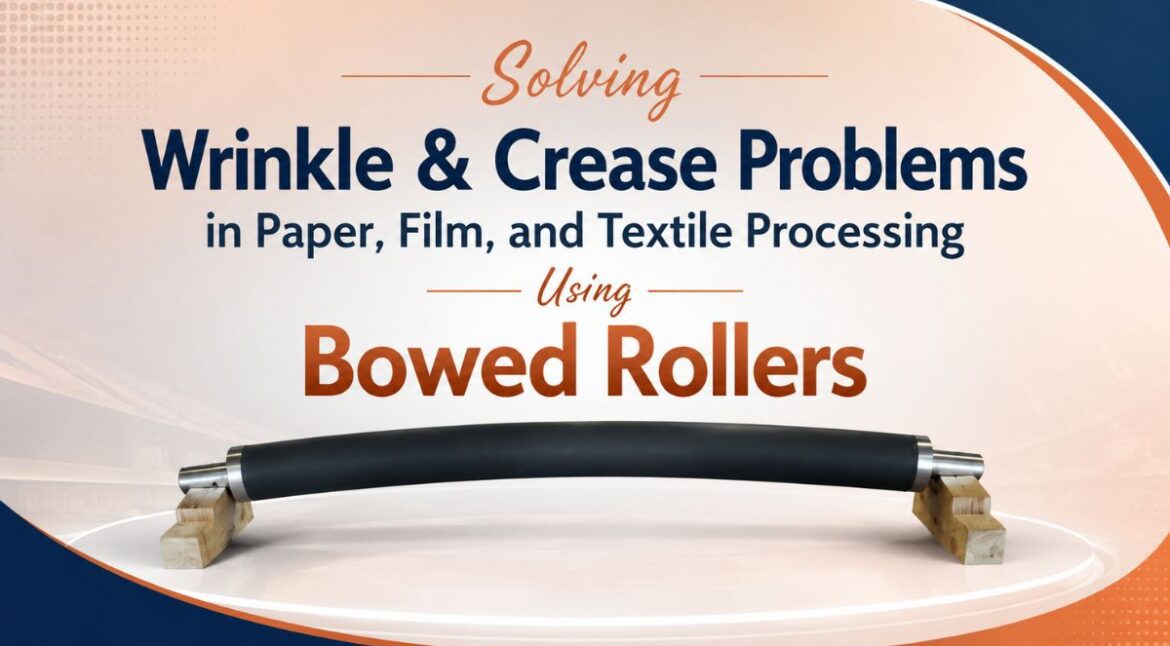
How to Eliminate Costly Wrinkles in Paper, Film, and Textile Processing Using Bowed Rollers
Every factory owner, plant manager, and machine operator running a continuous web processing line knows the frustration: you are running your production line at full speed, and suddenly, wrinkles or creases appear across the material.
Whether you are working with paper, plastic film, foil, or woven fabric, web wrinkles lead to rejected rolls, wasted raw materials, customer complaints, and costly machine downtime.
If you are struggling with material stretching, slack edges, or continuous creasing, there is a simple, proven mechanical solution used by top manufacturing plants worldwide: bowed rollers.
In this detailed practical guide, we will explore why wrinkles happen during material processing, how curved expander rollers solve these issues, and how choosing the right equipment partner—like Siva Rollers—can help you achieve flawless, wrinkle-free production every single day.
Why Do Wrinkles and Creases Form During Material Processing?
Before jumping into the solution, it helps to understand why your continuous web gets distorted in the first place. Whether your factory processes flexible packaging films, heavy paper boards, or delicate textiles, web materials are constantly under physical stress as they move across multiple guide rollers.
Here are the primary causes of web wrinkles on production lines:
1. Uneven Web Tension Across the Roll
If the tension across the width of your material is not perfectly equal, the looser side will lag behind while the tighter side pulls ahead. This imbalance causes the material to fold over itself, creating long longitudinal creases.
2. Roller Misalignment
Even a tiny misalignment in your guide rollers can force the material to travel sideways. As the material tries to correct its path, diagonal wrinkles form across the web surface.
3. Material Thickness Variations
Raw material rolls are rarely 100% uniform. Slight differences in film thickness, paper caliper, or fabric weave mean that certain sections of the roll stretch more than others under standard tension.
4. Environmental and Moisture Changes
Paper and textile materials absorb ambient humidity quickly. When moisture levels shift inside the factory, the edges of the web can expand faster than the centre, creating wavy edges or loose centres.
5. Static Electricity and Surface Friction
High-speed processing generates heavy static charges, especially on plastic films and synthetic fabrics. Static causes the web to cling awkwardly to guide rollers, creating unexpected bunching and folds.
The Real Business Cost of Unresolved Web Wrinkles
For manufacturing units in India and around the world, material waste directly cuts into profit margins. Wrinkles are not just a visual issue—they are a financial drain on your factory.
- Rejected Finished Products: Print shops cannot print clearly on creased film or paper. Lamination plants suffer from air bubbles and weak bonding over wrinkles.
- Increased Scrap Rates: Every meter of crumpled plastic film or ruined fabric thrown into the scrap bin increases your raw material cost per unit.
- Slower Production Speeds: Operators often lower machine speeds to prevent wrinkling, which drastically reduces your daily plant output.
- Frequent Unplanned Downtime: Stopping high-speed slitting, coating, or printing machines to manual un-crease web material wastes valuable labor hours.
To protect your bottom line and deliver pristine quality to your clients, you need a reliable method to keep your web smooth, flat, and centered at all speeds.
What is a Bowed Roller and How Does It Work?
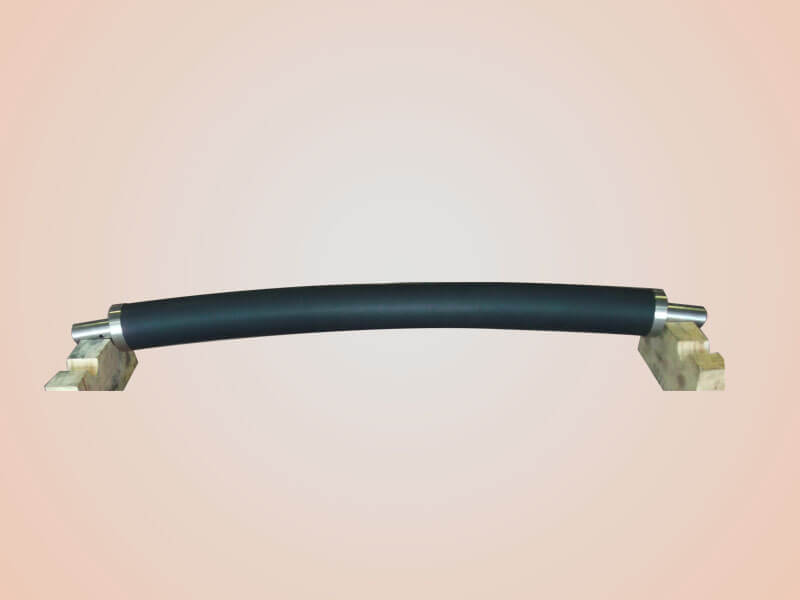
A bowed roller—also widely known across industries as a banana roller or curved expander bowed roller—is a specialized cylindrical roller designed with a pre-set curve along its axle.
Unlike a standard straight guide roller that simply rotates on a straight horizontal axis, a curved roller uses its angled surface to exert a outward spreading force on the moving material.
The Science Made Simple
Imagine holding a flexible strip of cloth between your two hands. If you push your hands slightly outward while pulling the cloth tight, the wrinkles instantly disappear.
A curved expander roller does exactly this automatically on a continuous production line:
- Center-to-Edge Spreading: As the material contacts the middle section of the curved roller surface, the outward angle of the roller face continuously pulls the web material outward toward both edges simultaneously.
- Tension Redistribution: Loose or slack sections of the web are stretched evenly, balancing out the tension across the entire width.
- Slit Separation: When placed after slitting blades, a curved roller spreads the individual cut strips apart, preventing them from overlapping or tangling before winding.
By continuously smoothing the web from the middle out to the sides, you eliminate folds, creases, and slack edges before the material reaches critical operations like printing, coating, laminating, or slitting.
How Bowed Rollers Benefit Different Manufacturing Industries
Every processed material behaves differently under tension. Let’s look at how curved expander rollers solve specific challenges across major industrial sectors.
1. Paper Mills and Paper Converting
Paper is sensitive to moisture and sudden tension changes. During high-speed rewinding, coating, or sheeting, paper webs are prone to center bubbles and edge creases.
Using an optimized paper roller with a curved bow profile ensures:
- Smooth feeding into calendar rolls and slitting stations.
- Prevention of interweaving during multi-roll slitting.
- Even glue distribution in corrugation and lamination units.
2. Flexible Packaging and Plastic Film Converting
Plastic films like BOPP, PET, LDPE, and PVC are prone to stretching and static cling. If too much tension is applied, thin films warp permanently.
A soft-covered rubber expander roller gently handles thin films without leaving scratches or marks, ensuring:
- Wrinkle-free printing on rotogravure and flexographic presses.
- Bubble-free lamination on multi-layer flexible packaging films.
- Perfectly flat winding on high-speed slitters.
3. Textile Processing and Dyeing
Woven, non-woven, and knitted fabrics stretch easily and warp when exposed to liquids, heat, or dyes.
In textile processing, an effective textile roller with a curved bow design helps:
- Keep wet or dry fabric open to its full working width.
- Eliminate selvage (edge) curling before stentering, drying, or calendering.
- Prevent diagonal distortion in printed fabric patterns.
Key Types of Bowed Rollers for Industrial Machinery
Depending on your machine layout, material type, and line speed, different roller constructions are required. Here are the primary types used in modern plants:
Rubber Sleeve Bowed Rollers
These feature a durable, high-density rubber sleeve mounted over a curved stationary axle with internal ball bearings.
- Best for: Plastic films, paper converting, aluminium foils, and delicate fabrics.
- Key Advantages: Excellent surface grip, soft touch that avoids material scratching, and high resistance to wear and mild chemicals.
Metal Surface Bowed Rollers
Featuring segmented metal rings (usually made of stainless steel or hard-chromed steel), these rollers are designed for heavy-duty or abrasive environments.
- Best for: High-temperature applications, high-speed paper manufacturing, and abrasive industrial textiles.
- Key Advantages: Exceptional durability, heat resistance, and long operational lifespan under heavy load conditions.
Fixed Bow vs. Adjustable Bow Rollers
- Fixed Bow Rollers: The degree of curvature (bow angle) is set permanently during manufacturing. These are ideal for long production runs using the exact same material type and width.
- Variable/Adjustable Bow Rollers: These allow machine operators to adjust the direction and amount of curvature manually while the machine is running. They offer maximum flexibility for plants that process a wide variety of materials and roll widths on a single line.
Simple Factors to Consider When Selecting the Right Roller
Choosing the right expansion roller for your machine line does not require complex engineering formulas, but you should keep a few practical factors in mind when consulting your supplier:
- Material Type and Thickness: Very thin plastic films require softer rubber sleeves with gentle surface traction, whereas thick paperboard requires stronger steel construction.
- Line Speed and Temperature: Ensure the internal bearings and rubber compounds are rated for your plant’s operational speed and thermal environment.
- Web Width and Diameter: Larger working widths require sturdy internal axles to prevent sagging under heavy web tension.
- Wrap Angle: The angle at which the material touches and leaves the roller (typically between 15° to 90°) determines how much spreading action is applied to the web.
When you work with an experienced manufacturer, their team can recommend the exact roller configuration based on your specific machine layout and material needs.
Why Manufacturers in India and Globally Choose Siva Rollers
When it comes to web handling components, precision manufacturing makes all the difference between a smooth-running production line and continuous downtime.
Siva Rollers is a leading Indian manufacturer and exporter of high-performance industrial rollers. Built on decades of engineering expertise, Siva Rollers serves paper, film, packaging, converting, and textile industries across India and international markets.
Here is why factory managers trust Siva Rollers as their preferred partner for solving web wrinkle problems:
1. Precision Engineering for Long Service Life
Every curved roller produced by Siva Rollers is manufactured using premium-grade raw materials, high-precision bearings, and dynamic balancing techniques. This ensures smooth, vibration-free rotation even at high machine speeds.
2. Custom Solutions for Every Production Line
No two manufacturing lines are identical. Siva Rollers offers tailored designs, including custom bow angles, specific rubber sleeve hardness levels, grooved surfaces, and custom mounting brackets to match your exact machinery requirements.
3. World-Class Quality at Competitive Prices
Based in India, Siva Rollers delivers international-grade manufacturing quality at highly competitive prices. Factory owners gain access to export-quality components that deliver exceptional ROI and long-term durability.
4. Global Export Capability
With robust export logistics and dedicated customer support, Siva Rollers efficiently serves international clients across Asia, the Middle East, Africa, Europe, and the Americas—ensuring timely delivery and reliable technical guidance wherever your plant is located.
5. Comprehensive After-Sales Support & Re-Sleeving
To help you maintain peak operational efficiency, Siva Rollers provides complete support, including rubber re-sleeving, bearing replacement, and refurbishing services to extend the lifespan of your existing rollers.
How to Prevent Wrinkles on Your Line Today
If you are currently facing crease issues on your production line, follow these simple steps:
- [ ] Inspect Machine Alignment: Check if guide rollers are parallel and level across the entire frame.
- [ ] Audit Web Tension: Make sure web tension is balanced from unwind to rewind without sudden spikes.
- [ ] Identify the Problem Area: Pinpoint exactly where the wrinkle forms—just before printing, at the lamination nip, or during slitting.
- [ ] Position the Curved Roller Correctly: Place a bowed expander roller just before the point where wrinkles cause the most damage (e.g., right before a print cylinder, nip roll, or slitter).
- [ ] Consult with an Expert Manufacturer: Reach out to the technical team at Siva Rollers to select the ideal rubber compound, bow angle, and roller diameter for your machinery.
Stop Material Waste and Upgrade Your Production Line Today
Wrinkles, creases, and web misalignment do not have to be an accepted cost of doing business. By integrating high-performance bowed rollers into your processing lines, you can instantly boost material quality, increase production speeds, and protect your profit margins.
Whether you are upgrading an existing production line in India or sourcing reliable industrial rollers for international factories, Siva Rollers is ready to deliver engineered solutions tailored to your exact operational needs.
Take the Next Step Toward Wrinkle-Free Production
Don’t let material waste hold your factory back.
Contact Siva Rollers today to speak with our technical team, request a custom quote, or find out how our expander roller solutions can transform your manufacturing performance.
Contact US : +91 75070 10009 , info@sivarollers.com
FAQs
A bowed roller is a curved industrial roller engineered to eliminate wrinkles, folds, and slack edges in continuous web processing. As paper, film, or fabric passes over its curved surface, the roller exerts a outward spreading force from the center toward both edges. This spreads the material evenly, balances web tension, and keeps the surface completely smooth.
The terms "banana roller" and "expander bowed roller" refer to the exact same equipment. Factory operators refer to it as a banana roller because the curved stationary axle resembles the shape of a banana. It is called an expander roller because its curved geometry expands and spreads the material widthwise.
To maximize wrinkle removal, a bowed roller should be placed immediately before the critical machine section where wrinkles cause damage—such as right before printing cylinders, lamination nip rolls, coating heads, or slitting knives. Positioning the roller close to these stations ensures the web enters completely flat.
- Rubber Sleeve Bowed Rollers use a flexible, soft rubber cover over internal bearings. They are ideal for delicate plastic films, paper converting, and light fabrics because they provide excellent grip without scratching the surface.
- Metal Surface Bowed Rollers feature segmented steel or hard-chromed metal rings. They are designed for heavy-duty, high-temperature, or abrasive applications like heavy paper production and coarse woven textiles.
- Fixed Bow Rollers have a single, pre-set curve angle. They are ideal for production lines running the same material, thickness, and width continuously.
- Adjustable Bow Rollers allow operators to change the bow direction and curvature intensity while the machine is running. They are best for versatile plants processing multiple material types and roll widths on one machine.
Yes. When placed directly after slitting blades, an expander bowed roller spreads the newly cut narrow strips away from each other before they reach the rewind section. This prevents the edges of adjacent rolls from interweaving, overlapping, or tangling.
In textile manufacturing, fabrics easily curl at the edges (selvage) during washing, dyeing, or drying. A specialized curved textile roller applies outward lateral tension, uncurling the edges and keeping the fabric open to its full working width before it enters stenters, calendar rolls, or drying cylinders.
Common signs include visible wear or grooves on the rubber surface, irregular rotation caused by worn internal bearings, uneven web spreading, or persistent material scratching. Siva Rollers offers complete re-sleeving and bearing replacement services to restore old rollers to original factory performance.
Installing reliable bowed rollers reduces raw material waste, eliminates customer rejections, permits higher line speeds, and prevents unscheduled machine downtime. By delivering flat, defect-free rolls consistently, factories achieve maximum daily throughput and lower cost-per-unit.
Siva Rollers is a trusted Indian manufacturer with global export capabilities, offering custom-engineered expander rollers built with high-grade materials, precision bearings, and dynamic balancing. They offer competitive direct-from-manufacturer pricing, custom designs tailored to your machinery, and comprehensive after-sales support including re-sleeving and maintenance.