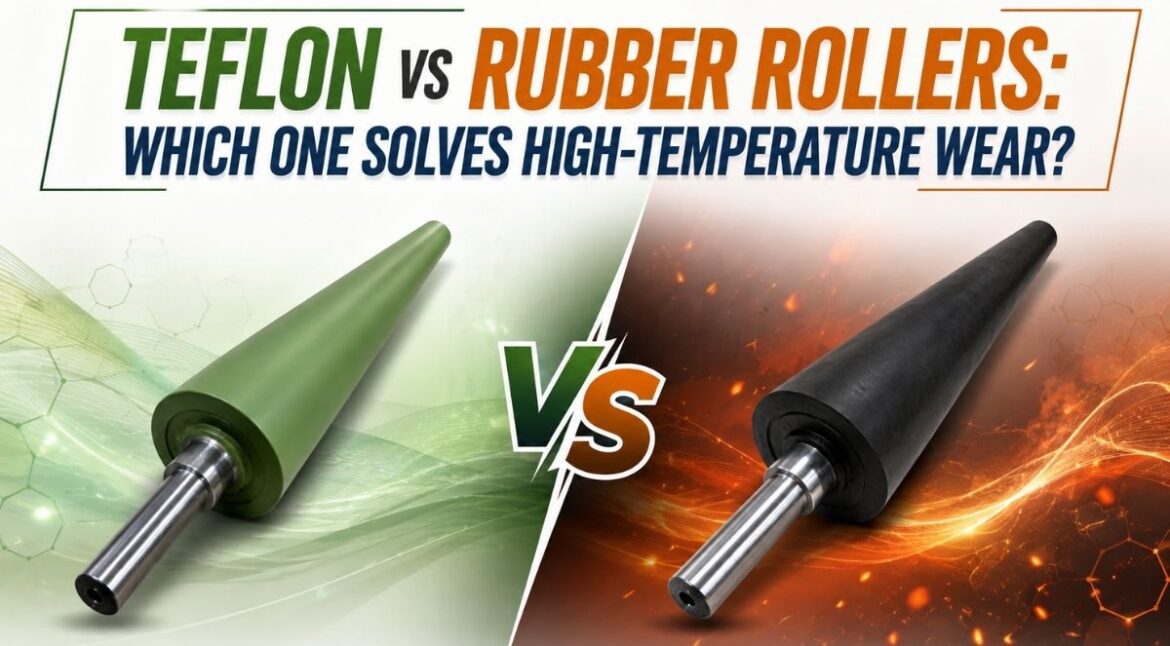
Teflon vs Rubber Rollers: Which One Solves High-Temperature Wear?
In high-speed manufacturing plants, an unscheduled machine shutdown is one of the most expensive interruptions a production line can face. Whether you operate in flexible packaging, textile processing, paper converting, or high-speed laminating, your equipment relies heavily on precision rollers to keep materials moving continuously.
Among all operational challenges, high temperature combined with continuous friction is the ultimate stress test for any industrial roller. When operating temperatures rise, standard roller surfaces often begin to degrade, crack, harden, or cause sticky materials to adhere to the roll surface. This leads to web breaks, surface defects on products, and constant maintenance cleanups.
Plant engineers and operations managers frequently face a critical question: Should you stick with traditional rubber-surfaced rollers, or upgrade to a high-performance Teflon Roller?
In this detailed guide, we will break down how heat affects both materials, where each type performs best, and how choosing the right Teflon-coated roller can solve severe high-temperature wear once and for all.
Understanding High-Temperature Wear in Industrial Operations
Before comparing materials, it helps to understand what actually happens on the plant floor when rollers operate in thermal environments.
High-temperature wear is rarely caused by heat alone. Instead, it is the result of three destructive factors working together:
- Thermal Softening or Degradation: Constant exposure to ambient or direct contact heat breaks down polymer bonds on the roller surface.
- Mechanical Friction: Moving sheets, films, foils, or fabrics generate ongoing friction as they pass over the roller at high speed.
- Chemical & Adhesive Sticking: Heat often causes inks, glues, molten resins, or coatings to melt, transferring sticky residue directly onto the roller face.
When a roller surface deteriorates under heat, friction increases. Higher friction generates more heat, creating a compounding cycle that ruins product quality and destroys the roller prematurely.
Rubber Rollers: Strengths, Limits, and Heat Challenges
Rubber-covered rollers—including natural rubber, synthetic polymers, and specialty elastomers like EPDM or silicone—have been manufacturing workhorses for decades. They offer excellent grip, natural compressibility, and forgiving surfaces that handle web tension variations smoothly.
Where Rubber Rollers Excel
Rubber surfaces provide high traction and flex, making them ideal for pulling or tensioning applications where slipping must be prevented. In room-temperature or moderate-temperature zones, rubber offers durable service and reliable cushioning.
What Happens to Rubber Under Extreme Heat?
Even heat-resistant rubber compounds (such as high-grade silicone rubber) have structural limitations when subjected to continuous heat and chemical exposure over long production cycles:
- Hardening and Surface Cracking: Prolonged heat causes rubber compounds to lose their flexibility. Over time, the outer layer becomes brittle, forming micro-cracks that ruin delicate material surfaces.
- Surface Tackiness and Material Buildup: As rubber warms up, its surface tack increases. If your process handles hot molten polymers, adhesives, or wet coatings, these substances stick to the heated rubber face, requiring frequent line shutdowns for manual wiping.
- Thermal Expansion Swelling: Rubber swells under heat and exposure to certain industrial solvents or oils. Even minor swelling distorts the roller profile, leading to uneven pressure distribution across the web.
Teflon Rollers: Built for Heat, Non-Stick, and Low Friction
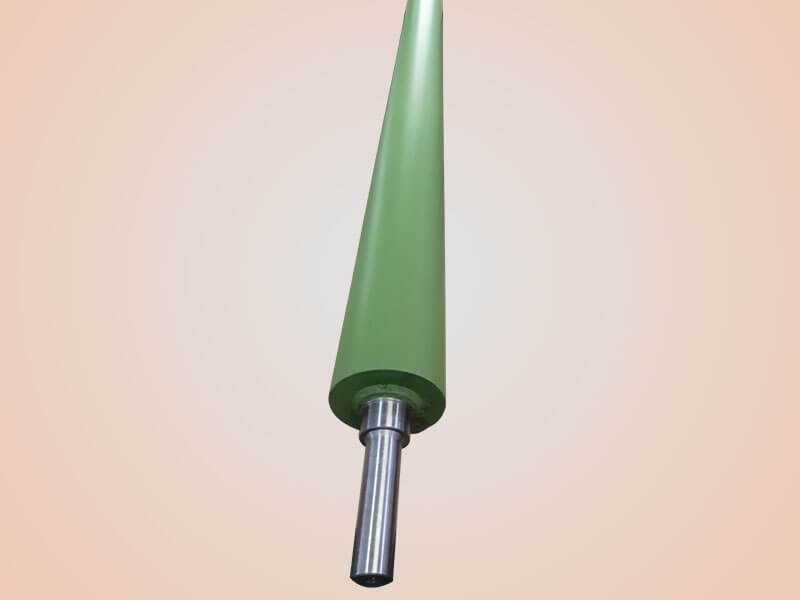
Teflon (polytetrafluoroethylene or PTFE) is famous worldwide for its heat resistance and low coefficient of friction. In industrial manufacturing, a Teflon Roller—whether solid fluoropolymer or a heavy-duty steel core protected by a custom fluoropolymer coating—is engineered specifically to tackle high-heat and sticky production environments.
To learn more about the scientific properties of fluoropolymer coatings, you can explore detailed polymer insights on the Chemours PTFE Resource Guide.
Why Teflon Handles Extreme Heat Better
Unlike elastomeric rubber, Teflon maintains its structural integrity across an exceptionally broad thermal range. It retains its physical properties even under continuous high-heat operations where standard elastomers quickly deteriorate.
Key operational advantages include:
- Unmatched Non-Stick Surface: Teflon exhibits near-zero surface energy. Molten plastics, wet adhesives, hot-melt glues, inks, and resins simply cannot bond to a Teflon-coated roller.
- Ultra-Low Surface Friction: Teflon boasts one of the lowest friction coefficients among solid materials. Materials glide across the roller smoothly without dragging, scratching, or stretching sensitive thin films.
- Chemical Immunity: Heat often intensifies chemical reactions. Teflon is inert to virtually all industrial chemicals, solvents, acids, and cleaning agents, preventing chemical degradation under hot conditions.
- Consistent Profile Integrity: Teflon does not swell, soften, or change shape when heated within its operating range. This ensures uniform contact pressure across the entire width of your web.
Teflon vs. Rubber Rollers: Side-by-Side Comparison
To choose the right surface for your machine, let us examine how these two materials compare across critical real-world plant factors:
1. Temperature Resistance & Lifespan
- Rubber Rollers: Standard rubbers perform well at ambient temperatures. Special silicone rubbers can handle elevated heat, but continuous thermal cycles accelerate elastomer aging, hardening, and surface degradation.
- Teflon Rollers: Teflon thrives in high-heat zones. It provides consistent long-term performance without losing surface integrity, drastically reducing how often rollers must be recoated or replaced.
2. Resistance to Sticking and Build-Up
- Rubber Rollers: Sticky substances naturally adhere to rubber when hot. Cleaning dirty rubber rolls requires solvents, abrasives, and substantial labor time.
- Teflon Rollers: Residues wipe off effortlessly. In many continuous process lines, sticky materials drop off automatically, preventing scrap and eliminating frequent cleaning downtime.
3. Surface Friction & Web Drag
- Rubber Rollers: High grip and high friction. Great for driving webs forward, but problematic when low drag or smooth gliding is required.
- Rubber-to-Heat Friction: High friction creates additional friction heat, worsening thermal degradation over time.
- Teflon Rollers: Extremely low friction. Prevents static buildup, surface marring, and web dragging on heat-sensitive substrates.
4. Mechanical Cushioning & Compression
- Rubber Rollers: Soft, resilient, and compressible. Conforms to variations in thickness across processed webs.
- Teflon Rollers: Rigid, smooth, and firm. Ideal for hard nip points, heat sealing, guiding, and coating applications where dimensional stability is essential.
Real-World Industry Insights: Where Switching Saves Money
Many industrial plants make the mistake of using standard rubber rollers in high-heat zones simply because those rollers were installed by default when the machine was new. Upgrading to a specialised Teflon-coated roller pays immediate dividends in several specific manufacturing applications:
Flexible Packaging & Heat Sealing Lines
In high-speed pouch making, bag manufacturing, and lamination, heat-seal jaws and guide rolls continuously touch molten plastic films. Rubber rolls in these positions wear down rapidly and build up burned plastic residue. A smooth Teflon coating ensures clean release, crisp seals, and zero plastic build-up.
Textile Processing & Drying Units
Textile finishing often involves hot chemical baths, dyes, and thermal curing units. Standard rubber rollers absorb processing chemicals and degrade under drying oven temperatures. Teflon-surfaced rolls resist chemical absorption and prevent dye transfer between fabric batches.
Converting, Paper, and Film Extrusion
When handling delicate extrusion films or coated paper stocks, surface scratches can ruin an entire production batch. The low-friction surface of a Teflon roller guides the moving sheet without dragging, keeping film clarity intact.
For industry standards regarding roller manufacturing tolerances and safety guidelines, engineers often reference international manufacturing standards established by the International Organization for Standardization (ISO).
How to Determine Which Roller Solution You Need
Choosing between rubber and Teflon comes down to analysing your specific process conditions:
- Choose a Rubber Roller if: You operate at normal ambient temperatures, require high traction to drive a heavy web, or need a soft, compressive nip surface to absorb substrate thickness variations.
- Choose a Teflon Roller if: Your operation involves continuous high temperatures, hot adhesives, tacky resins, harsh solvents, or high speeds where surface friction creates drag and material damage.
In many modern production lines, the optimal setup uses a strategic combination: rubber rollers in cold tensioning zones, and high-durability Teflon rollers in heated, sticky processing zones.
Why Choose Siva Rollers for Your Industrial Roller Needs?
When upgrading your machine components, raw material quality and the coating process make all the difference. A poorly applied fluoropolymer coating can peel or pit, causing early failure on your line.
At Siva Rollers, we have built our reputation as a premier Teflon Coated Roller Manufacturer in India. We combine engineering precision with practical manufacturing expertise to deliver long-lasting roller solutions customized for your exact operational environment.
The Siva Rollers Advantage:
- Custom Engineering: Every Industrial Roller is crafted to meet your precise dimensional tolerances, thermal requirements, and load capacities.
- Advanced Coating Technology: Our specialized Teflon coating process delivers high surface adhesion, uniform thickness, and exceptional resistance to peeling under high thermal stress.
- Focus on Total Cost of Ownership: We do not just sell rollers—we help plant managers reduce machine downtime, minimise maintenance labour, and extend component lifespans.
- Proven Track Record: Serving diverse industries across India and abroad, Siva Rollers is trusted by engineers for quality consistency, honest craftsmanship, and dependable delivery schedules.
Whether you need a brand-new custom roller or want to re-coat an existing roller core with high-grade Teflon, our expert team is ready to analyze your setup and recommend the right solution.
Take Control of Your Production Line Efficiency
High-temperature wear does not have to be an accepted cost of doing business. By upgrading heat-exposed, high-friction positions on your machinery to high-performance Teflon rollers, you protect your product quality, boost line speeds, and eliminate constant cleaning headaches.
Ready to eliminate high-heat roller failures on your production floor?
Visit Siva Rollers today to connect with our technical experts and request a custom consultation for your facility. Let us help you build a smoother, more reliable production process.
- Email Us: info@sivarollers.com
- Call/WhatsApp Us: +91 75070 10009
- Send an Inquiry: Simply fill out our quick contact form on the website with your roller dimensions, and our technical team will get back to you within 24 hours!
FAQs
A Teflon Roller is used in industrial applications where high temperature, friction, chemical exposure, or sticky materials can affect roller performance. Its low-friction and non-stick surface makes it suitable for flexible packaging, textile processing, paper converting, film extrusion, coating, and heat-sealing applications.
Yes, a Teflon Roller is generally more suitable for continuous high-temperature applications. Rubber can harden, crack, swell, or become tacky when exposed to prolonged heat, while Teflon maintains its surface properties within its operating range.
The main difference is their surface behaviour. Rubber Rollers provide excellent grip, flexibility, and cushioning, making them useful for tensioning and driving applications. Teflon Rollers offer low friction, non-stick performance, and better resistance to heat and chemical exposure.
Continuous heat can cause rubber to lose flexibility and become hard or brittle. Heat can also increase surface tackiness and cause swelling when the roller is exposed to certain chemicals, oils, or solvents. These changes can affect roller performance and product quality.
A high-quality Teflon Roller can typically withstand continuous operating temperatures between 250°C and 280°C. This makes it ideal for high-heat industrial applications like thermal lamination, extrusion coating, heat sealing, and polyfilm processing.
Yes. Teflon Rollers can be useful in flexible packaging, film processing, lamination, and heat-sealing applications where hot or sticky materials come into contact with the roller surface. Their smooth, low-friction surface helps reduce sticking and web drag.
A Rubber Roller may be the better choice when the process operates at normal or moderate temperatures and requires high traction, flexibility, or cushioning. Rubber is particularly useful for applications where the roller needs to grip or compress the moving material.
Teflon has strong resistance to many industrial chemicals, solvents, acids, and cleaning agents. This makes Teflon Coated Rollers suitable for processes where heat and chemical exposure occur together. The actual suitability should be checked against the specific chemicals used in the process.
A Teflon Roller can reduce maintenance problems by minimizing material sticking and surface buildup. Because residues are easier to remove from the non-stick surface, production teams may spend less time cleaning the roller and dealing with interruptions caused by buildup.
Yes. PTFE (Teflon) is highly resistant to industrial chemicals, solvents, adhesives, inks, acids, and cleaning agents. This chemical resistance protects the roller surface from corrosion and significantly increases operational lifespan.
Choose a Teflon Coated Roller based on the actual operating conditions of your production line, including temperature, material being processed, friction, chemical exposure, speed, and the type of roller application. Siva Rollers manufactures customized Teflon Coated Rollers based on specific industrial requirements.