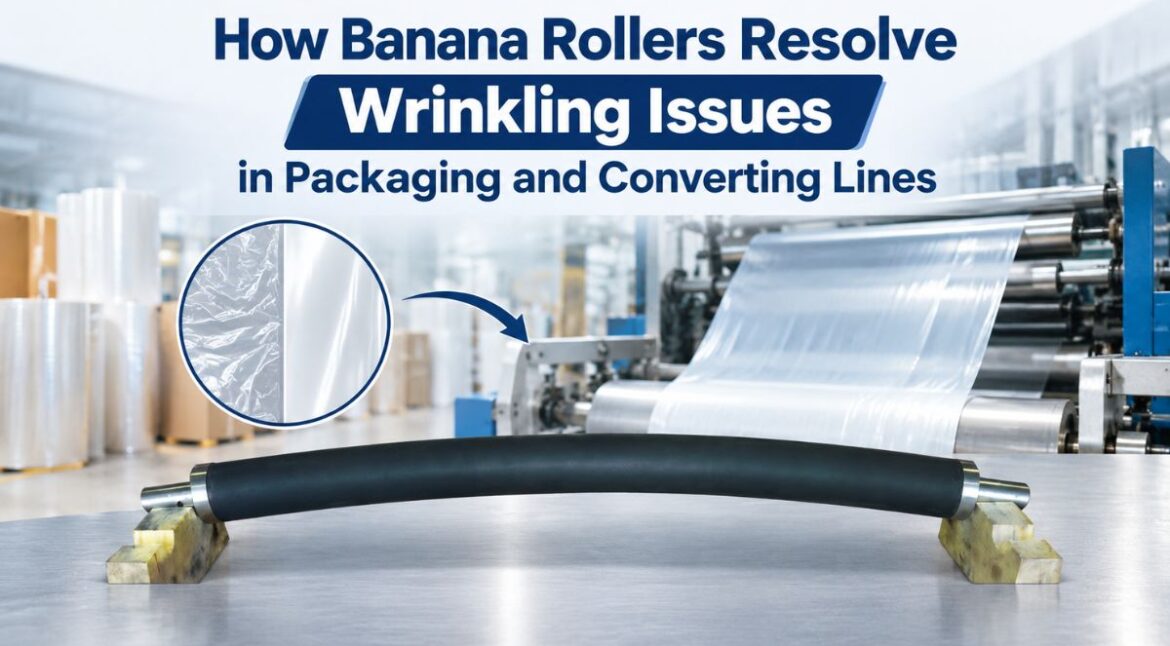
How Banana Rollers Resolve Wrinkling Issues in Packaging and Converting Lines
In any modern flexible packaging or converting plant, smooth web movement is the secret behind consistent output quality. Whether you are extruding plastic film, running high-speed multi-color flexographic printing, laminating multi-layer structures, or slitting paper rolls, one silent enemy constantly threatens production efficiency: web wrinkling.
A single persistent crease running down a moving web can lead to thousands of meters of wasted film, uneven coating, ink misregistration, and costly machine downtime. Production teams often spend hours adjusting web tension, changing guide rolls, or tweaking temperature controls—only to discover that the root cause lies in how the moving material spreads across the line.
This is where Banana Rollers (frequently known as bowed rollers or expander rollers) step in.
In this comprehensive guide, we will explore why wrinkles happen, how a curved expander roller solves lateral web defects without damaging delicate materials, where these rollers fit into converting lines, and how choosing the right Banana Roller Manufacturer helps plant operators achieve smooth, trouble-free production day after day.
The Real-World Cost of Web Wrinkles on the Factory Floor
Walk through any flexible packaging converting plant, and you will quickly notice how sensitive moving materials can be. Today’s packaging substrates—such as ultra-thin polyethylene (PE) films, cast polypropylene (CPP), biaxially oriented PET (BOPET), aluminum foil, and lightweight non-woven fabrics—are engineered for efficiency. However, their light gauge makes them susceptible to distortion.
When a moving web develops creases or folds, the consequences ripple across the entire operation:
- Material Wastage: A crease formed during lamination or slitting often renders the finished roll unusable. Scrap rates increase quickly, consuming valuable profit margins.
- Printing Defects: In printing presses, wrinkles distort graphics, cause color bleeding, and lead to poor registration that fails quality inspections.
- Unplanned Downtime: Machine operators are forced to slow down production lines or halt machinery entirely to smooth out material folds manually.
- Inconsistent Roll Density: Creased materials create soft spots, baggy edges, or uneven roll profile during rewinding, leading to customer complaints during final conversion.
To eliminate these headaches, production teams must understand why materials gather and crease in the first place—and why standard straight cylindrical rollers are often insufficient on their own.
Why Do Web Materials Wrinkle Under Pressure?
Before examining how expander rollers work, it helps to understand why web materials lose their flat profile as they travel across rollers.
A web moves through a machine line under longitudinal (lengthwise) tension. As it travels over straight guide rollers, it encounters various physical forces and mechanical variations:
Elastic Distortion and Thickness Variations
No material roll is perfectly uniform across its entire width. Tiny variations in gauge thickness mean that one side of the web may stretch slightly more than the other. This creates uneven tension zones across the web width.
Roller Misalignment and Deflection
Even a tiny misalignment between parallel rollers forces the web to path toward the side with higher tension. As the material attempts to correct its path, it gathers in the middle, creating longitudinal (trough) wrinkles.
Thermal and Moisture Changes
During processes like hot-melt lamination, drying, or extrusion coating, heat expands thin films unevenly. As temperature levels fluctuate, localized expansion causes the material to ripple or form “baggy” sections.
Lateral Forces
When material enters a process zone—such as a nip roller or print cylinder—it experiences compression. If there is no force pushing the material outward toward the edges, the excess width folds over itself.
Standard straight guide rollers carry the web forward, but they cannot actively pull material outward to maintain lateral flat tension. To spread the web smoothly across its full width, converting lines rely on curved Banana Rollers.
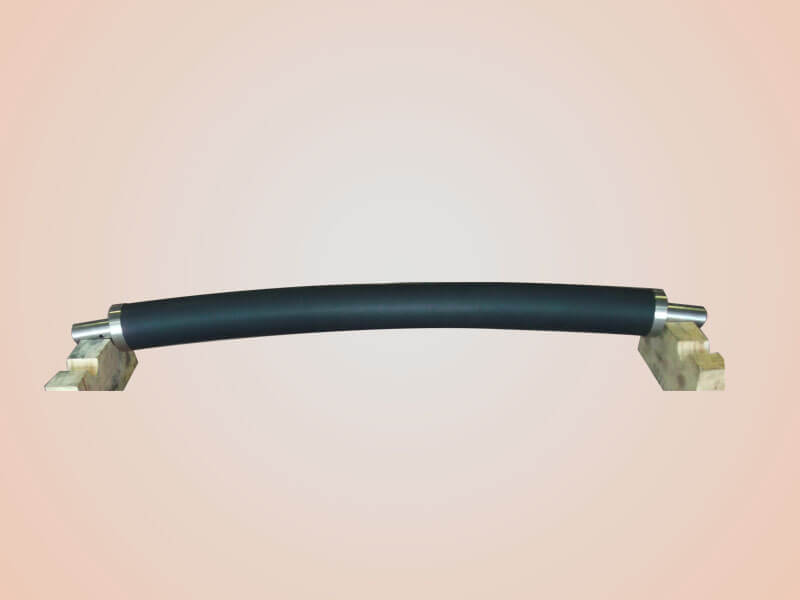
What is a Banana Roller and How Does It Work?
roller—is a specialized roller designed with a fixed curved axis (a distinct “bow”) rather than a straight shaft.
While a standard roller turns on a straight centerline, a banana roller features a stationary curved inner shaft fitted with specialized bearings and a flexible outer sleeve (or segmented metallic rings) that rotates smoothly around this curved path.
   Outward Spreading Force
  <=================================>
     .-----------------------------.
    /  Smooth Outward Material Path \   <-- Curved Bow Profile
   '---------------------------------'
The Spreading Principle Explained Simply
The working principle of an expander roller relies on geometry and friction:
- Entering the Curve: As the flat web approaches the bowed face of the roller, it touches the center of the curve first or spreads gradually across the arc, depending on the wrap angle.
- Divergent Paths: Because the roller face curves outward from the centerline toward both edges, the path that the web follows diverges as it travels across the roller.
- Lateral Stretching: The rotating sleeve carries the web along these divergent outward paths. This creates a gentle, continuous sideways pulling force from the middle of the web toward its outer edges.
- Wrinkle Removal: This outward force counteracts inward web collapse, stretching out creases, diagonal folds, and slack areas before the web moves to the next process station.
By continuously smoothing the substrate from the center outward, the expander roller ensures that the material remains flat, stable, and evenly tensioned as it enters critical process points like printing units, slitting blades, or nip points.
To learn more about industrial web handling principles and standards, you can explore technical resources provided by organizations like TAPPI (Technical Association of the Pulp and Paper Industry) and the Flexible Packaging Association.
Key Applications in Packaging and Converting Lines
Expander rollers play a vital role across almost every stage of flexible packaging manufacturing, paper converting, and film processing. Here is a look at where these rollers make the biggest impact on the factory floor:
A. Blown Film Extrusion and Cast Film Lines
As plastic resins melt and extrude into thin plastic sheets or blown tubes, the cooling web remains extremely sensitive to stretch. Before the film is flattened into a lay-flat tubing or collapsed through nip rollers, localized tension differences can cause severe bagginess.
Installing a bowed rubber expander roller right before winding ensures that the extruded film spreads evenly, preventing gauge band buildup and flat-roll defects.
B. Flexographic and Rotogravure Printing
In multi-color printing, maintaining dimensional stability is critical. If the web develops micro-wrinkles while traveling between print stations:
- Ink distribution becomes spotty and uneven.
- Registration shifts, making text and images appear blurry or misaligned.
- Delicate film substrates can tear under sudden edge stress.
Placing a banana roller immediately before the web enters each printing deck stabilizes the material path, keeping registration tight across long production runs.
C. Lamination Lines (Solvent-based, Solventless, and Thermal)
Combining two or more distinct substrates—such as bonding printed PET film to aluminum foil or polyethylene—requires uniform pressure across the entire nip.
If either substrate enters the laminating nip with creases, air bubbles and unbonded streaks get trapped permanently between the layers. Expander rollers installed on both unwinding web paths smooth out both materials right before they meet at the lamination nip, ensuring crystal-clear optical clarity and strong bond strength.
D. Slitting and Rewinding Machinery
Slitting is often the final quality checkpoint before rolls are shipped to customers. During high-speed slitting:
- Slit web strips can overlap or interlock with adjacent strips after leaving the knives.
- Narrow web cuts may twist or wander.
A bowed expander roller positioned right after the slitting section separates the individual slit bands, guiding them cleanly onto separate rewind shafts without edge friction or roll interweaving.
E. Paper and Foil Converting
Heavy paperboard, thin tissue, and aluminum foils present opposite web handling challenges. While paper can wrinkle due to moisture absorption, foil tears easily if pulled unevenly. Rubber-covered expander rollers gently distribute web tension across fragile foils and heavy papers alike without marking or scratching delicate surface coatings.
Practical Plant Floor Insights: Getting the Best Performance
While banana rollers are simple in concept, installing and adjusting them requires practical understanding. Plant managers and machine operators can maximize roller efficiency and service life by following these floor-tested practices:
Understanding Wrap Angle and Bow Orientation
For an expander roller to spread a web effectively, the material must wrap around the roller surface at a specific angle (typically between 20° and 90°).
- Bow Direction: The apex (the most curved part of the bow) must point toward the direction of web travel or outward toward the web exit path to generate positive spreading action.
- Lead-in and Lead-out Distance: The distance between the bowed roller and the adjacent guide rolls should be calculated carefully. Giving the web sufficient space after leaving the expander roller allows the outward tension to settle naturally without creating edge stretch.
Matching Sleeve Material to the Application
The outer surface of a banana roller must match the chemical, thermal, and surface characteristics of the material being processed:
- Nitrile / Neoprene Rubber Sleeves: Excellent for general-purpose paper, film, and packaging applications requiring good traction and wear resistance.
- Silicone Covers: Ideal for sticky or high-temperature environments, such as hot-melt lamination or extrusion coating where release properties are necessary.
- EPR / EPDM Covers: Suitable for solvent-heavy environments, such as solvent-based coating lines where chemical resistance prevents rubber swelling.
- Segmented Metallic Bowed Rollers: Preferred for heavy paperboard, non-woven materials, high-speed textile lines, or cleanroom environments where rubber dust cannot be tolerated.
Preventive Maintenance for Smooth Operation
A stuck or stiff internal bearing on a bowed roller can do more harm than good, causing localized drag that actually induces web wrinkles.
- Periodically check that the outer sleeve rotates freely without unusual resistance.
- Inspect the rubber cover for surface wear, groove formation, or chemical degradation.
- Ensure the stationary bow adjusting mechanism is clean and properly lubricated so operators can adjust the bow angle smoothly when switching substrate types.
How Siva Rollers Supports Converting and Packaging Plants
Selecting the right expander roller is not just about purchasing hardware—it is about choosing a manufacturing partner who understands real-world web dynamics, material behavior, and machinery design.
As a leading Banana Roller Manufacturer and trusted Expander Roller Manufacturer in India, Siva Rollers has spent decades developing high-performance roller solutions tailored to the diverse demands of the global packaging and converting industries.
Here is how Siva Rollers builds trust and long-term reliability for manufacturing plants:
Custom-Engineered Solutions
No two converting lines run under identical conditions. Differences in web speed, substrate thickness, line tension, and environmental temperatures require tailored roller geometry. Siva Rollers designs each Banana Roller with customized bow ratios, precise face widths, and specialized rubber compounds optimized for your specific line setup.
High-Precision Construction
A reliable expander roller depends on precision internal engineering. Siva Rollers uses premium-grade internal bearing assemblies, dynamic balancing techniques, and high-strength curved shafts to ensure smooth rotation even at high line speeds. This attention to detail eliminates vibration, reduces torque requirements, and extends roller service life.
Application-Specific Rubber Formulations
Whether your application demands anti-static properties for high-speed film slitting, heat resistance for extrusion coating, or high wear resistance for paper converting, Siva Rollers formulates and vulcanizes rubber sleeves in-house to maintain strict quality standards.
Real-World Technical Guidance
Beyond manufacturing, the engineering team at Siva Rollers collaborates directly with plant managers and machine operators. From determining ideal roller placement on existing frames to troubleshooting persistent web tracking issues, Siva Rollers provides practical support that keeps production lines running efficiently.
Simple Checklist: Is Your Line Ready for an Expander Roller?
If you are experiencing any of the following recurring production issues, introducing a properly engineered expander roller can yield immediate improvements in quality and throughput:
Issue Observed | Root Cause | Solution with Expander Roller |
Center Creasing | Excess material width gathering toward the center of the web path. | Center-to-edge outward spreading pushes loose material toward the margins. |
Interlocking Slit Rolls | Slit web strips wandering after passing through slitter knives. | Post-slitting bowed roller creates fan-out separation between slit strips. |
Air Bubble Trapping | Uneven substrate contact during multi-layer lamination. | Pre-nip expander roller flattens both webs before they press together. |
Ink Misalignment | Web distortion between print decks on flexo or gravure presses. | Bowed roller stabilizes web width and tension across printing stations. |
Turning Web Waste into Production Efficiency
In modern packaging and converting operations, profitability depends on yield efficiency, consistent quality, and minimal downtime. Allowing web wrinkles to compromise your finished rolls creates unnecessary scrap and customer rejections.
Banana Rollers offer a mechanical, energy-efficient solution to web instability. By continuously applying gentle, outward force from the center of the web toward its edges, these expander rollers eliminate creases, prevent interweaving during slitting, and maintain flat web paths across all converting processes.
When upgrading your production lines or designing new machinery, partnering with an experienced Expander Roller Manufacturer ensures that your rollers are engineered to handle your specific line speeds, web tension, and material characteristics.
Discover how custom-engineered bowed expander rollers can optimize your packaging and converting lines by visiting Siva Rollers.
Contact US : +91 75070 10009 , info@sivarollers.com
FAQs
A Banana Roller, also called a Bowed Roller or Expander Roller, is a curved roller designed to spread a moving web outward from the center toward the edges. It helps reduce wrinkles, creases, slack areas, and web instability during converting processes.
Banana Rollers use a curved roller profile to create divergent web paths. As the web passes over the roller, the rotating sleeve generates an outward spreading action that helps flatten creases and counteract inward web collapse.
Banana Rollers are commonly used in flexible packaging, film extrusion, flexographic and rotogravure printing, lamination, slitting and rewinding, paper converting, and foil processing lines.
A properly selected Banana Roller can help address center creasing, web wrinkles, baggy areas, slit-roll interlocking, air-bubble trapping during lamination, and web distortion between printing stations.
Yes. Banana Rollers can be used for flexible packaging films such as PE, CPP, and BOPET. They help spread the web evenly and maintain a flatter material path during processes such as extrusion, printing, lamination, and winding.
A standard guide roller has a straight centerline and primarily carries the web forward. A Banana Roller has a curved axis that creates an outward spreading action, helping maintain web flatness and reduce lateral wrinkling.
Selection should consider the web material, line conditions, roller placement, web tension, required bow geometry, surface or sleeve material, and operating environment. The roller should be matched to the specific converting-line application.
Yes. In printing lines, Banana Rollers can help stabilize the web between printing stations. In lamination lines, they can help flatten substrates before they enter the laminating nip, reducing the risk of wrinkles and trapped air.
Maintenance should include checking that the outer sleeve rotates freely, inspecting the cover for wear or chemical degradation, and keeping the bow-adjustment mechanism clean and properly lubricated. Bearing problems or excessive drag can contribute to web wrinkling.
Choose a manufacturer that can understand your web-handling application and provide a roller suited to your line conditions, material characteristics, roller placement, and required geometry. The content identifies Siva Rollers as a Banana Roller and Expander Roller manufacturer serving packaging and converting applications.