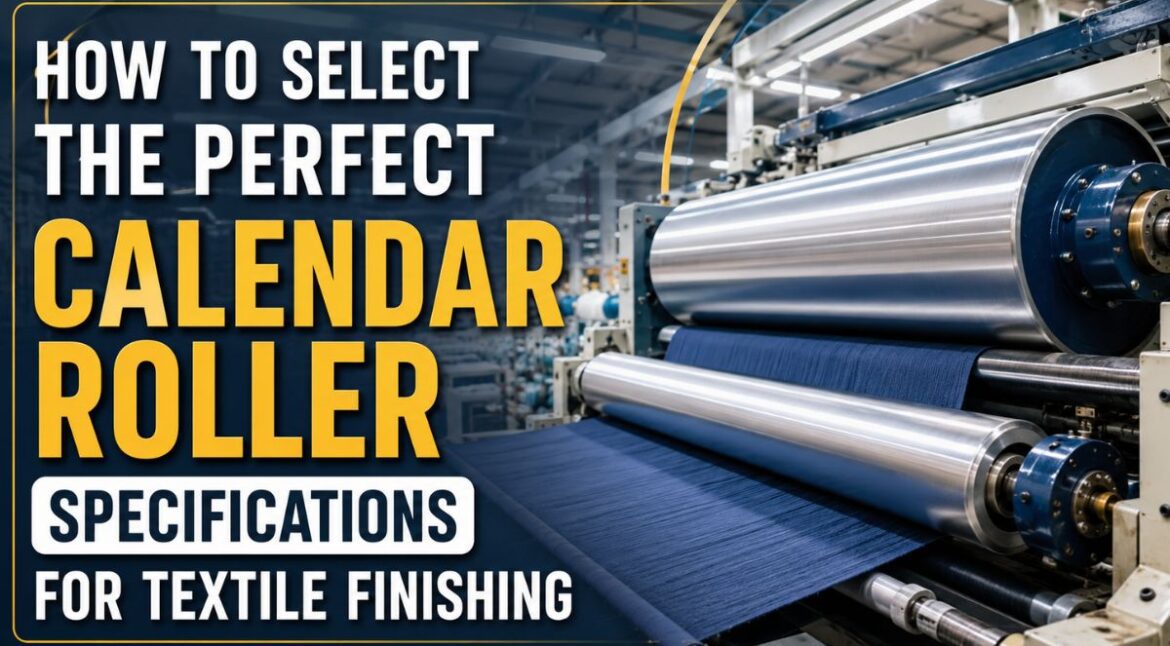
How to Select the Perfect Calender Roller Specifications for Textile Finishing
In the Indian textile industry, quality is everything. When a customer touches a piece of fabric, they instantly judge your brand. They want to feel smoothness, see a rich shine, and experience a premium texture.
But as a textile manufacturer, how do you achieve that perfect finish consistently?
The answer lies in one critical component of your textile finishing machine: the Calender Roller.
Selecting the right Calender Roller is not just a technical choice; it is a major business decision. If you choose the wrong roller, you will face endless problems like uneven fabric shine, fabric burning, and high machine breakdown costs. On the other hand, the right roller will make your fabric look outstanding, speed up your production, and save you lakhs of rupees in maintenance.
At Siva Rollers, a trusted Calender Roller Manufacturer based in India with global export capabilities, we help textile business owners solve these exact problems.
In this easy-to-understand guide, we will break down exactly how to choose the perfect roller specifications for your textile finishing needs, without confusing you with heavy engineering jargon.
Why the Right Calender Roller Matters for Your Fabric Quality
Before we look at how to choose a roller, let us understand what happens when the roller is not a perfect match for your machine.
Many textile mills in India buy cheap or incorrect rollers to save a little money upfront. Soon, they start facing these common headaches:
- Uneven Fabric Finish: One side of the fabric looks highly polished, while the other side looks dull.
- Fabric Damage and Cracks: If the roller surface is too hard or hot for delicate fabrics, it can tear or weaken the threads.
- Frequent Machine Stops: Cheap rollers wear out quickly, forcing you to stop production for repairs. This delays your orders and hurts your reputation with buyers.
To avoid these problems, you need a high-quality Calender Textile Roller designed specifically for your target fabric.
4 Simple Steps to Select the Best Calender Roller for Your Business
You do not need to be an engineer to select the right roller. By focusing on these four practical steps, you can easily find the perfect fit for your factory.
Step 1: Identify Your Fabric Type (What are you finishing?)
Different fabrics require different amounts of heat, pressure, and surface softness.
- Cotton and Natural Fibers: These require a good balance of moisture, high pressure, and heat to flatten the threads and create a soft, natural shine.
- Polyester and Synthetics: Synthetic fabrics are sensitive to high heat. They need very precise temperature control so they do not melt or shrink.
- Blended Fabrics: If you work with cotton-polyester blends, you need a highly versatile roller that can handle mixed properties without damaging either fiber.
Step 2: Define Your Finishing Goal (What look do you want?)
What do your customers want the final fabric to look like?
- High Gloss/Shine: If you want a shiny, mirror-like finish on the fabric, you need a highly polished steel roller paired with a soft backing roller.
- Matte or Soft Feel: If you want a soft, smooth hand-feel without too much shine, a cotton-filled or fiber-filled roller is the best choice.
- Pattern or Embossing: If you want to print a 3D pattern on the fabric, you will need a specially engraved embossing roller.
Step 3: Choose the Right Material Combination
A calendering machine usually works using a pair of rollers pressing against each other. To get the perfect finish, you must choose the right combination:
- Hard Metal Rollers (Steel or Chilled Iron): These are excellent for heating up and pressing the fabric hard. They provide the heat and pressure needed to flatten the fibers.
- Soft/Resilient Rollers (Cotton, Wool-Paper, or Polyamide Sleeve): These act as a cushion. When the hard steel roller presses against this soft roller, it allows the fabric to pass through safely, adding bulk, softness, and an even finish without crushing the fabric threads.
Step 4: Focus on Simple Operational Features
Instead of getting lost in complex engineering formulas, focus on these practical features when talking to your Calender Roller Manufacturer:
- Even Heat Distribution: Ensure the heated roller heats up equally from the left side to the right side. If the center is hotter than the edges, your fabric quality will be highly inconsistent.
- Bending Resistance: Under high pressure, long rollers tend to bend slightly in the middle. Ask for rollers designed to maintain uniform pressure across the entire width of the fabric.
- Easy Maintenance: Choose rollers that are easy to clean and do not accumulate dust or chemical residues from the processed fabrics easily.
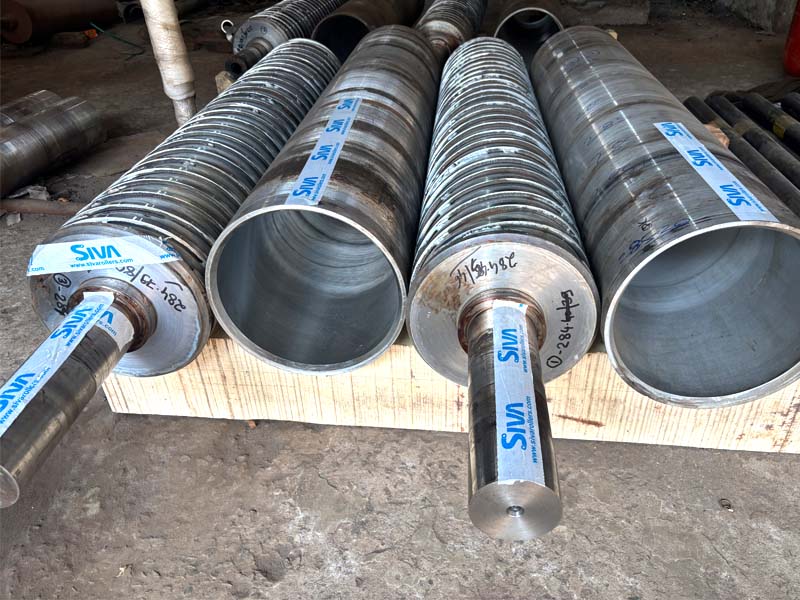
The Hidden Cost of Cheap Rollers: Why Quality Always Wins
In the B2B textile market, it is tempting to choose the cheapest supplier. However, experienced textile manufacturers know that a cheap roller is actually much more expensive in the long run.
Here is why:
Feature | Cheap / Low-Quality Roller | Siva Rollers (High-Quality) |
Lifespan | Wears out in 6 to 12 months. | Lasts for years with minimal wear. |
Fabric Rejection Rate | High (due to uneven shine or fabric burns). | Near zero (consistent quality throughout). |
Energy Consumption | Heats up slowly, wasting electricity. | Highly efficient heating design saves power. |
Maintenance Cost | Frequent resurfacing and bearing changes needed. | Low maintenance, saving labor and downtime. |
By investing in a premium Calender Roller India manufacturers trust, you protect your business from sudden production losses and keep your buyers happy with top-quality fabric.
Why Siva Rollers is the Preferred Calender Roller Manufacturer in India & Globally
When it comes to manufacturing high-performance rollers, Siva Rollers is a name trusted by leading textile brands. Based in India, we combine local manufacturing expertise with international quality standards, making us a top exporter to textile hubs worldwide.
Here is what makes us different:
1. Tailored to Your Specific Machine and Fabric
We do not believe in “one-size-fits-all.” Our team talks to you, understands your fabric type, your machine speed, and your target quality, and then designs a custom Calender Textile Roller built specifically for your business.
2. World-Class Indian Engineering with Global Export Standards
From our state-of-the-art manufacturing facility in India, we build rollers that meet global quality benchmarks. Whether your factory is in Surat, Coimbatore, Ludhiana, or anywhere across the globe, we pack and ship our products with extreme care to ensure they reach you in perfect condition.
3. Superb Surface Finish for Flawless Fabric
Our metal rollers undergo high-precision grinding and polishing. This guarantees a glass-like surface finish that transfers a beautiful, uniform shine to your fabrics without any defects or marks.
4. Expert Technical Support and Guidance
We don’t just sell you a roller and disappear. Our experienced team helps you understand how to run the rollers, how to maintain them, and how to prolong their life, ensuring you get the absolute best return on your investment.
Get a Free Consultation for Your Textile Mill Today!
Choosing the right roller specs does not have to be a confusing guessing game. Let the experts do the hard work for you.
Whether you want to upgrade your existing textile finishing machine, reduce fabric rejection rates, or increase your daily production capacity, Siva Rollers is here to guide you.
Contact Siva Rollers today! Tell us your fabric finishing goals, and our experts will suggest the perfect roller configuration to maximize your profits.
FAQs
Choose a Calender Roller based on your fabric type, desired fabric finish (gloss, matte, embossing), machine specifications, operating temperature, production speed, and roller material. A custom-designed roller ensures consistent fabric quality, reduced downtime, and longer service life.
The most important factors include:
- Fabric type (cotton, polyester, blends, nonwoven)
- Roller diameter and face length
- Surface finish requirements
- Temperature range
- Pressure distribution
- Roller material
- Machine compatibility
- Production speed
- Maintenance requirements
Selecting the correct specifications improves productivity and fabric quality.
A Calender Roller is an industrial roller used in textile finishing machines to improve the appearance, texture, thickness, and smoothness of fabrics. By applying controlled heat and pressure, it creates finishes such as gloss, softness, embossing, or uniform thickness on textiles.
The primary function of a Calender Roller is to apply uniform heat and pressure to fabric. This process improves surface smoothness, enhances fabric shine, reduces thickness variations, and produces consistent finishing quality while increasing production efficiency.
Polyester fabrics require Calender Rollers with accurate temperature control because excessive heat can cause shrinkage or melting. Precision-engineered rollers ensure consistent heat distribution and high-quality finishing without damaging synthetic fibers.
Yes. Many worn Calender Rollers can be refurbished through grinding, polishing, re-chroming, balancing, surface restoration, or repairing damaged sections. Refurbishment can restore performance and extend roller life at a lower cost than replacement.
The ideal temperature depends on the fabric type. Cotton fabrics generally require higher temperatures than polyester or synthetic materials. The correct temperature should be selected based on the fabric's properties to avoid shrinkage, scorching, or surface damage while achieving the desired finish.
Cotton fabrics generally require a combination of a heated steel roller and a resilient cotton-filled or fiber-filled roller. This combination provides uniform pressure and heat, resulting in a soft feel, improved smoothness, and a natural glossy finish.
Uniform heat distribution ensures the entire fabric width receives the same temperature. This prevents uneven gloss, inconsistent finishing, fabric distortion, and quality variations between the center and edges of the material.
Fabric rejection can be reduced by:
- Using correctly specified Calender Rollers
- Maintaining uniform roller temperature
- Applying consistent pressure
- Regular roller maintenance
- Selecting the proper roller surface finish
- Matching the roller to the fabric type
These practices improve finishing consistency and minimize defects.