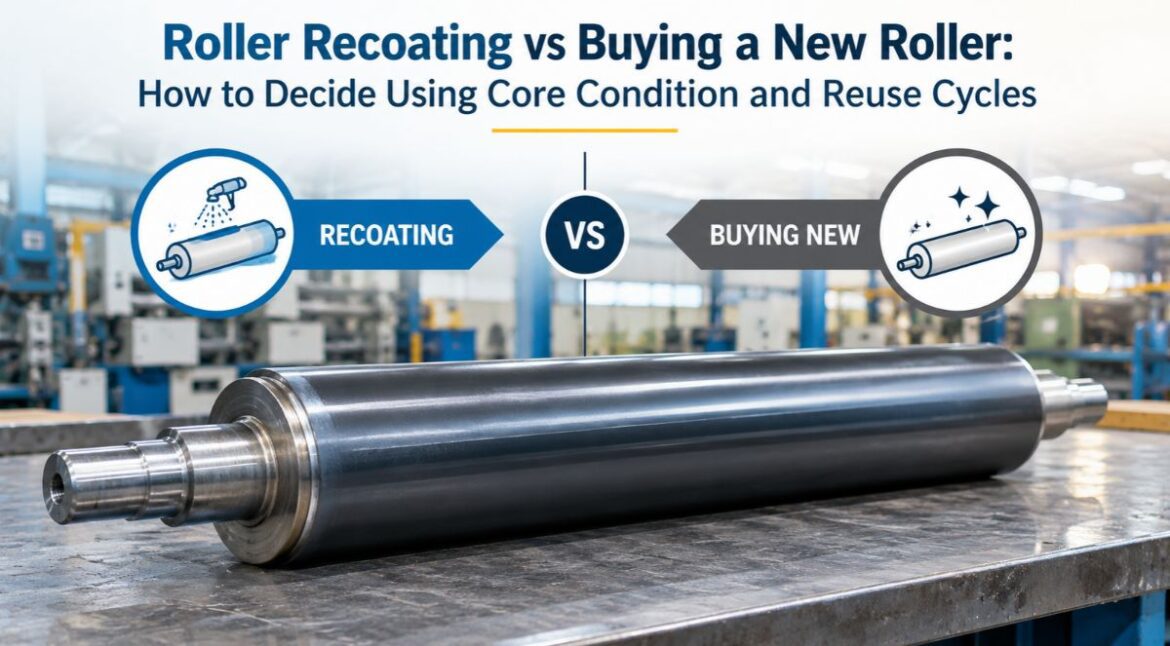
Roller Recoating vs. Buying a New Roller: How to Decide Using Core Condition and Reuse Cycles
In modern manufacturing facilities, industrial rollers are the silent workhorses of the production line. Whether running continuous web lines in textiles, handling delicate flexible film in packaging, or guiding high-speed paper feeds, rubber-coated rollers, PU rollers, and ebonite rollers bear constant mechanical and environmental stress.
Over time, every industrial roller surface degrades. You notice surface wear, uneven pressure distribution, chemical swelling, micro-cracks, or hardness changes. When production output begins to show defects or inconsistent tension, plant engineers and maintenance managers face a critical decision:
Should you send the worn roller for recoating, or should you invest in a completely new replacement roller?
Making the right choice affects not only your maintenance budget but also machine uptime, product quality, and long-term operational efficiency. Making a hasty choice without assessing the underlying steel or stainless steel core can lead to unexpected line stoppages or unnecessary capital expenses.
This guide explores how to evaluate your rollers using core condition assessment and reuse cycle tracking—giving you a clear, practical framework to make the right choice for your factory floor.
Understanding the Two Main Components of an Industrial Roller
To evaluate whether to recoat or replace, you first need to separate an industrial roller into its two fundamental parts:
- The Core (Metal Shell and Shaft/Journals): The structural base, usually crafted from steel, stainless steel, seamless pipe, or specialized alloys. It bears mechanical torque, maintains structural balance, and supports load during operation.
- The Coating (Covering Layer): The functional outer material, such as natural rubber, synthetic elastomer, polyurethane (PU), ebonite, or specialized heat-resistant compounds. It provides surface grip, chemical resistance, release properties, or specific hardness levels needed for processing.
When a roller shows surface failure, in most cases, only the outer coating has reached the end of its useful lifespan. The heavy-duty metal core underneath often remains structurally intact.
This simple separation is why roller refurbishment and recoating exist as standard maintenance practices in industrial plants across India and globally.
Need Custom Industrial Rollers?
✓ Custom Diameter & Length
✓ Temperature Control Design
✓ Fast Manufacturing
✓ Technical Support
Evaluating Core Condition: The Foundation of the Decision
The key rule in industrial roller maintenance is simple: You should only recoat a roller if its core is structurally sound.
Applying a fresh rubber or polymer surface on a damaged, bent, or fatigued core is a wasted effort. It leads to poor vibration control, uneven wear patterns, premature coating failure, and potential damage to your processing machinery.
Before deciding to strip and recoat, a thorough core inspection must take place. Here are the key indicators plant engineers must evaluate:
1. Journal and Shaft Integrity
The journals (shaft ends) sustain mechanical stress, bearing friction, and drive torque.
- Key Check: Inspect journal bearing seats and keyways for scoring, fretting corrosion, surface wear, or dimensional distortion.
- Decision Impact: If journal wear is minor, precision machining, sleeving, or metallizing can restore original dimensions. However, if journals show severe cracking, deep grooving, or torsional distortion, repairing them may not be practical, making a new roller necessary.
2. Shell Thickness and Wall Uniformity
During every recoating cycle, the old coating is stripped off, and the outer surface of the metal core is grit-blasted or lightly machined to create a clean profile for compound bonding.
- Key Check: Over multiple refurbishment cycles, repeated surface preparation can gradually reduce metal wall thickness.
- Decision Impact: If the shell wall becomes too thin, the roller loses structural rigidity. Under operating nip pressure, a thin-walled roller will flex or deflect, causing uneven nip contact across the machine width. Once shell wall thickness falls below critical limits, core replacement is required.
3. Dynamic Balance and Concentricity (Runout)
A roller operating at medium or high speeds must run smoothly without wobble or vibration.
- Key Check: Place the bare metal core on precision turning equipment or dynamic balancing rigs to check total indicator reading (TIR) runout.
- Decision Impact: Bent shafts or warped shells create uneven centripetal forces. Minor imbalance can often be corrected during refurbishment through dynamic balancing. Severe core warping, however, means the core must be retired.
4. Internal and External Corrosion
Rollers operating in wet processing, chemical baths, or high-humidity environments (such as textile dyeing, paper converting, or film washing lines) are vulnerable to moisture ingress.
- Key Check: Inspect internal bore surfaces, weld seams, and end-plate joints for deep rust, pitting, or chemical attack.
- Decision Impact: Internal oxidation degrades metal strength silently. If deep rust or weld cracking is detected, recoating the exterior will not prevent catastrophic mechanical failure during operation.
Tracking Roller Reuse Cycles: How Many Times Can You Recoat?
A common question among maintenance teams is: How many times can an industrial roller core be reused?
There is no single universal number because reuse cycles depend heavily on the operating environment, machine speeds, load pressures, and core design. However, practical experience shows clear patterns across processing industries:
Typical Lifespan by Industrial Application
- Light to Medium-Duty Applications: Rollers used in packaging, film converting, slitting, and light paper printing under controlled temperature and clean environments can often undergo 4 to 7 recoating cycles over their operational lifetime.
- Heavy-Duty High-Nip Applications: Calender rollers, squeeze rollers, or heavy industrial processing rollers operating under high load, elevated heat, or aggressive chemical contact typically support 2 to 4 recoating cycles before metal fatigue or shell thinning requires core retirement.
- Corrosive or High-Impact Lines: Rollers exposed to acidic dips, harsh solvents, or high impact may require earlier replacement due to core pitting and weld degradation.
Establishing a Core Logbook
To manage reuse cycles effectively, structured maintenance programs track each roller core using a unique identification tag or serial number. Documenting the following data helps plant managers make accurate decisions:
- Original manufacturing date and core specifications
- Dates of previous recoating cycles
- Compound type, hardness, and coating thickness applied each time
- Observed runout and dimensional checks before each recoating
- Operating line history and total running hours
When a core approaches its maximum recommended reuse cycles, maintenance teams can proactively plan for a new roller build without suffering unplanned downtime.
When to Choose Roller Recoating
Recoating is often the most sensible choice when the metal core passes all structural inspections. Here are the main reasons to choose recoating:
1. Sound Core with Surface Wear Only
If the existing rubber or elastomer surface has worn down evenly, suffered minor surface glazing, or aged naturally—but the core runout, journals, and wall thickness remain within tight tolerances—recoating is the logical, highly effective route.
2. Custom Formulation Upgrades
Recoating allows you to adapt to changing production needs. If your process switches to new inks, solvents, or higher operating temperatures, you do not need a new core. You can simply strip the old surface and apply an upgraded compound formulation tailored to the new chemical or thermal requirements.
3. Reduced Material Waste
Reusing intact steel or stainless steel cores keeps high-grade metal in service, reduces industrial scrap, and aligns with sustainable manufacturing practices without compromising line performance.
4. Shorter Refurbishment Timelines
Manufacturing a complete custom roller from scratch involves raw material sourcing, heavy machining, shaft fitment, welding, and balancing before coating application. Recoating an existing bare core skips the preliminary core fabrication steps, helping restore equipment to service more quickly.
When Buying a New Roller Is Necessary
While recoating offers clear benefits, there are distinct operational scenarios where investing in a brand-new custom manufactured roller is the safer, smarter strategy:
1. Structural Core Failure
If inspection reveals journal cracks, permanent shaft deflection, severe corrosion pitting, or compromised internal welds, repairing the core becomes impractical. Placing fresh rubber over a structural flaw introduces high operational risks.
2. Machine Modifications or Process Redesigns
When upgrading production lines for higher operating speeds, wider web widths, or increased nip pressures, older roller cores may no longer meet updated load demands. A newly engineered roller designed with heavier wall thickness or upgraded shaft geometry ensures smooth integration with upgraded machinery.
3. Missing or Damaged Spare Stock
Every continuous manufacturing facility needs reliable standby inventory. Relying entirely on a single roller per position leaves production vulnerable during maintenance turnarounds. If your plant lacks a backup, ordering a new roller establishes a healthy rotation schedule.
4. Excessive Maintenance History
When a core has reached the end of its design life through multiple refurbishment cycles, metal fatigue increases the risk of unexpected breakdown. Replacing aged cores protects high-speed lines from sudden failures.
Strategic Comparison: Recoating vs. Buying New
To help your team evaluate options quickly, here is how the two approaches compare across core operational parameters:
Operational Consideration | Roller Recoating | Buying a New Roller |
Prerequisite | Core must pass structural, runout, and journal checks | Required when core is damaged, fatigued, or missing |
Material Utilization | Reuses existing steel/stainless steel core | Uses fresh raw materials for core fabrication |
Process Flexibility | Easy to update coating hardness or material formulation | Complete freedom to modify core geometry and surface spec |
Lead Time | Generally faster; skips preliminary metal fabrication | Includes metal sourcing, turning, welding, and balancing |
Inventory Impact | Requires scheduled rotation during downtime | Builds backup stock for critical production positions |
Best Practices for Extending Industrial Roller Life
Whether using a new roller or a refurbished one, practical preventive maintenance habits help maximize overall operational lifespan and protect core integrity:
Proper Storage and Handling
- Store idle rollers horizontally supported on their journal ends, never resting directly on the coated surface, to prevent permanent flat spots.
- Rotate stored rollers periodically to distribute internal stress evenly.
- Protect stored rubber and elastomer surfaces from direct sunlight, ozone sources, and moisture.
Nip Pressure and Alignment Balance
- Ensure driving and driven shafts are aligned with precision to prevent uneven localized heat buildup across the roll face.
- Avoid applying excess nip pressure beyond application requirements, as over-compression accelerates mechanical wear and core flexing.
Regular Cleaning and Chemical Compatibility
- Use cleaning solutions compatible with your specific coating material to avoid surface swelling, hardening, or cracking.
- Remove residual chemicals, adhesives, or particulate buildup at the end of every operating shift.
Choosing an Experienced Industrial Roller Partner in India
Managing your roller assets successfully requires accurate technical inspection, reliable surface strip-down processes, precision grinding, and application-specific compound selection.
Based in Ahmedabad, Gujarat, Siva Rollers (Siva Engineering Works) serves as a trusted industrial roller manufacturer in India. With expertise across rubber rollers, PU rollers, ebonite coated rollers, stainless steel guide rollers, calender rollers, and specialized coating solutions, Siva Rollers supports processing industries nationwide.
Whether your facility requires comprehensive core inspection, customized recoating services, or precision-engineered new industrial rollers for textile, packaging, paper, plastic, steel, or printing lines, partnering with an experienced manufacturer ensures consistent performance, extended core life, and reliable operational continuity.
Final Decision Framework for Plant Engineers
When deciding your next step, follow this practical workflow:
- Remove and Clean: Strip surface residues and thoroughly clean the bare assembly.
- Inspect Core Integrity: Check journals, measure runout, inspect welds, and verify shell wall thickness.
- Review Reuse History: Check the roller logbook to confirm total prior refurbishments.
- Evaluate Process Needs: Determine if current line speeds, temperatures, or chemicals require updated coating specs.
- Decide with Confidence: If the core is sound and within fatigue limits, proceed with expert recoating. If the core shows structural defects or fatigue, invest in a precision-manufactured new roller to safeguard your production line.
By applying this structured evaluation, plant engineers can maintain consistent production quality, optimize maintenance spending, and keep manufacturing lines running smoothly.
FAQs
The decision depends mainly on the condition of the roller core. If the steel or stainless steel core, journals, shell thickness, runout, and internal structure are sound, recoating can be a practical option. If the core has severe cracks, permanent shaft distortion, deep corrosion, or structural fatigue, a new roller may be the safer choice.
An industrial roller core should be inspected for journal and shaft condition, shell wall thickness, concentricity, runout, corrosion, weld condition, and previous refurbishment history. Recoating should only be considered when the core remains structurally sound and suitable for continued operation.
Yes, a worn rubber roller can often be recoated when the underlying metal core is in good condition. Recoating can restore the working surface without replacing the complete roller core. However, the core should be inspected before the old coating is stripped and a new coating is applied.
There is no universal number because reuse depends on the roller design, operating load, speed, temperature, chemicals, and core condition. The content indicates that light- to medium-duty applications may often support around 4–7 recoating cycles, while heavy-duty high-nip applications may support around 2–4 cycles before core retirement becomes necessary.
A new roller is generally considered when the existing core has serious structural problems such as journal cracks, permanent shaft deflection, severe corrosion pitting, compromised welds, excessive fatigue, or excessive refurbishment history. Replacement may also be appropriate when machine modifications require a different core design or geometry.
Roller recoating can reduce the need to manufacture a completely new core when the existing core is structurally suitable for reuse. It reuses the existing steel or stainless steel core and can avoid several preliminary manufacturing steps involved in building a new roller.
Before recoating, the roller should be checked for journal integrity, shaft condition, shell wall thickness, dimensional condition, runout, concentricity, corrosion, weld condition, and previous recoating history. The required coating material and process should also be reviewed according to the application's operating conditions.
Yes, when the existing core remains suitable, recoating can allow the working surface to be adapted to changing production requirements. Depending on the application, the coating formulation, hardness, or material can be selected according to changes in chemicals, inks, solvents, temperature, or other process requirements.
Roller recoating normally reuses the existing metal core after removing the old coating and preparing the surface for a new coating. Manufacturing a new roller involves creating or preparing a new core, including processes such as metal sourcing, machining, shaft fitment, welding, balancing, and coating. The appropriate option depends on core condition and production requirements.
Some minor core or journal issues may be repairable through suitable machining, sleeving, metallizing, or balancing processes. However, severe cracking, major shaft distortion, deep corrosion, compromised welds, or serious structural fatigue may make the core unsuitable for recoating. A proper inspection should be completed before deciding on repair or replacement.
Siva Rollers (Siva Engineering Works), based in Ahmedabad, Gujarat, supports industrial roller requirements including customized recoating services and precision-engineered new industrial rollers. Its product and service experience covers applications involving rubber rollers, PU rollers, ebonite coated rollers, stainless steel guide rollers, calender rollers, and other industrial roller solutions.
Start by stripping and cleaning the roller, inspecting the core, checking journals and runout, verifying shell wall thickness and weld condition, and reviewing previous recoating cycles. Then evaluate the current machine's speed, temperature, pressure, and chemical requirements. If the core is structurally sound, recoating may be suitable; if structural defects or fatigue are present, a new roller should be considered.