Top 5 Signs It’s Time to Replace Your Printing Rollers — And Where to Buy the Best
In the high-stakes world of commercial printing, packaging, and industrial coating, your press machinery is only as good as the rollers operating inside it. Printing rollers—whether rubber, polyurethane, silicone, or specialized elastomeric compounds—are the true workhorses of your production line. They dictate ink transfer precision, coating uniformity, line speed, and ultimately, the final aesthetic quality of your printed product.
However, even the highest-grade industrial printing rollers don’t last forever. Continuous friction, aggressive solvents, heavy mechanical pressure, UV exposure, and thermal cycles gradually degrade roller surfaces and cores over time.
Operating worn-out rollers is one of the most expensive mistakes a printing plant manager can make. What starts as minor streaking or slight density variation quickly escalates into wasted substrate, excessive ink consumption, unscheduled press downtime, and costly customer rejections.
If you’ve noticed a drop in print quality or press efficiency, your rollers may be sending you warning signals. In this comprehensive guide, we will break down the top 5 signs it’s time to replace your printing rollers, the hidden costs of delaying roller maintenance, and where you can source premium, custom-engineered printing rollers to maximize your ROI.
Is Your Press Running Below Capacity?
Don’t let worn rollers ruin expensive jobs and waste raw materials. Talk to the precision engineering experts at Siva Rollers for a free technical consultation and custom quote.
The Hidden Costs of Running Damaged Printing Rollers
Before diving into the physical signs of wear, it is critical to understand the financial impact of delayed roller replacement. Many press operators push their rollers far past their optimal lifespan to save on immediate replacement costs. Unfortunately, this logic usually backfires.
Running degraded rollers leads to:
- Massive Material Scrap Rates: Worn rollers cause spotty ink distribution, forcing press operators to throw away hundreds of meters of film, paper, or foil during setup and execution.
- Excessive Chemical and Ink Waste: To compensate for hardened or uneven roller surfaces, operators often increase press nip pressure or over-saturate ink fountains, wasting expensive inks and coatings.
- Severe Mechanical Wear on Presses: Hardened or unevenly worn rollers create unbalanced forces, accelerating wear on press bearings, gears, drive shafts, and cylinders.
- Unplanned Downtime and Missed Deadlines: Sudden roller failure or delamination during a high-speed production run forces emergency shutdowns, costing thousands of dollars per hour.
By proactively identifying roller degradation, you can schedule replacements during planned maintenance windows, ensuring uninterrupted production and maximum profitability.
Top 5 Signs It’s Time to Replace Your Printing Rollers
1. Visible Surface Defects: Cracks, Pitting, Glazing, and Grooves
The most straightforward indicator that your printing roller needs immediate replacement is physical surface damage. During daily washing or pre-press inspections, take a close look at the elastomeric cover.
Common visual red flags include:
- Surface Glazing: Over time, inks, fountain solutions, and aggressive cleanup solvents form a hard, glass-like layer over the porous rubber surface. Glazed rollers lose their natural tack and cannot carry or transfer ink effectively, leading to washed-out prints.
- Cracking and Crazing (Ozone Attack): Microscopic cracks or fine “spiderweb” patterns on the roller ends or face indicate chemical oxidation, solvent attack, or exposure to environmental ozone. These cracks trap ink particles, making color changes nearly impossible and causing localized ink voiding.
- Pitting and Gouges: Physical debris, dried ink chunks, or accidental tool slips can gouge the roller face. These pits leave persistent blank spots or unwanted patterns across every revolution.
- Grooving and Circumferential Scratches: A worn doctor blade, improper nip adjustments, or abrasive particles can cut deep grooves along the circumference of the roller, ruining coating uniformity.
The Fix: While mild glazing can sometimes be remediated with specialized deglazing chemical washes, deep cracks, pitting, and grooving require immediate roller stripping, recoating, or full replacement.
2. Inconsistent Ink & Coating Transfer (Streaking, Ghosting, Spotty Coverage)
When print defects begin appearing repeatedly across your production runs, your rollers are often the primary culprit. Printing rollers must maintain a perfectly uniform, smooth, and resilient surface to deliver precise metering and distribution.
Keep an eye out for these telltale print quality issues:
- Density Variations Across the Web: If print density is dark on the left side of the sheet but faded on the right, your roller has developed an uneven taper across its face.
- Streaking and Banding: Horizontal or vertical lines across the printed substrate typically indicate chatter marks, flat spots, or uneven durometer (hardness) zones on the roller surface.
- Ghosting: When previous images or patterns faintly re-appear in solid print areas, it signals that the dampening or form roller has lost its chemical affinity for ink absorption and release.
- Mottled or “Orange Peel” Coating Finish: In flexographic or gravure varnishing lines, a damaged applicator roller cannot smooth out liquid coatings, leaving a textured, unappealing surface finish.
If your press operators spend hours adjusting fountain keys, impression settings, and ink viscosity without fixing these quality flaws, the problem isn’t the ink—it’s your rollers.
3. Hardening or Softening (Shore A Durometer Deviation)
Rubber and elastomer rollers are formulated with specific hardness levels measured on the Shore A Durometer scale. For example, dampening rollers might require a soft 25–35 Shore A rating, while flexo impression or heavy industrial coater rollers may demand a firmer 70–90 Shore A rating.
Over time, exposure to temperatures, mechanical stress, and cleaning chemicals drastically alters the roller’s original hardness:
- Roller Hardening: Continuous chemical exposure causes plasticizers inside the rubber compound to leach out. As the roller hardens, it loses its elasticity and resilience. It can no longer flex properly under nip pressure, causing poor ink transfer, heavy dot gain, and accelerated plate wear.
- Roller Softening & Gummy Surfaces: Incompatible solvents, aggressive wash mixtures, or plasticizer migration from inks can soften the rubber compound. The surface becomes sticky, gummy, or sponge-like, leading to severe swelling, rubber transfer onto plates, and structural breakdown.
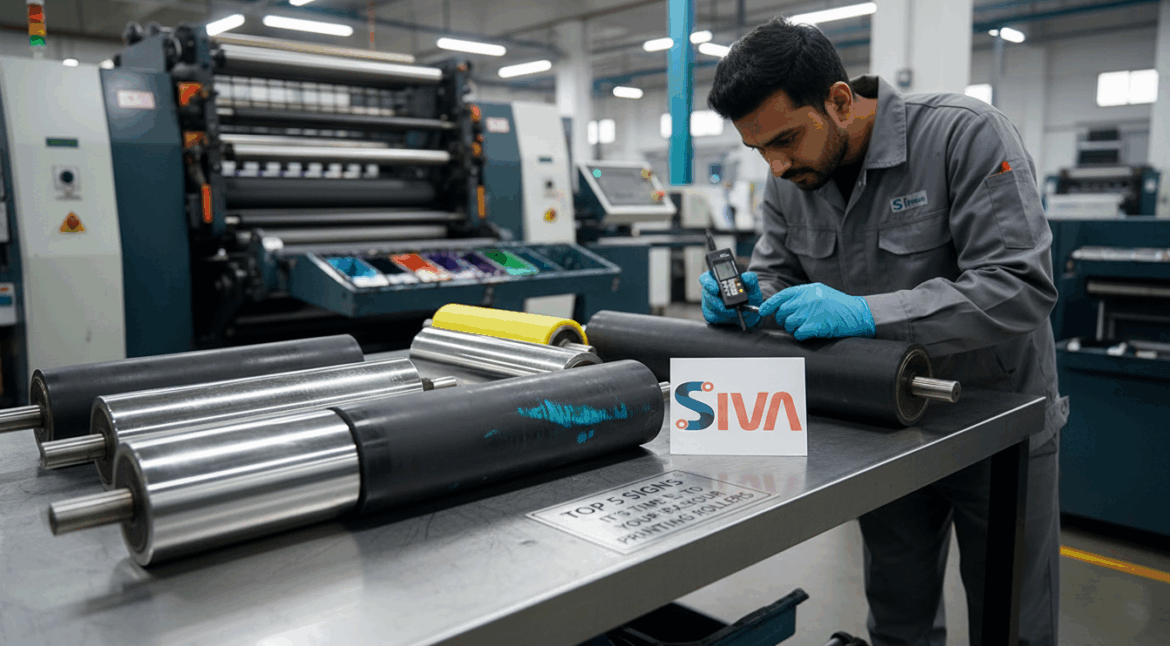
How to Check: Regularly measure your rollers with a calibrated Shore A durometer gauge during routine maintenance. If the reading strays by more than 5 to 8 points from the manufacturer’s original specifications, it’s time for a replacement.
4. Dimensional Changes: Swelling, Shrinking, or Tapering
For optimal ink transfer, a printing roller must maintain a mathematically precise cylindrical shape across its entire face width. Any variation in diameter disrupts the exact nip footprint required for clean imaging.
Watch out for these dimensional distortions:
- End Swelling (Bell-Mouth Effect): Solvents and inks often accumulate near the edges of the roller, causing the rubber ends to swell larger than the middle. This creates excessive nip pressure at the margins, leading to premature plate wear and edge-flaring.
- Center Depression (Concave Wear): Heavy production runs using narrow web sizes concentrate wear in the middle of the roller. Over time, the center diameter decreases, causing light ink density in the middle of wide-web jobs.
- Circumferential Tapering: Uneven mechanical pressure or bearing misalignment causes one side of the roller to wear down faster than the other, resulting in a subtle cone shape.
Even a microscopic deviation of 0.05 mm in roller diameter can ruin high-resolution graphics, flexo halftone screens, and thin-film barrier coatings. When dimensional integrity is lost, regrinding or replacing the roller is mandatory.
5. Excessive Heat Generation & Bearing / Journal Wear
Printing rollers do not operate in isolation; they are part of a precision mechanical assembly. Severe heat buildup during operation is a major warning sign that your roller assembly is failing.
Excess heat stems from two main causes:
- Internal Hysteresis (Flex Fatigue): When rubber rollers undergo continuous high-speed compression and relaxation, energy is converted into heat inside the elastomer compound. If the rubber formulation is poor or overloaded, internal heat builds up until the rubber bond breaks down, causing internal blistering, de-bonding from the metal core, or explosive rubber failure.
- Worn Journals and Bearings: Damaged roller journals (the metal shaft ends), worn keyways, or rusted bearings create excessive vibration, drag, and mechanical friction. This friction transfers heat directly into the rubber ends, destroying the seal and compound integrity.
If your rollers feel excessively hot to the touch after short production cycles, or if you hear grinding, clicking, or squeaking noises from the press frame, stop the press immediately to inspect both the roller surface and the steel core.
+-----------------------------------------------------------------------------------+
|                                 SUMMARY CHECKLIST                                 |
|                 5 Quick Indicators That You Need New Rollers                      |
+-----------------------------------------------------------------------------------+
|  [ ] 1. Surface cracked, pitted, glazed, or grooved                               |
|  [ ] 2. Unexplained print defects (streaking, ghosting, density loss)             |
|  [ ] 3. Durometer reading shifted by >5-8 Shore A points                          |
|  [ ] 4. Physical distortion (end swelling, center hollows, diameter taper)        |
|  [ ] 5. Excessive heat buildup, core vibration, or journal wear                   |
+-----------------------------------------------------------------------------------+
Should You Regrind/Recover or Buy New Printing Rollers?
When faced with roller damage, press managers often ask: Should we regrind/re-cover our existing core, or buy a completely new roller assembly?
- Regrinding/Stripping & Re-covering: If the underlying steel or aluminum core is completely intact, straight, and dynamic balancing is stable, stripping the old rubber and vulcanizing a brand-new elastomeric compound onto the core is a cost-effective, high-value option.
- Full Replacement: If the metal core is bent, scored, corroded, or has worn journal bearings, re-covering will only yield short-term results. Purchasing a completely new, precision-machined roller assembly guarantees peak press performance and long-term reliability.
To ensure you choose the most economical and high-performing option, work with a specialized manufacturer who offers both precision core fabrication and advanced polymer re-covering.
Where to Buy the Best Printing Rollers: Why Industry Leaders Choose Siva Rollers
When it comes to high-performance industrial rollers, precision engineering is non-negotiable. Subpar rubber compounds or improperly balanced shafts will ruin print quality and reduce equipment lifespan.
If you are looking for top-tier durability, unmatched accuracy, and custom engineering, Siva Rollers is your premier partner.
Why Siva Rollers is the Trusted Choice for Printing & Packaging Plants:
- Custom Rubber & Elastomeric Formulations: At Siva Rollers, we engineer polymer compounds tailored specifically to your press chemicals, speed, temperature, and ink types. Whether you need EPDM, Nitrile (NBR), Silicone, Neoprene, Polyurethane (PU), or Hypalon, our rollers offer outstanding chemical, solvent, and heat resistance.
- State-of-the-Art Dynamic Balancing & Precision Machining: Every roller manufactured by Siva Rollers undergoes strict CNC turning, precision cylindrical grinding, and dynamic balancing. This eliminates press vibration, guarantees concentricity, and extends your bearing life.
- Versatility Across Printing & Industrial Applications: We manufacture and re-cover custom rollers for every major printing technique and industrial application:
- Flexographic Printing Rollers (Anilox rubber, dampening, fountain, pressure rollers)
- Rotogravure Printing Rollers (Impression rollers, doctoring rollers, ink transfer rollers)
- Offset Printing Rollers (Inking, dampening, duct, and distributor rollers)
- Lamination, Coating, & Converting Rollers (Solventless laminating, UV coating, nip rollers)
- Extended Operational Lifespan & Lower Total Cost of Ownership: Our proprietary vulcanization and bonding technology prevents rubber-to-core separation, reducing friction heat and surface wear. You enjoy longer production runs between maintenance cycles, drastically reducing your total cost of ownership.
- Fast Turnaround Times & Dedicated Technical Support: We understand that press downtime costs you money. Siva Rollers provides rapid production turnaround, custom OEM core fabrication, and expert technical support to keep your plant running at peak efficiency.
Transform Your Press Performance Today with Siva Rollers
Don’t let worn, degraded printing rollers eat away at your profit margins, waste raw materials, and frustrate your operators. By recognizing the early signs of roller wear—from subtle durometer shifts to visible surface glazing—you can stay ahead of downtime and maintain pristine print quality.
When it’s time to upgrade or replace your rollers, partner with an industry leader committed to precision, durability, and performance.
Ready to Upgrade Your Printing Rollers?
Get in touch with the technical experts at Siva Rollers today. Whether you need custom OEM rollers, urgent re-covering services, or a customized quote for your printing line, our team is ready to deliver solutions engineered for your success.
FAQs
Common signs include surface cracks, glazing, pitting, grooves, repeated streaking or ghosting, inconsistent ink transfer, changes in roller hardness, dimensional distortion, excessive heat, vibration, or worn journals. If these problems continue after normal press adjustments and cleaning, the roller should be inspected for regrinding, re-covering, or replacement.
The five common warning signs are visible surface damage, inconsistent ink or coating transfer, changes in roller hardness, dimensional changes such as swelling or tapering, and excessive heat or mechanical vibration. Regular roller inspection can help identify these problems before they cause major production issues.
Yes. A damaged, uneven, glazed, or incorrectly worn roller can affect ink or coating distribution and contribute to streaking, ghosting, banding, mottling, or uneven print density. However, these defects can also have other causes, so the roller should be inspected along with the press, ink, and operating conditions.
The decision depends mainly on the condition of the existing roller core. If the core is straight and structurally sound, stripping the old covering and re-covering it may be suitable. If the core, journals, bearings, or other critical components are damaged, a new roller assembly may be more appropriate.
Roller hardness affects how the roller responds to nip pressure and interacts with the printing or coating process. If the elastomer becomes significantly harder or softer than its required condition, ink transfer, coating consistency, pressure distribution, and overall print quality can be affected.
Printing rollers can deteriorate because of repeated mechanical pressure, friction, incompatible cleaning chemicals, solvents, heat, ink exposure, abrasive contamination, improper nip settings, and normal wear. The exact cause depends on the roller compound, machine conditions, and operating environment.
Measure the roller diameter at multiple locations across its face width and compare the readings with the required roller dimensions. Checking for end swelling, center wear, tapering, and other diameter differences can help identify dimensional problems that may affect nip pressure and material transfer.
Printing and industrial rollers can be manufactured or re-covered with suitable elastomeric coverings based on the application. Depending on the process, requirements may include rubber, polyurethane, silicone, or other application-specific compounds. The appropriate material should be selected according to factors such as chemicals, temperature, speed, pressure, and the printing process.
Businesses looking for custom printing rollers can work directly with an industrial roller manufacturer that can review the machine application, roller dimensions, covering requirements, and operating conditions. Siva Rollers (Siva Engineering Works) manufactures and supplies industrial rollers from Ahmedabad, Gujarat, with solutions based on specific application requirements.
For an accurate quotation, provide the roller drawing or dimensions, overall face width, core details, covering material if known, required hardness if specified by the machine or process, operating temperature, chemicals or solvents used, machine/application details, and the quantity required. If the existing roller is available, photographs and inspection details can also help with evaluation.