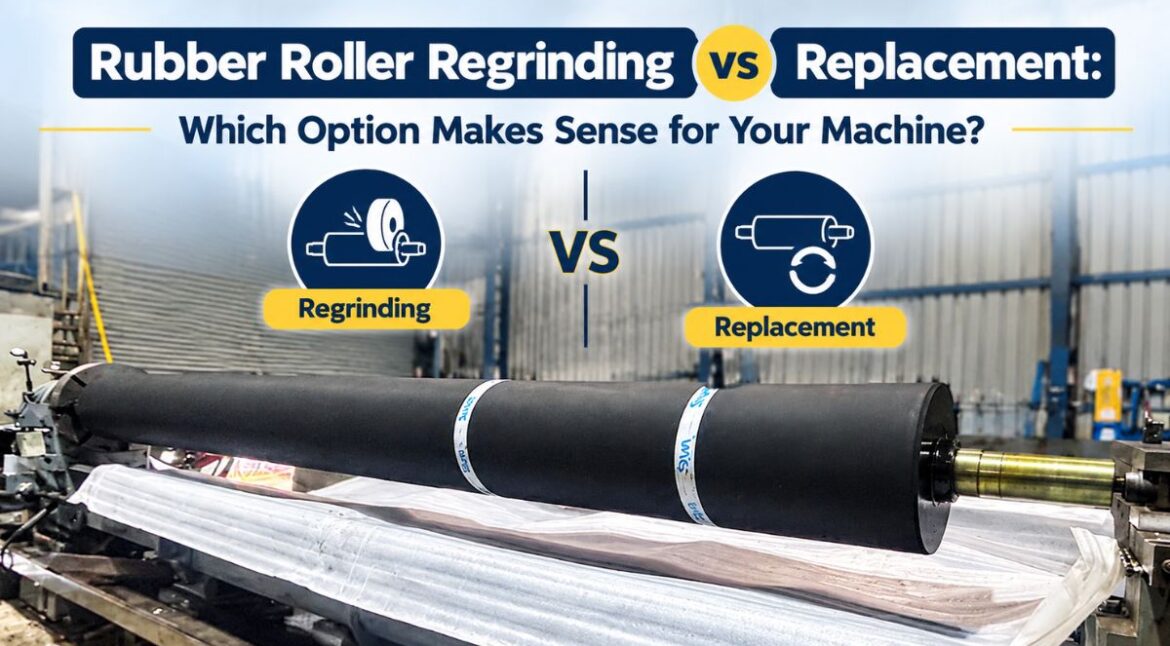
Rubber Roller Regrinding vs Replacement: Which Option Makes Sense for Your Machine?
If you manage a factory floor, operate a printing press, or run a high-speed packaging line, you know the quiet anxiety of watching a key machine slow down.
Everything seems fine until you start noticing slight inconsistencies on your production line. Maybe the ink coverage is no longer uniform. Maybe your flexible packaging film is slipping, or the textile web is dragging unevenly across the machine bed.
When you track down the issue, it almost always points to one crucial component: the rubber roller.
Every industrial roller on your equipment operates under relentless friction, heat, dynamic load, and chemical contact. Over time, even the most durable rubber roller suffers surface fatigue, micro-cracks, or dimensional wear.
When that happens, maintenance teams face a classic operational dilemma: Should you regrind the existing roller, or is it time for a complete replacement?
Making the wrong call can cost you double. Regrinding a worn-out roller past its usable limit leads to early failure and ruined production runs. On the flip side, replacing a roller that only needed a minor surface touch-up wastes valuable maintenance budget.
In this guide, we will break down both options in plain, practical language so you can make the smartest, most cost-effective choice for your facility.
Understanding the Role of Your Rubber Roller
To make the right choice between regrinding and replacement, it helps to look at what a rubber roller actually does inside your machine core.
A rubber roller is rarely just a rotating cylinder. It acts as a precise pressure application device, a liquid metering tool, or a delicate material transport bridge.
Whether in offset printing, film lamination, metal strip processing, or textile finishing, the outer elastomeric layer absorbs vibrations, adjusts to thickness variations in your raw materials, and maintains a continuous, smooth line of contact (known as the nip point).
Over months of continuous operation, several mechanical and chemical factors wear down this outer layer:
- Surface Glazing: Heat and friction harden the outer surface layer, making it smooth, glossy, and unable to grip materials or hold liquids effectively.
- Grooving and Pitting: A single hard particle or repeated material edge contact creates deep channels across the working length of the roller.
- Chemical Swelling or Shrinkage: Solvents, inks, and cleaning agents can cause the synthetic compound to swell unevenly or leach out oils, making the surface soft or brittle.
- Dimensional Distortion: Constant load causes the middle section to thin out (coning or hour-glassing), leading to uneven pressure distribution.
When any of these signs appear, you have to act. But which path should you take?
Option 1: Rubber Roller Regrinding
What Is Regrinding?
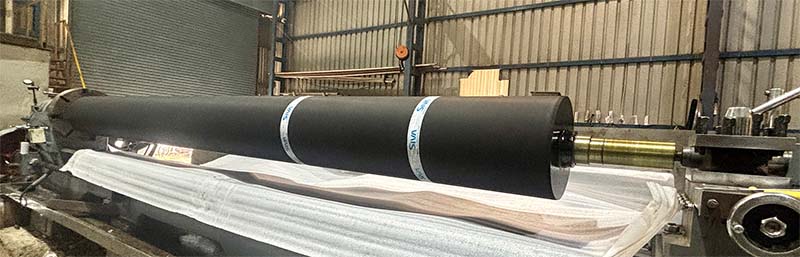
Regrinding (sometimes called re-surfacing or outer-diameter dressing) is a precision machining process where a thin layer of the worn rubber surface is ground away on specialized cylindrical grinding machinery.
The goal of regrinding is simple: strip off the damaged, oxidized, or grooved outer skin to expose fresh, clean elastomeric material underneath, restoring perfect roundness (concentricity) and surface profile.
The Advantages of Regrinding
- Faster Turnaround and Lower Immediate Cost
Regrinding utilizes the existing steel or aluminum metal core and the existing rubber sleeve. Because you are not paying for new metal fabrication or an entire fresh rubber coating process, regrinding is significantly more economical in terms of upfront cash outflow. Turnaround times are usually much shorter than full manufacturing.
- Restores Surface Quality Rapidly
If the core underlying rubber structure is healthy, a fine regrind removes surface glaze, shallow cuts, and minor flat spots. The resulting surface finish performs virtually like a new roller for light to medium-duty applications.
- Eco-Friendly and Reduces Scrap
Reusing both the metal shaft and the bulk of the rubber cover reduces industrial scrap and lowers your plant’s overall material footprint.
When Regrinding Makes Absolute Sense
Regrinding is your best option under the following conditions:
- The surface damage consists of shallow scratches, mild glazing, or light circumferential grooves.
- The original wall thickness of the rubber layer is generous enough to allow stock removal without exposing or weakening the core connection.
- The rubber compound has retained its original elasticity and has not hardened, cracked, or degraded throughout its depth.
- The underlying metal core is completely straight, free of journal wear, and structurally sound.
The Hidden Limits of Regrinding
Regrinding is not a permanent fountain of youth for your equipment. Every time a rubber roller is ground down, its overall diameter decreases.
A smaller outer diameter alters the machine’s gearing ratios, line speed, and stroke range for pressure adjustment. If you remove too much rubber stock, the remaining layer becomes too thin to absorb operational shocks, leading to rapid heat buildup and sudden delamination.
Option 2: Complete Roller Replacement (or Full Stripping & Recovering)
What Is Roller Replacement?
Replacement can mean two things depending on the condition of your component:
- Full Recovering (Re-rubbering): Stripping the damaged rubber compound entirely off the metal core, inspect/repair the core, apply a fresh chemical bonding agent, and mold/vulcanize an entirely new rubber or synthetic coating.
- Complete New Fabrication: Manufacturing a brand-new metal core from scratch along with a fresh specialized cover.
The Advantages of Replacement
- Original Factory Dimensions and Tolerances
A newly manufactured or fully recovered roller brings your machine back to its original design specifications. Gearing, line speed calculations, and pressure settings line up perfectly without custom operator workarounds.
- Tailored Rubber Formulations
Industry standards and material sciences advance rapidly. Choosing a full replacement allows you to upgrade your roller compound to suit new operational demands. For example, if your line now uses harsher cleaning solvents or higher temperature cycles, you can switch from standard neoprene to a highly specialized silicone or fluoropolymer coating.
- Guaranteed Structural Integrity
Full replacement includes a thorough check (and repair or remake) of the inner metal journals, keyways, bearing seats, and internal balance. This eliminates hidden vibration issues that regrinding cannot solve.
When Replacement Is the Only Safe Choice
Replacement or complete re-rubbering is required when:
- The rubber layer is too thin to grind without dropping below operational diameter limits.
- The rubber has aged, turned brittle, or developed deep structural cracks that reach down to the metal shaft.
- The bond between the rubber cover and the metal core has failed (you can feel soft spots or see lifting at the edges).
- The steel journal ends are badly worn, bent, or damaged beyond minor sleeve repairs.
- Your process requirements have changed, demanding higher heat resistance, better non-stick properties, or different durometer hardness levels.
Key Decision Factors: How to Choose for Your Machine
To help your team choose without guessing, evaluate these four real-world operational parameters:
+-----------------------------+
                      |   Check Surface Wear Depth  |
                      +--------------+--------------+
                                     |
             +-----------------------+-----------------------+
             |                                               |
     [ Shallow Wear ]                                [ Deep Cracks ]
             |                                               |
  Check Rubber Thickness                         Check Core Integrity
             |                                               |
     +-------+-------+                               +-------+-------+
     |               |                               |               |
 [Sufficient]   [Too Thin]                       [Damaged]       [Intact]
     |               |                               |               |
     v               v                               v               v
  REGRIND       RECOVER /                        REPLACE         RECOVER /
                REPLACE                           CORE           RECOVER
1. Depth of Surface Imperfections
Measure the depth of the deepest cut or groove across the roller face. If removing that depth reduces your overall diameter past the machine’s adjustment limit, regrinding is off the table.
2. Condition of the Metal Core
Even a perfectly ground rubber surface will fail if the internal shaft has dynamic imbalance or journal wear. According to precision machinery guidelines maintained by global bodies like the International Organization for Standardization (ISO), mechanical runout in rotative cores exponentially accelerates bearing and surface wear. Always inspect the core before deciding to regrind.
3. Surface Property Requirements
For specialized lines requiring release properties, anti-static behavior, or severe temperature resilience (such as thermal lamination or adhesive coating lines), simple regrinding might expose an degraded inner layer that lacks the necessary chemical properties.
In high-release applications, upgrading to specialized coatings—such as those developed by an established Teflon Roller Manufacturer in India—is far more reliable than repeatedly dressing down a degraded standard rubber cover.
4. Cost of Unplanned Downtime
Calculate what one hour of emergency machine shutdown costs your operation. If a marginal roller fails two weeks after a budget regrind, the lost production capacity will far outweigh the savings achieved by avoiding a full replacement.
Why Quality Engineering Matters: The Siva Rollers Advantage
Whether you choose to regrind or replace, the outcome depends entirely on the technical expertise of your manufacturing partner. Working with a generic machine shop often leads to inaccurate dynamic balance, incorrect rubber hardness choices, and early bond failure.
This is where working with a dedicated Rubber Coated Roller Manufacturer makes all the difference.
At Siva Rollers, engineering excellence drives every step of the process. Recognized as a trusted industrial partner and leading Teflon Roller Manufacturer in India, Siva Rollers delivers customized roller solutions built for demanding industrial environments.
What Sets Precision Manufacturing Apart?
- Material Matching Expertise: Selecting the exact elastomer (EPDM, Nitrile, Silicone, Neoprene, or Fluoropolymer) formulated specifically for your line speed, working temperature, and chemical exposure.
- Precision Surface Finishing: Utilizing advanced cylindrical grinding equipment to achieve exact micro-inch surface finishes and crown profiles tailored to your process.
- Core Integrity & Balance: Verifying dynamic balance and journal concentricity so your machines run vibration-free at maximum rated speed.
- Specialized Coatings: Providing advanced non-stick and anti-adhesive surface technologies, such as specialized Teflon sleeves and coatings, for high-tack applications in packaging, conversion, and processing industries.
By consulting with industry specialists who follow strict quality protocols (such as guidelines outlined by the Rubber Manufacturers Association), you ensure every industrial roller on your floor yields maximum working life and consistent product output.
The Verdict: Making the Right Call
There is no one-size-fits-all answer, but there is a clear rule of thumb:
- Choose Regrinding when the core is sound, rubber depth is ample, wear is superficial, and quick maintenance turnarounds are required for standard operational loads.
- Choose Replacement or Full Recovering when surface damage runs deep, rubber properties have degraded chemically, diameter limits have been reached, or you need to upgrade to high-performance coatings like Teflon or specialized synthetics.
By building a regular inspection schedule and measuring roller profiles during scheduled maintenance turnarounds, you can catch wear early—allowing you to regrind when appropriate and replace before a catastrophic breakdown occurs.
Need Expert Guidance on Your Industrial Rollers?
If you are unsure whether your current rollers can be safely reground or need a full structural upgrade, consult the technical team at Siva Rollers. Explore custom rubber compounds, high-precision core engineering, and high-performance Teflon coating options designed to keep your production lines running smoothly. Visit Siva Rollers today to discuss your industrial roller requirements with experienced specialists.
FAQs
Rubber roller regrinding removes a thin layer of the worn surface to restore roundness and surface condition. Replacement or recovering involves removing the damaged covering and applying a new one, or manufacturing a completely new roller when required.
Regrinding may be suitable when the roller has shallow scratches, mild glazing, or light grooves, while the rubber layer still has sufficient thickness and the metal core remains structurally sound.
Replacement or recovering should be considered when the rubber is too thin for further grinding, has deep cracks or significant deterioration, the rubber-to-core bond has failed, or the metal core or journals are badly damaged.
Regrinding can have a lower immediate cost because it reuses the existing metal core and rubber covering. However, the condition of the roller should be evaluated first, because regrinding a roller beyond its usable limit can result in premature failure and additional downtime.
No. Regrinding mainly addresses surface-level problems. Deep structural cracks, insufficient rubber thickness, bond failure, or serious core and journal damage may require recovering or replacement instead.
Common warning signs include surface glazing, grooves, pitting, chemical swelling or shrinkage, dimensional distortion, uneven material movement, slipping film, and inconsistent ink coverage.
There is no fixed number stated in the source content. Each regrinding operation reduces the roller's outside diameter, so further regrinding depends on remaining rubber thickness and the machine's acceptable diameter and adjustment limits.
A good surface finish alone cannot correct problems caused by a damaged core. Journal wear, imbalance, bending, or other core issues can affect roller performance, so core condition should be checked before deciding to regrind.
Yes. Replacement or full recovering provides an opportunity to select a covering better suited to changed operating requirements, such as different temperature, chemical exposure, hardness, or release-property needs.
Check the depth of surface damage, remaining rubber thickness, condition of the metal core, required surface properties, machine diameter limits, and potential cost of unplanned downtime. Superficial wear with a sound core may favor regrinding, while deep damage, degraded rubber, or dimensional limitations may require recovering or replacement.