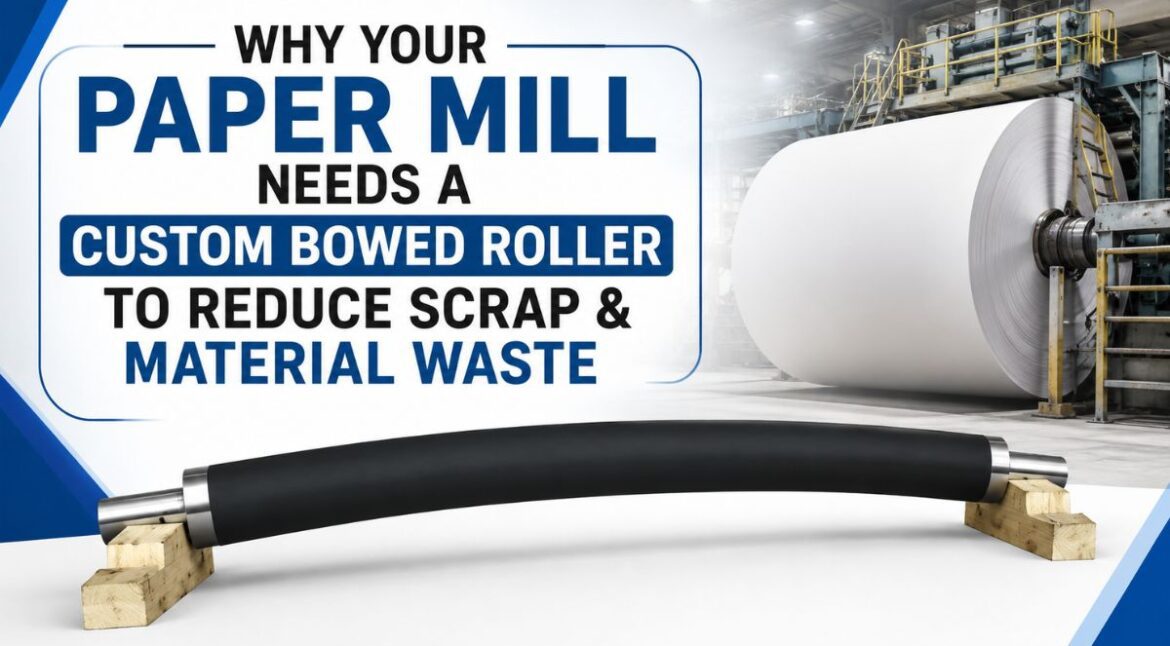
Why Your Paper Mill Needs a Custom Bowed Roller to Reduce Scrap & Material Waste
Every paper mill operator knows the heart-wrenching feeling of watching hundreds of meters of prime paper turn into unusable scrap in seconds.
You set up your production line, dial in the web tension, speed up the machine, and suddenly it happens. A tiny crease appears near the center of the sheet. Within minutes, that crease folds over into a permanent wrinkle, causing edge tears or uneven rewinds.
Before your team can hit the stop button, valuable raw material, electricity, and operating hours have vanished straight into the recycling pulper.
In modern paper manufacturing, profit margins are won or lost on the shop floor. While plant managers often focus on raw material costs or high-speed automation, they frequently overlook one small but crucial hero on the line: the Bowed Paper Roller.
When properly customized to your specific web path, a bowed roller acts as the ultimate guardian against paper wrinkles, baggy centers, and material waste.
Let’s dive deep into why standard off-the-shelf rollers often fail, how custom curvature changes everything, and how investing in the right paper roller technology keeps your mill profitable and smooth-running.
What Exactly Is a Bowed Paper Roller?
To understand why this component is so vital, let’s strip away complex engineering terminology and look at what a bowed paper roller actually does.
Imagine holding a soft cloth tightly at both ends and pulling it straight. If the middle sags even slightly, wrinkles form down the center. To smooth out those wrinkles, you wouldn’t just pull harder to the sides; you would gently push outward from the center toward the edges.
That is precisely what a bowed roller (often called a curved roller or spreader roller) does for a moving paper sheet.
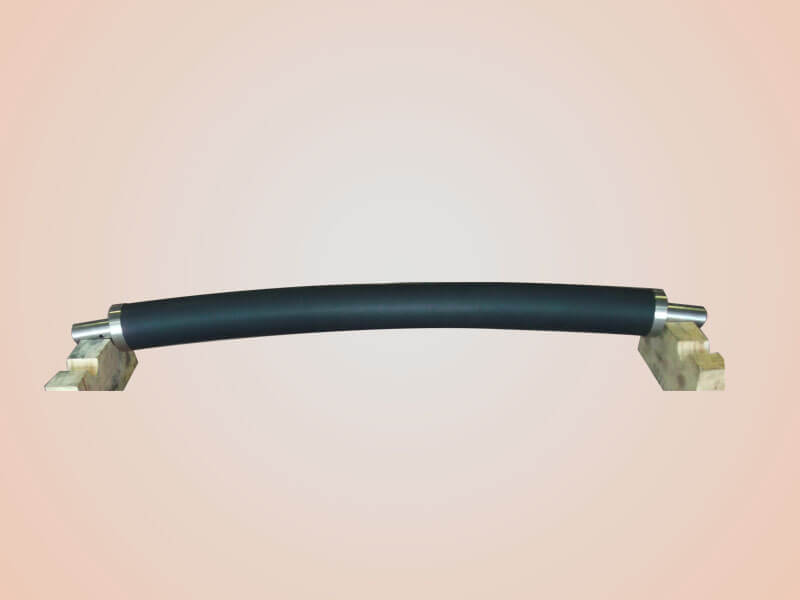
Unlike a standard straight paper roller that simply supports weight, a bowed roller features a deliberately curved stationary shaft fitted with multiple inner bearings and a flexible outer sleeve.
As the paper web passes over this smooth curve, the roller applies a gentle outward spreading action from the center toward both edges of the sheet. This outward force flattens out slack areas, removes wrinkles, and ensures uniform tension across the entire width of the paper web.
Why “One-Size-Fits-All” Rollers Cause More Problems Than They Solve
When paper mills experience web tracking or wrinkle issues, the quick reaction is often to buy a generic, standard bowed roller off the shelf.
While a standard roller might offer temporary relief, it frequently introduces new operational headaches over time. Here is why standard rollers fail under demanding mill conditions:
1. Paper Grades Vary Widely
A mill running lightweight tissue or 40 GSM kraft paper requires completely different spreading dynamics than a line producing 350 GSM duplex board. A standard bow curve that works well for thick board will overstretch and tear delicate tissue sheets.
2. Line Speeds and Tension Differences
High-speed slitter-rewinders subject paper webs to rapid speed changes and tension spikes. A generic roller shaft that lacks precise balancing or correct bearing placement can vibrate at high speeds, creating wave patterns on the paper instead of smoothing them out.
Moisture and Heat Factors
In the wet press or drying section of a paper machine, rollers operate under humid and warm conditions. Standard outer sleeves can swell, harden, or wear unevenly when exposed to continuous moisture and friction, leading to costly line shutdowns.
4. Machine Layout Constraints
No two paper mill layouts are identical. Lead-in distances, wrap angles, and space restrictions vary from machine to machine. Installing a standard roller with an incorrect bow angle can actually force wrinkles into the sheet rather than taking them out.
This is why forward-thinking paper mills are shifting away from generic replacements and opting for custom-designed spreading solutions tailored specifically to their equipment.
The Real-World Benefits of Custom Bowed Rollers
When a bowed paper roller is engineered specifically for your mill’s unique operating environment, the transformation on the plant floor is immediate.
Here is how a custom solution directly impacts your bottom line and operational efficiency:
1. Dramatic Reduction in Material Scrap
By eliminating sheet creasing before paper enters critical processing zones—such as coating units, calendars, or rewinder drums—you prevent massive rejection rates. The paper sheet stays flat and true, ensuring every meter produced meets customer quality standards.
2. Clean Roll Separation in Slitter-Rewinders
One of the biggest stress points in paper converting is the slitter section. When a wide web is cut into multiple narrow rolls, the slit edges tend to overlap and interlock if the sheet sags.
A custom bowed roller placed immediately after the slitter blades spreads the narrow strips slightly apart, ensuring clean separation and tight, uniform rewound rolls every single time.
3. Protection for Delicate Coatings and Laminations
If you produce coated board, specialty paper, or laminated packaging materials, any surface wrinkle will trap air bubbles or cause uneven liquid application. Custom bow profiles ensure an even layer of coating across the entire sheet width, reducing chemical waste and rework.
4. Higher Safe Operating Speeds
When operators know the web is unstable, their natural response is to run the machine slower to avoid paper breaks. A stable, custom-spread paper web allows you to safely increase production speeds without risking sudden sheet snaps or jam-ups.
Key Mill Sections Where Custom Bowed Rollers Are Essential
To maximize waste reduction, plant engineers must position curved rollers at strategic locations along the paper path. Here are the key areas where a custom bowed roller delivers the highest return on investment:
The Press Section
Early in the paper-making process, the sheet contains high moisture levels and is easily deformed. A custom rubber-covered bowed roller helps keep the wet felt and paper web flat, preventing deep-set structural creases before the sheet enters the dryer section.
Size Press & Coating Units
Uneven liquid absorption leads to localized paper expansion, which quickly turns into loose diagonal wrinkles. Placing a bowed spreader roller right before the applicator nip flattens the sheet so liquid or starch distributes evenly.
Calender Stacks
Passing a wrinkled sheet through high-pressure calender rolls can permanently damage both the paper and the expensive calender roll surfaces. A heat-resistant bowed paper roller ensures a wrinkle-free entrance into the calender nip.
Slitter-Rewinders & Converting Lines
This is the final checkpoint before your product reaches the customer. Custom bowed rollers ensure optimal sheet tension, precise roll separation, and crisp, straight-edged finished rolls.
How Siva Rollers Earned Industry Trust as a Leading Manufacturer in India
When it comes to custom web-handling components, partner reliability matters just as much as engineering precision. A poorly manufactured roller can lead to premature bearing failure, sleeve tearing, or unbalanced operation that disrupts your entire production schedule.
As a premier Bowed Roller Manufacturer in India, Siva Rollers has built a solid reputation on practical field experience, deep industry knowledge, and an unwavering commitment to quality.
Siva Rollers understands that no two paper production lines are identical. Instead of offering off-the-shelf compromises, their team works closely with paper mill operators, maintenance engineers, and plant managers to understand the exact operating conditions of each machine.
What Makes Siva Rollers a Trusted Name?
- Hands-On Industrial Insight: The engineering team at Siva Rollers brings years of real-world experience on paper mill floors, understanding how moisture, speed, and tension impact web behavior.
- Precision Customization: Every bowed paper roller is crafted to exact customer specifications, taking into account wrap angles, line speeds, paper GSM, and environmental conditions.
- High-Grade Materials: Siva Rollers uses durable inner shaft steel, high-precision bearing assemblies, and specialized rubber or metallic sleeves engineered to withstand continuous industrial wear.
- Smooth Operational Balance: Each roller undergoes thorough quality checks and dynamic balancing to ensure smooth, vibration-free performance even at elevated production speeds.
- Long-Term Service Mindset: Beyond manufacturing, Siva Rollers provides practical guidance on installation, bow adjustment, and preventative maintenance, establishing genuine long-term partnerships with paper mills across India and overseas.
By prioritizing practical performance over empty claims, Siva Rollers has become a go-to partner for mills seeking consistent web quality and reduced scrap rates.
Practical Signs Your Paper Mill Needs to Upgrade Its Spreading Setup
Not sure if your current roller setup is holding your mill back? Look out for these tell-tale warning signs on your production floor:
- Operators Frequently Adjusting Hand Controls: If your machine crew is constantly tweaking tension controls or manually pulling on the web to clear center slack, your web spreading system is underperforming.
- Visible “V-Shaped” or “Tree” Wrinkles: If you regularly notice diagonal crease lines forming near the center of the sheet as it enters the rewinder, your current spreader is not delivering adequate outward force.
- Slit Roll Interlocking: If slit paper rolls stick together or require physical force to separate on the unwind stand, your post-slitter spreading angle is incorrect.
- Uneven Wear on Existing Roller Covers: Grooves, cracks, or uneven wear patterns on your current paper roller sleeve indicate improper alignment or material mismatch for your specific paper grade.
Addressing these issues with a custom-built bowed roller is one of the quickest, most cost-effective ways to restore line stability and cut material waste.
Final Thoughts: Turning Scrap Reduction into Mill Profitability
In today’s competitive market, sustainable profitability isn’t just about making more paper—it’s about wasting less paper.
Every ton of scrap paper reduced directly improves your raw material efficiency, lowers energy consumption, and protects your brand’s reputation for deliverable roll quality.
A generic roller might seem like a simple solution, but only a custom-engineered bowed paper roller can deliver the precise spreading force needed to handle complex paper grades and demanding line speeds.
By partnering with a trusted Bowed Roller Manufacturer in India like Siva Rollers, you give your mill the exact tool it needs to eliminate wrinkles, prevent interwound rolls, and keep your production lines running smoothly day after day.
Is web tension or sheet creasing driving up scrap rates on your production line? Reach out to the technical team at Siva Rollers today to discuss a custom bowed roller solution built specifically for your paper mill layout.
Contact US : +91 75070 10009 , info@sivarollers.com
FAQs
A Bowed Paper Roller is a specially curved roller used to spread a moving paper web from the center toward both edges. It helps remove wrinkles, reduce baggy areas, improve web tension distribution, and prevent paper defects during manufacturing and converting.
A Bowed Roller reduces scrap by removing wrinkles, creases, slack areas, and web overlap before they cause paper breaks, edge damage, coating defects, or rejected rolls. A properly customized roller helps maintain a flatter and more stable paper web throughout the production process.
A Bowed Paper Roller can be installed at critical web-handling points such as the press section, size press, coating unit, calender stack, slitter-rewinder, and paper converting line. The ideal position depends on the machine layout, web path, wrap angle, and location where wrinkles or slack develop.
Yes. A correctly designed Bowed Roller creates an outward spreading action across the moving paper web, helping flatten center wrinkles, diagonal creases, and loose areas. However, the roller must be properly selected and installed according to the paper grade and web path.
A custom Bowed Paper Roller is designed according to your paper grade, web width, machine speed, tension conditions, wrap angle, moisture level, and available installation space. This provides more effective web spreading than a generic roller with a fixed design.
Yes. In slitter-rewinder operations, a Bowed Roller can help spread narrow paper strips after slitting, improving separation between rolls. This reduces the risk of slit rolls overlapping, interlocking, or sticking together during rewinding.
Common signs include repeated center wrinkles, V-shaped creases, baggy centers, slack edges, frequent operator tension adjustments, slit roll interlocking, and uneven wear on the existing roller cover. These issues may indicate that the current spreading setup is not suitable for the production line.
A stable and properly spread paper web can help operators run the production line more confidently and reduce slowdowns caused by wrinkles, web instability, and paper breaks. A custom Bowed Roller may therefore support higher safe operating speeds when the spreading problem is a major cause of production limitations.
Yes. Bowed Rollers can be customized for different paper grades, including lightweight paper, tissue, kraft paper, coated paper, duplex board, specialty paper, and other converting materials. The design should match the specific web-handling requirements of the application.
Important factors include paper web width, paper GSM, machine speed, web tension, wrap angle, roller position, moisture conditions, operating temperature, available space, and the type of wrinkle or web-handling problem. These details help determine the correct roller design and spreading performance.
A Bowed Roller helps keep the paper web flat before it enters coating or laminating sections. This can reduce wrinkles and uneven web movement that may otherwise contribute to coating irregularities, trapped air, material rejection, and rework.
Siva Rollers (Siva Engineering Works) manufactures custom Bowed Rollers and Bowed Paper Rollers for industrial web-handling applications. Customization can be based on factors such as wrap angle, line speed, paper GSM, operating conditions, and machine layout to help improve web spreading and reduce paper waste